
Extracting groundwater without
a valid CGWA NOC is not a minor compliance gap, it is treated as a violation of
the Environment (Protection) Act, 1986, with real financial and operational
consequences. This guide explains the penalties for illegal groundwater
extraction in India, what triggers them, and how industries can avoid
falling on the wrong side of enforcement.
What Counts as Illegal Extraction
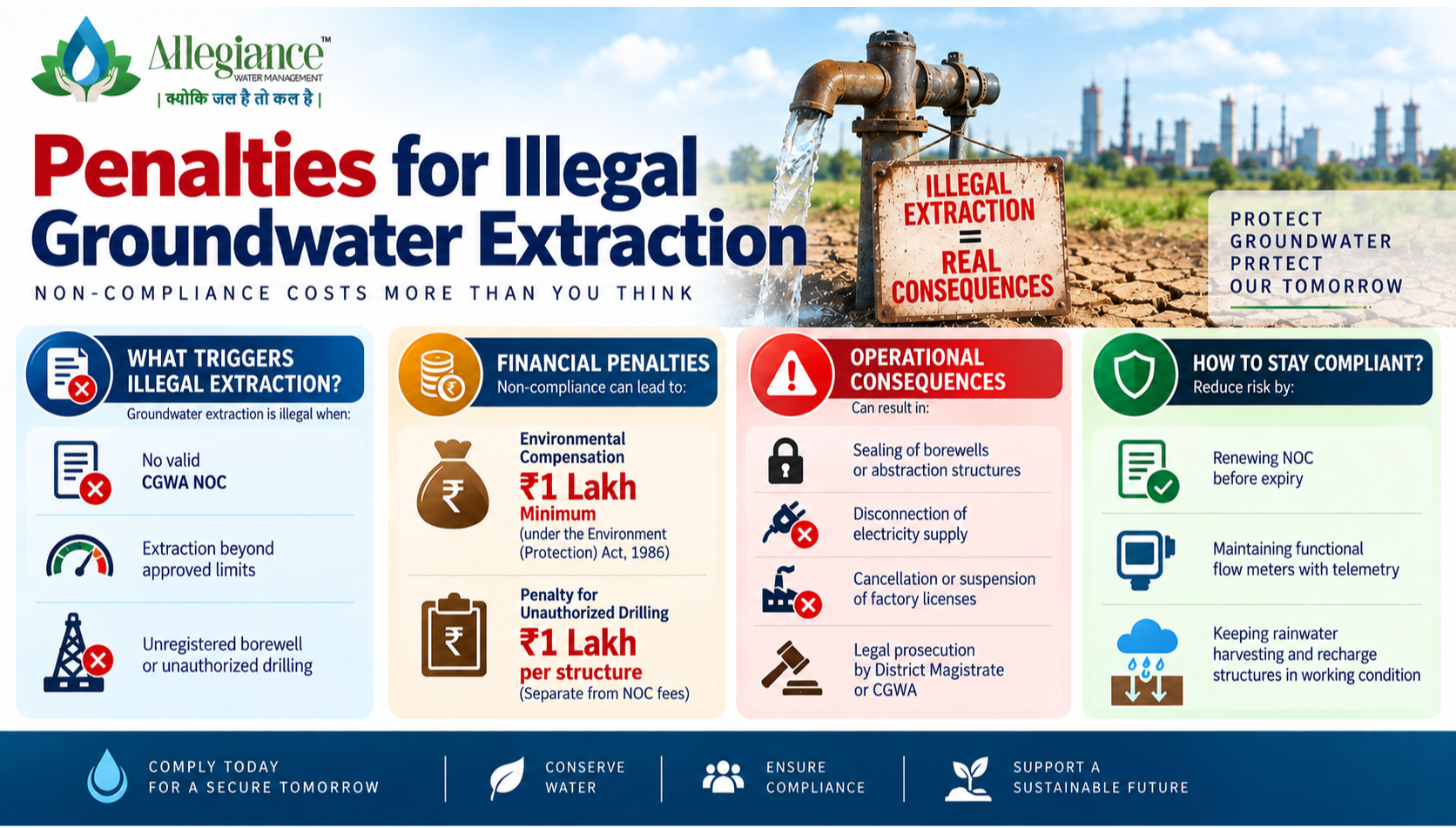
Groundwater extraction is
treated as illegal when it occurs without a valid CGWA NOC, beyond the volume
approved in an existing NOC, through an unregistered borewell or unauthorized
drilling rig, or in violation of specific conditions attached to an approved
NOC. Tribunals have repeatedly held that extraction of groundwater for
commercial use without a valid NOC is illegal and makes the entity liable for
environmental compensation, regardless of intent or ongoing efforts to obtain
approval.
Environmental Compensation
The primary financial penalty
for unauthorized extraction is environmental compensation, assessed under the
framework of the Environment (Protection) Act, 1986. Current enforcement
guidance places this compensation at a minimum of one lakh rupees, calculated
based on the quantum and duration of unauthorized extraction, and it is charged
separately from any application or renewal fees owed to CGWA.
Penalties for Unauthorized Drilling
Constructing a groundwater
abstraction structure using an unregistered or unauthorized drilling rig is
treated as a distinct violation, separate from operating without an NOC.
Current penalty provisions place this violation at one lakh rupees per structure,
reinforcing that both the extraction activity and the infrastructure used to
create it fall under regulatory scrutiny.
Operational Consequences Beyond Fines
Financial penalties are often
just the starting point. Non-compliance with NOC conditions or unauthorized
extraction can also result in:
•
Immediate sealing of borewells or abstraction
structures
•
Disconnection of electricity supply to the extraction
point
•
Legal prosecution initiated by the District Magistrate
or CGWA authorized officers
•
Cancellation or suspension of factory operating
licenses
•
Rejection of linked approvals, including Consent to
Establish or Operate from Pollution Control Boards
For industries, a sealed borewell or disconnected power supply
can halt production entirely, making the operational disruption far more costly
than the fine itself.
Repeated and Cumulative Violations
Each violation under the
current penalty framework is treated separately, meaning cumulative penalties
can apply when multiple conditions are breached at once, such as operating
without a valid NOC while also failing to maintain required flow meters or rainwater
harvesting structures. In cases of severe or repeated environmental damage,
authorized officers may pursue criminal prosecution in addition to financial
penalties.
Common Triggers for Enforcement Action
•
Operating a borewell after the NOC has expired without
renewal
•
Extracting more than the approved daily or annual
volume
•
Failing to install or maintain CGWA-compliant flow
meters with telemetry
•
Not constructing or maintaining the rainwater
harvesting and recharge structures required under the NOC
•
Drilling new borewells without local authority
permission in addition to the CGWA NOC
How Industries Can Avoid Penalties
The most reliable way to avoid
enforcement action is to treat compliance as continuous rather than a one-time
application. This means renewing the NOC well before expiry, keeping flow
meters and telemetry devices functional and reporting data regularly, maintaining
rainwater harvesting and recharge structures in working condition, and
submitting annual compliance reports with supporting photographic evidence.
Partnering with an experienced groundwater consultation provider for ongoing
monitoring and documentation significantly reduces the risk of falling into
violation unintentionally.
Conclusion
Illegal groundwater extraction
carries consequences that go well beyond a simple fine, from environmental
compensation and sealed borewells to license cancellation and legal
prosecution. Industries that build ongoing compliance, including functional
monitoring equipment and maintained recharge structures, into their water
strategy protect themselves from both regulatory and operational risk.