
Walk across any school or
college campus during the monsoon and you will see the same thing: water
pouring off classroom roofs, hostel terraces, and auditoriums straight into the
drains. Meanwhile, the borewell behind the admin block is working harder every
summer. Rainwater harvesting for educational institutions fixes that
mismatch, and it does something extra that few other water projects can: it
teaches thousands of students how water conservation actually works.
Why Schools and Colleges Need Rainwater Harvesting for Water Security
Educational campuses are
quietly heavy water users. Hostels, canteens, laboratories, sports grounds,
restrooms, and gardens add up to a large daily demand, and many institutions
depend on their own borewells to keep it all running. At the same time, they
have what most buildings do not: large roof areas and open land. Capturing even
part of that rainfall can ease summer shortages and reduce how often the campus
has to rely on tanker water.
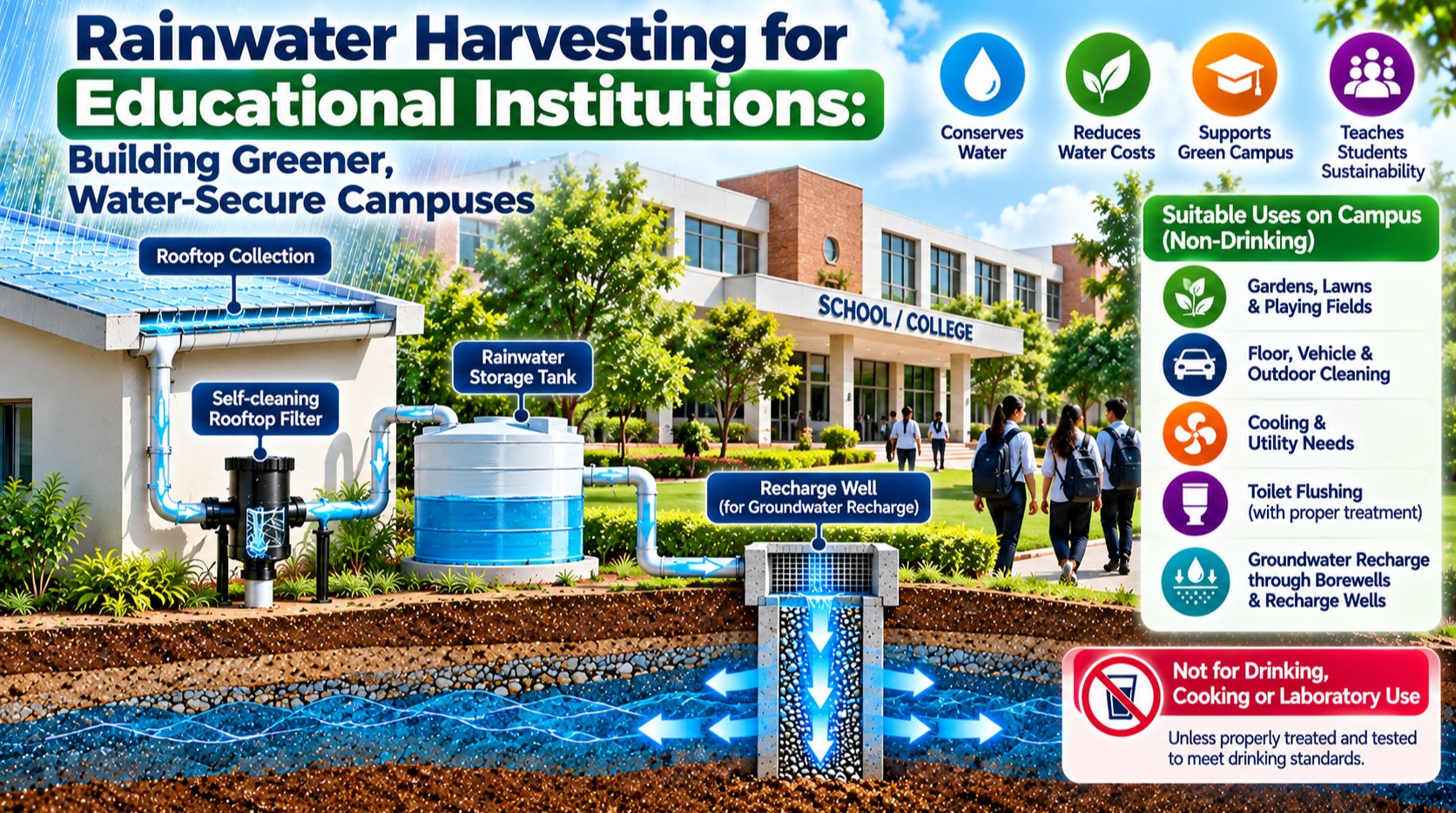
Where Harvested Rainwater Works Best on a Campus
Rainwater does not have to be
used for everything to be valuable. On a typical campus, the sensible uses are
the non-drinking ones:
•
Watering gardens, lawns, and playing fields
•
Washing floors, vehicles, and outdoor areas
•
Cooling and utility needs in larger campuses
•
Toilet flushing, where separate plumbing and proper
treatment are in place
•
Groundwater recharge through borewells and recharge
wells
Water for drinking, cooking, and laboratory use should stay on
the campus's regular treated supply, unless harvested water has been properly
treated and tested to meet drinking standards.
How Rooftop Rainwater Harvesting Works for Educational Institutions
The setup is simple enough to
explain in a classroom. Rain lands on the roof, flows down the pipes, and
passes through a rooftop rainwater filter that strips out leaves, dust, and
debris. The clean water then goes to an underground sump for reuse, or straight
into a borewell or recharge well to top up the groundwater. For campuses with
several buildings, each roof section gets its own filter so that nothing is
overloaded during a heavy storm.
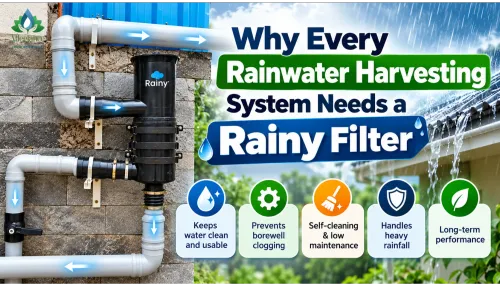
A Self-Cleaning Rainwater Filter That Suits Busy Campuses
School and college maintenance
teams are small and stretched, so the equipment has to look after itself. The
Rainy filter is self-cleaning: it flushes debris out automatically each time it
rains, runs on gravity with no electricity, and filters at above 90 percent
efficiency. Models cover roof areas from about 120 square metres to 500 square
metres per unit, so a small primary school and a large university block can
both be matched with the right size.
Groundwater Recharge for Campuses with Open Land
Many institutions have
playgrounds, lawns, or unused corners that are perfect for recharge. A V-wire
injection well or recharge pond lets filtered run-off percolate down through
layers of gravel, sand, and activated carbon into the aquifer. It needs very
little space, almost no upkeep, and the area above can often keep serving its
original purpose. Old, dried-up borewells on campus can also be brought back to
life as recharge points.
Rainwater Harvesting and CGWA Compliance for Educational Institutions
Institutions that run their own
borewells for large-scale use can come under CGWA's groundwater regulations as
bulk commercial users. A documented rainwater harvesting system, supported by a
feasibility survey and basic maintenance records, helps strengthen NOC
applications and renewals. Adding a CGWA-compliant flow meter and a piezometer
to track groundwater levels gives the institution a clear record of how much it
draws and how the aquifer responds.
Green Campus Benefits: Sustainability, Savings, and Student Learning
•
Lower dependence on tanker water during dry months
•
Reduced water bills for gardening, washing, and utility
use
•
Recharged groundwater around the campus and
neighborhood
•
A strong contribution toward green campus and
sustainability goals, including green building certifications
•
A living classroom, where students can see conservation
in action instead of reading about it
How to Get Started with Rainwater Harvesting on Your Campus
The first step is a short
feasibility survey: total roof area, existing borewell condition, available
open land, and how the site drains. From there, a geohydrological survey guides
the recharge design, and the right filter sizes are chosen building by building.
Most institutions find it easiest to install before the monsoon and set a
simple yearly check so the system is ready every season.
Final Thoughts
A rainwater harvesting system
is one of those rare campus projects that saves water, saves money, and teaches
a lesson all at once. Students who walk past a working recharge well every day
tend to carry that idea with them long after graduation. For any school,
college, or university thinking seriously about sustainability, it is a very
practical place to start.