
Letting a CGWA NOC lapse
can bring groundwater extraction to a halt overnight. With the renewal process
now fully digital through the Bhuneer Portal, industries need to understand the
exact steps, timelines, and documentation involved to keep their approval
active without interruption. This guide walks through how to renew a CGWA NOC
correctly and on time.
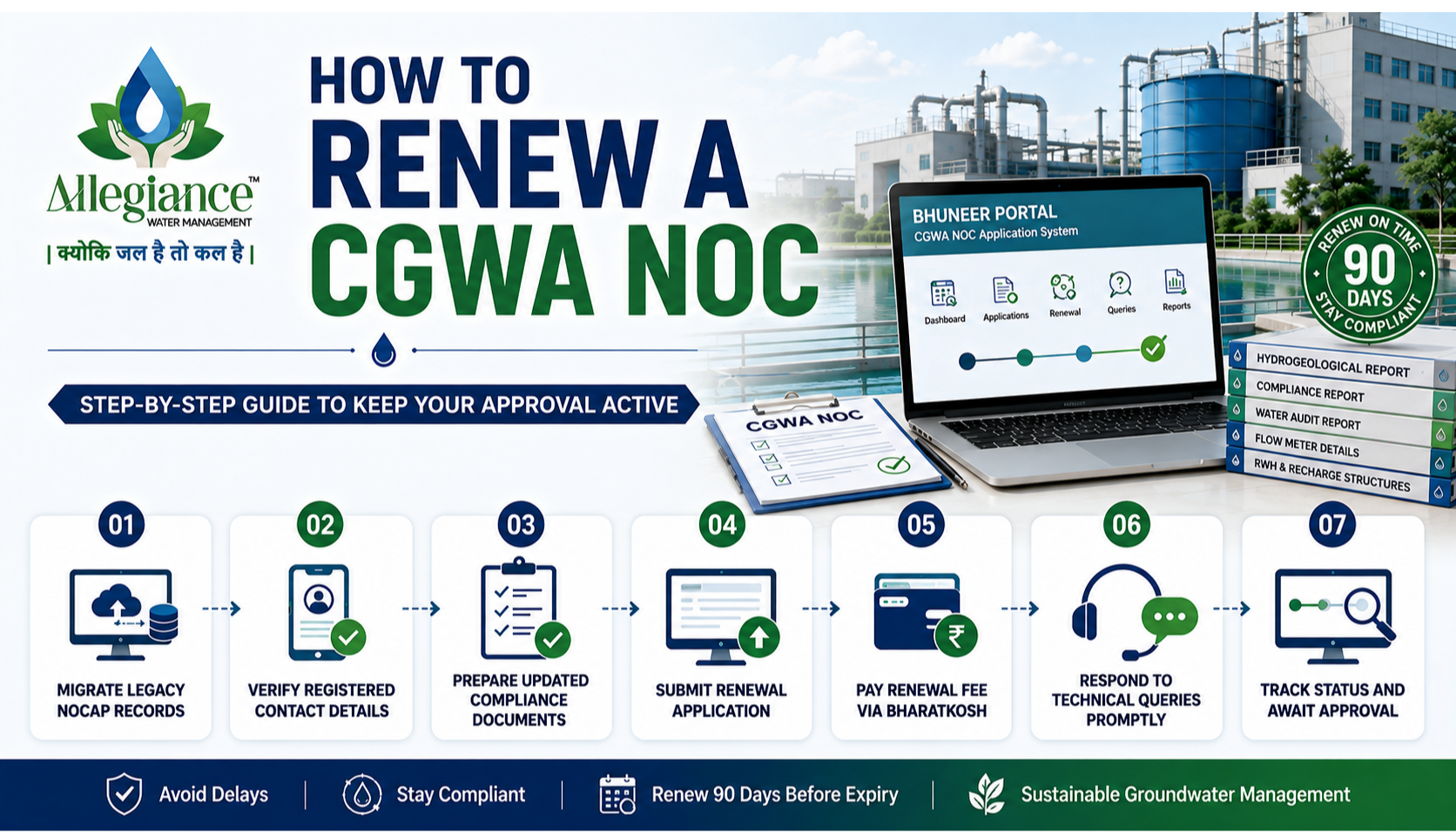
When to Start the Renewal Process
CGWA guidelines require renewal
applications to be submitted at least 90 days before the current NOC's expiry
date. This is not a courtesy recommendation, it is an operational requirement
built into the Bhuneer Portal's compliance tracking system, since renewal
applications go through the same technical review process as fresh
applications. Starting late significantly increases the risk of the NOC lapsing
before approval comes through.
Step 1: Migrate Legacy NOCAP Records
If your current NOC was issued
under the older NOCAP system, which covers virtually all NOCs issued before
late 2024, the Bhuneer Portal will not allow a renewal application to proceed
until that record is migrated. This is done by logging into the Bhuneer Portal,
navigating to the Renewal section, selecting the option to import the
application from NOCAP, and entering the legacy NOC number to link the record.
This migration must be completed even if the existing NOC is still valid and
not yet due for renewal.
Step 2: Verify Registered Contact Details
After searching for the
migrated record, applicants must verify their registered email ID and mobile
number, then upload the old NOC certificate to finalize the data linking
process. This step ensures the portal's SMS and email alerts, which update
applicants on every status change, reach the right contact.
Step 3: Prepare Updated Compliance Documents
Renewal applications require a
fresh set of documents demonstrating continued compliance with the original NOC
conditions, including:
•
Updated hydrogeological report or impact assessment
report
•
Self-compliance report confirming rainwater harvesting
structures are functional
•
Digital flow meter details, including make, model, BIS
certification, and confirmation that telemetry is transmitting monthly data
•
Water audit report, required for high-volume users
•
Details of the Sewage Treatment Plant and Effluent
Treatment Plant, where applicable
•
Valid Consent to Operate from the State Pollution
Control Board
•
Photographs of existing rainwater harvesting and
recharge structures
Step 4: Submit the Renewal Application
Once the migration and
documentation are ready, the renewal application form is filled out on the
dashboard with updated project and extraction details. All supporting documents
must be uploaded in PDF format within the prescribed file size limit, since incorrect
formats or oversized files are a common cause of rejection at this stage.
Step 5: Pay the Renewal Fee
Renewal fees are paid online
through the integrated Bharatkosh payment gateway. Applicants should also be
prepared for additional charges, such as environmental compensation or
penalties, if there was any unauthorized extraction during the previous NOC period.
Step 6: Respond to Technical Queries Promptly
The Bhuneer Portal includes a
dedicated query module for direct communication with CGWA officials, keeping
every technical exchange attached to the specific application. If a query is
raised during review, responding promptly with the requested clarification or
data is essential, since the review cannot move forward until the query is
resolved.
Step 7: Track Status and Await Approval
Applicants receive real-time
SMS and email alerts at every stage, from submission confirmation to query
notifications and final approval, removing the need to repeatedly log in to
check progress. Once approved, the renewed NOC becomes active, and the compliance
cycle, including monitoring and reporting obligations, continues.
What Happens If You Miss the Renewal Window
Failing to renew before expiry,
or failing to meet original NOC conditions such as rainwater harvesting and
metering requirements, results in the NOC lapsing. Continued groundwater
extraction after lapse is treated as unauthorized extraction under the Environment
(Protection) Act, 1986, carrying penalties that can include substantial monthly
fines, disconnection of power supply to the extraction structure, and potential
legal action.
How to Make Renewal Easier
Keeping rainwater harvesting
structures well-maintained, ensuring flow meters and telemetry devices remain
functional year-round, and conducting regular water audits makes the renewal
documentation process far smoother when the 90-day window arrives. Partnering
with an experienced groundwater consultation provider for the hydrogeological
update and self-compliance reporting further reduces the risk of delays.
Conclusion
Renewing a CGWA NOC on the
Bhuneer Portal is a structured but detail-heavy process, made harder for anyone
still carrying an unmigrated legacy NOCAP record. Starting at least 90 days
early, keeping compliance infrastructure functional throughout the NOC period,
and preparing documentation in advance are the surest ways to renew without
disruption to your operations.