
Think about the roof of a mall,
an office tower, or a business park. It is huge, it is flat, and during the
monsoon it is doing nothing except sending thousands of litres straight into
the drain. Rooftop rainwater harvesting for commercial complexes turns
that wasted rainfall into something useful. Here are the benefits property
owners and facility managers actually notice.
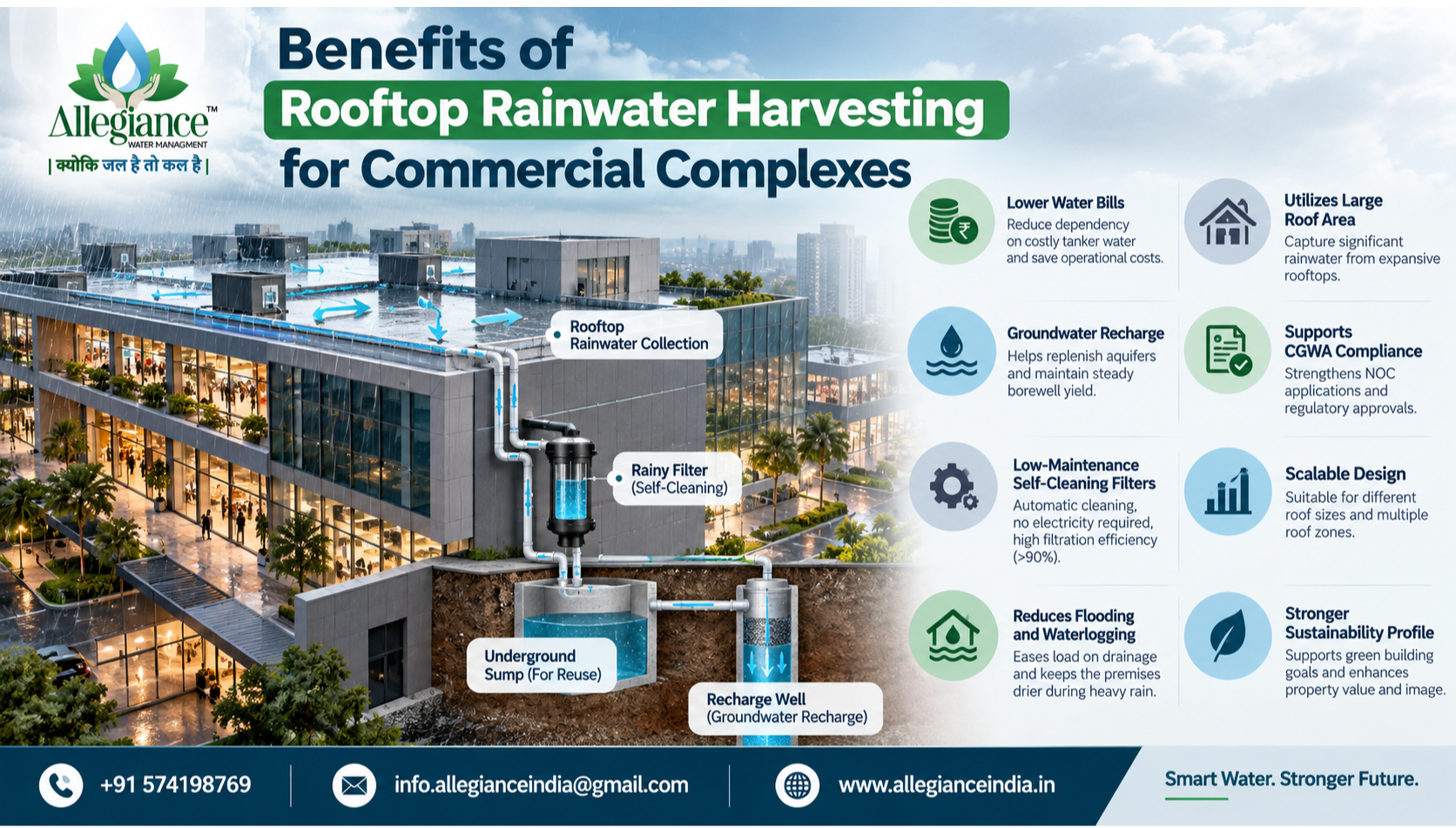
Lower Water Bills and Less Dependence on Tanker Water
Commercial complexes use a lot
of water every day for restrooms, landscaping, cleaning, and cooling systems.
When municipal supply falls short or the borewell slows down in summer, the gap
is usually filled by tankers, and tanker costs add up quickly. Harvested
rainwater, used for non-drinking needs, takes a real bite out of that expense.
It is a one-time setup that keeps giving back every monsoon.
Rooftop Rainwater Harvesting Makes Use of Your Large Roof Area
Commercial buildings have an
advantage that homes do not: size. A bigger roof means more water collected
from every shower. A single large complex can capture a serious volume in one
heavy downpour, and because the roof is already there, you are using space you
already own rather than building something new.
Groundwater Recharge for Commercial Properties With Borewells
Many commercial complexes run
their own borewells to back up the main supply. Sending filtered rainwater back
into those borewells, or into a recharge well, helps replenish the aquifer the
building depends on. Over several monsoons, that can mean steadier borewell
yield and fewer dry-season surprises, for the complex and for the neighbourhood
around it.
Support for CGWA Compliance and Regulatory Approvals
Bulk commercial users that draw
groundwater can fall under CGWA's regulations, and conservation measures are a
big part of what regulators look for. A documented rainwater harvesting system,
backed by a feasibility survey and maintenance records, strengthens NOC
applications and renewals. Add a CGWA-compliant flow meter and a piezometer to
monitor groundwater levels, and you have a clean, auditable record to show.
Low-Maintenance, Self-Cleaning Rainwater Filters for Busy Facility Teams
Facility teams already have
plenty on their plates, so a system that needs constant attention will not
last. The Rainy filter cleans itself, flushing debris out automatically each
time it rains. It runs on gravity with no electricity, filters at above 90
percent efficiency, and is built from UV-treated polyethylene with an SS-304
food-grade filter element. In practice that means a quick yearly check before
the monsoon, and not much else.
Scalable Design for Different Roof Sizes
Commercial complexes rarely
have one simple roof. There are towers, podiums, parking decks, and annexes,
all draining differently. Rainy filters are available for roof areas from
around 120 square metres up to 500 square metres per unit, with discharge from
120 LPM to over 480 LPM, so each roof zone can be given a filter that matches
it instead of overloading a single unit.
Reduced Flooding and Waterlogging Around the Complex
Large paved and roofed areas
push a lot of run-off into drains all at once, which is how basements, ramps,
and parking areas end up flooded. Capturing part of that water at the roof, and
recharging it into the ground, eases the load on drainage and helps keep the
surroundings drier during heavy rain.
A Stronger Sustainability Profile for Tenants, Investors, and Visitors
Occupiers and investors are
paying more attention to how buildings manage water. A working rainwater
harvesting system is visible proof of a sustainability commitment, and it
supports green building goals, including IGBC-aligned efforts. It is the sort of
practical detail that quietly improves a property's reputation.
What a Commercial Rainwater Harvesting System Typically Includes
•
Rooftop rainwater filters sized to each roof zone
•
An underground sump for reuse in landscaping, cleaning,
and similar non-drinking uses
•
Borewell recharge or V-wire injection wells for
groundwater recharge
•
A silt trap to keep sediment out of recharge structures
•
Optional flow meters and piezometers for monitoring and
compliance
How to Get Started
It begins with a feasibility
survey: total roof area, how the building drains, the state of any existing
borewells, and where space is available for storage or recharge. A
geohydrological survey then guides the recharge design. Most complexes find it
easiest to complete installation before the monsoon so the system is working
from the very first rain.
Final Thoughts
For a commercial complex,
rooftop rainwater harvesting is one of the few upgrades that saves money,
supports compliance, protects groundwater, and improves the property's image
all at once. The roof is already there, the rain is already falling. The only
thing left to decide is whether to let it run down the drain.
Contact Us
Phone: 9574198769
Email: info.allegianceindia@gmail.com
Website: www.allegianceindia.in