
Incomplete documentation is one
of the most common reasons CGWA NOC applications face delays or rejection.
Knowing exactly what to prepare before starting your CGWA NOC application
on the Bhuneer Portal can save weeks of back-and-forth. This guide lists the
core documents required, with variations based on project type and extraction
volume.
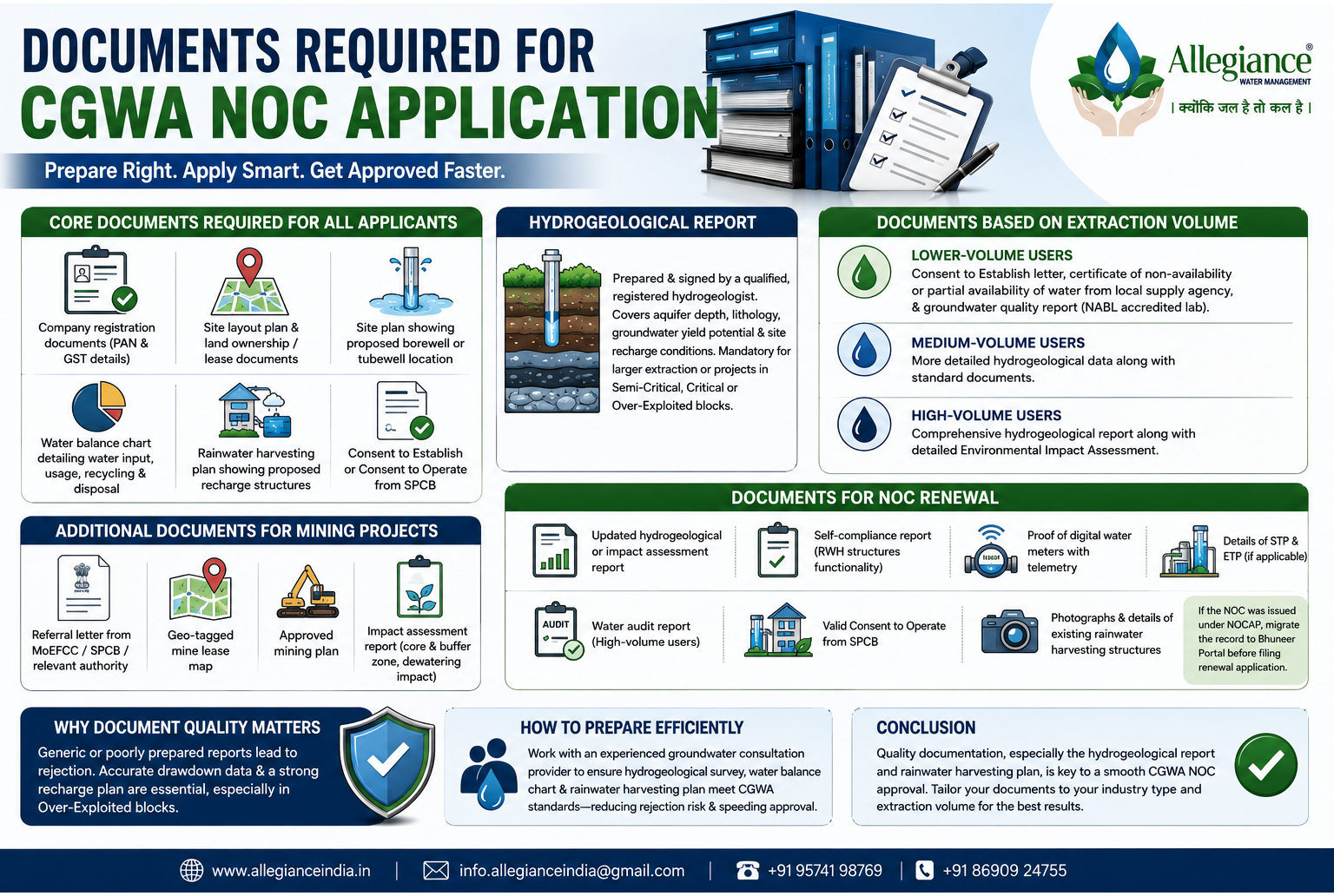
Core Documents Required for All Applicants
Regardless of industry type,
most CGWA NOC applications require the following baseline documents:
•
Company registration documents, including PAN and GST
details
•
Site layout plan and land ownership or lease documents
•
Site plan showing proposed borewell or tubewell
location
•
Water balance chart detailing water input, usage,
recycling, and disposal
•
Rainwater harvesting plan showing proposed recharge
structures
•
Consent to Establish or Consent to Operate from the
State Pollution Control Board
Hydrogeological Report
The hydrogeological report is
the technical backbone of any CGWA NOC application. Prepared and signed by a
qualified, registered hydrogeologist, it covers aquifer depth, lithology,
groundwater yield potential, and site-specific recharge conditions. This report
demonstrates that the proposed extraction will not create a harmful drawdown
affecting neighboring wells, and it becomes mandatory for larger extraction
volumes or projects located in Semi-Critical, Critical, or Over-Exploited
blocks.
Documents Based on Extraction Volume
Documentation requirements scale
with the volume of groundwater an industry plans to extract:
•
Lower-volume users typically need a Consent to
Establish letter, a certificate confirming non-availability or partial
availability of water from the local supply agency, and a groundwater quality
report from an NABL-accredited laboratory
•
Medium-volume users are generally required to submit
more detailed hydrogeological data alongside the standard documents
•
High-volume users extracting large daily quantities
must submit a comprehensive hydrogeological report along with a detailed
Environmental Impact Assessment
Additional Documents for Mining Projects
Mining and quarrying projects
that encounter or extract groundwater generally require additional
documentation, including:
•
Referral letter from the Ministry of Environment,
Forest and Climate Change, State Pollution Control Board, or relevant
environmental authority
•
Geo-tagged mine lease map
•
Approved mining plan from the concerned government
department
•
Impact assessment report covering groundwater
conditions in the core and buffer zones, including dewatering impact
Documents for NOC Renewal
Renewal applications require an
updated set of documents proving continued compliance with the original NOC
conditions:
•
Updated hydrogeological report or impact assessment
report
•
Self-compliance report confirming functionality of
rainwater harvesting structures
•
Proof of installation and proper functioning of digital
water meters with telemetry
•
Details of the Sewage Treatment Plant and Effluent
Treatment Plant, where applicable
•
Water audit report, required for high-volume users
•
Valid Consent to Operate from the State Pollution
Control Board
•
Photographs and details of existing rainwater
harvesting structures
If the original NOC was issued under the older NOCAP system,
the record must first be migrated into the Bhuneer Portal before the renewal
application can be filed.
Why Document Quality Matters
Generic or poorly prepared
hydrogeological reports are among the leading causes of NOC rejection. The
report must present accurate drawdown data and demonstrate that proposed
extraction stays within the safe yield of the local aquifer. Projects located in
Over-Exploited blocks face particularly high scrutiny and typically need to
show a strong mitigation plan, such as aggressive artificial recharge measures,
to support approval.
How to Prepare Efficiently
Working with an experienced
groundwater consultation provider helps ensure the hydrogeological survey,
water balance chart, and rainwater harvesting plan are prepared to CGWA's
technical standards from the outset. This reduces the risk of rejection due to
incomplete or inconsistent documentation and speeds up the overall approval
timeline.
Conclusion
The CGWA NOC application
depends heavily on the quality and completeness of the documents submitted,
particularly the hydrogeological report and rainwater harvesting plan.
Understanding what is required in advance, and tailoring the documentation to
your industry type and extraction volume, gives your application the best
chance of smooth approval.