
A CGWA NOC application
that gets delayed or rejected almost always traces back to a handful of
avoidable errors. With the process now running entirely through the Bhuneer
Portal, applicants face stricter technical scrutiny than under the older
system. This guide highlights the most common mistakes industries make and how
to avoid them.
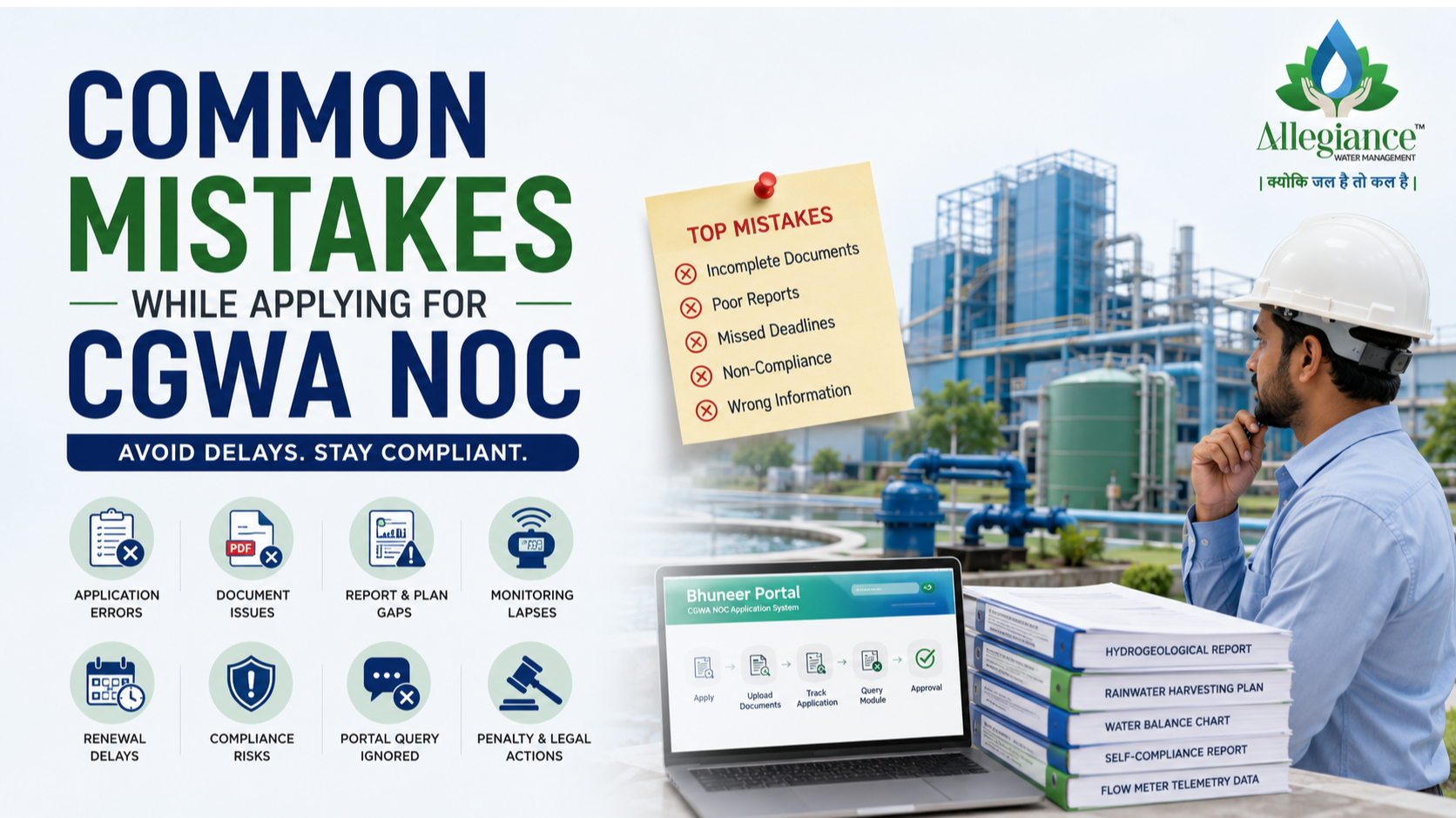
Mistake 1: Skipping the NOCAP Data Migration
One of the most common causes
of delay is attempting to file a renewal directly on the Bhuneer Portal without
first migrating records from the legacy NOCAP system. Virtually all NOCs issued
before late 2024 exist only in NOCAP, and Bhuneer will not process a renewal
until that old record is imported using the legacy NOC number. Applicants often
lose valuable time discovering this only after their renewal filing gets stuck.
Mistake 2: Submitting a Generic Hydrogeological Report
The hydrogeological report is
the most scrutinized document in the entire application. A report that lacks
site-specific field data, accurate drawdown analysis, or proof that extraction
stays within the safe yield of the local aquifer is rejected at technical
review, regardless of how complete the rest of the application is. Generic,
templated reports without genuine field investigation are a leading cause of
rejection in the current regulatory environment.
Mistake 3: Incorrect File Formats or Oversized Documents
All supporting documents must
be uploaded in PDF format with a maximum file size limit per document.
Applicants who upload scanned images, Word files, or oversized PDFs frequently
see their applications rejected on technical grounds before they even reach
substantive review.
Mistake 4: Filing Renewals Too Close to Expiry
CGWA guidelines require renewal
applications to be submitted at least 90 days before the current NOC expires.
This is not a suggestion but an operational requirement built into the portal's
compliance tracking, since renewals go through the same technical review as
fresh applications. Waiting until the last few weeks often results in the NOC
lapsing before renewal is approved, exposing the applicant to penalties for
unauthorized extraction.
Mistake 5: Weak or Missing Rainwater Harvesting Plan
CGWA evaluates applications on
sustainability, not just extraction volume. A rainwater harvesting plan that is
vague, unsupported by a proper water balance chart, or missing recharge
structure details weakens the application significantly. Projects in Over-Exploited
or Critical blocks face even higher scrutiny and need to show robust mitigation
measures such as high-rate artificial recharge.
Mistake 6: Non-Functional or Unreported Flow Meters
For renewals in particular,
CGWA now checks digital flow meter installation details, including meter make,
model, BIS certification, and confirmation that telemetry data is transmitting
regularly. Applicants who installed meters but stopped maintaining them, or
never enabled telemetry reporting, frequently run into compliance issues during
renewal.
Mistake 7: Incomplete Self-Compliance Reporting at Renewal
Renewal applications require a
detailed self-compliance report proving that all conditions from the original
NOC, especially rainwater harvesting and metering requirements, have been met.
Missing photographs, incomplete STP or ETP details, or an outdated water audit
report can stall the renewal process even when the underlying compliance is
genuinely in place.
Mistake 8: Selecting the Wrong Application Category
The Bhuneer Portal requires
applicants to select their industrial segment, such as Industrial,
Infrastructure, or Mining, at the start of the application. Choosing the wrong
category leads to mismatched documentation requirements and often forces a
fresh submission, wasting both time and the non-refundable processing fee.
Mistake 9: Ignoring Query Module Responses
The Bhuneer Portal includes a
structured query module for direct communication between applicants and CGWA
officials. Applications that go unanswered when a technical query is raised are
effectively stalled, since the review cannot proceed until the applicant
responds with the requested clarification or additional data.
Mistake 10: Underestimating Penalties for Non-Compliance
Some industries continue
extracting groundwater without an approved NOC while their application is
pending, assuming submission alone provides cover. Illegal extraction under the
Environment (Protection) Act, 1986 carries serious penalties, including substantial
monthly fines, disconnection of power supply to the extraction structure, and
potential legal action, making it critical to align operations with actual
approval status rather than application status.
How to Avoid These Mistakes
Working with an experienced
groundwater consultation partner for the hydrogeological survey, water balance
chart, rainwater harvesting plan, and flow meter installation significantly
reduces the risk of these errors. A properly documented, technically sound
application not only avoids rejection but also builds a stronger compliance
record for future renewals.
Conclusion
Most CGWA NOC application
failures come down to preventable issues, incomplete migration, weak technical
reports, missed deadlines, or non-functional monitoring equipment.
Understanding these common mistakes in advance gives industries a clear path to
a smoother approval process and long-term compliance.