
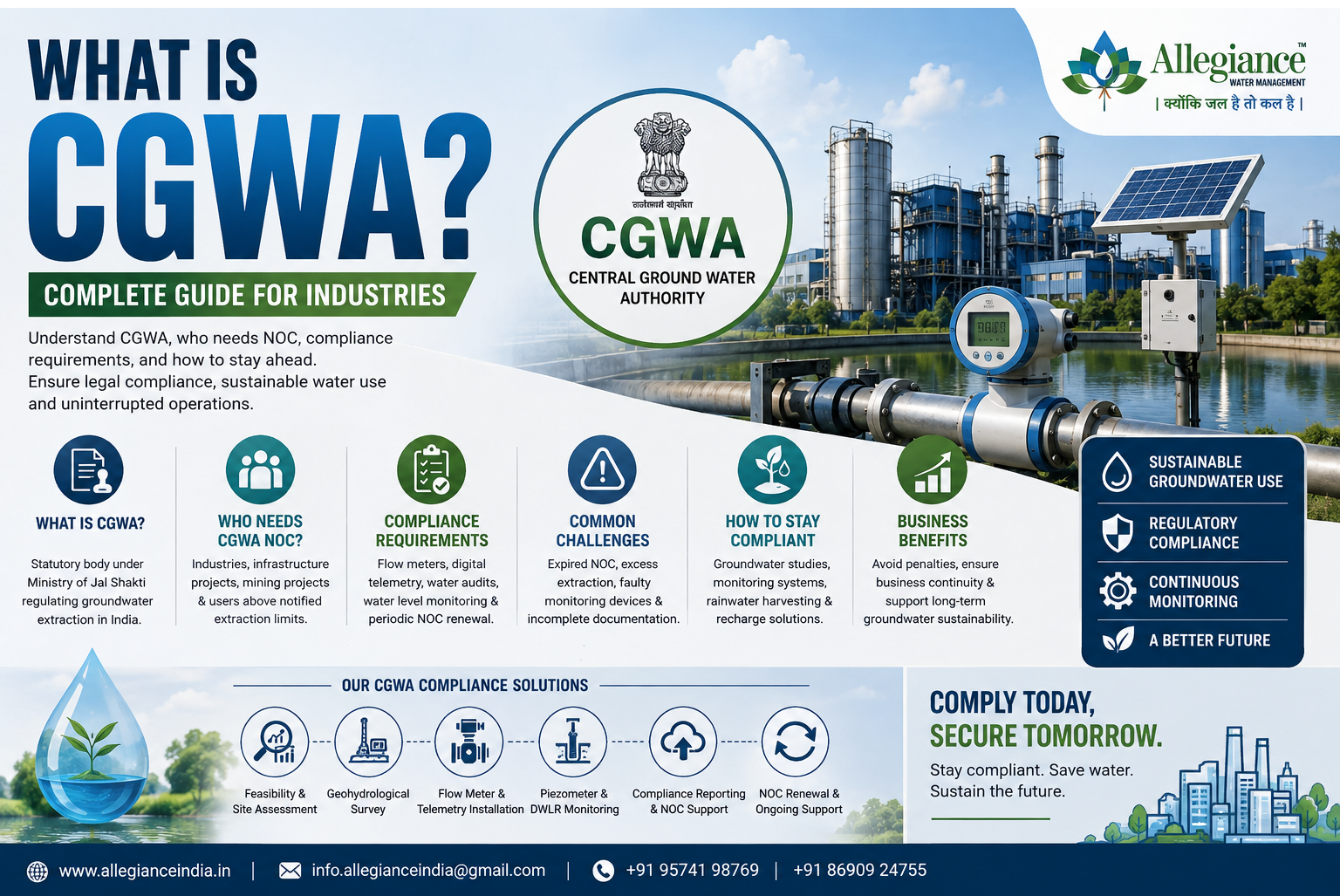
Any industry in India that
draws groundwater eventually runs into one term: CGWA. Understanding
what this authority does, who needs its approval, and how to stay compliant is
essential for factories, infrastructure projects, and mining operations. This
guide breaks down CGWA in simple terms for industry decision-makers.
What is CGWA?
CGWA stands for the Central
Ground Water Authority, a statutory body under India's Ministry of Jal Shakti.
It was constituted under the Environment (Protection) Act, 1986, following
directions from the Supreme Court, to regulate and control groundwater extraction
across the country. Its core mandate is to ensure that groundwater, a shared
and depleting resource, is used sustainably by industries, infrastructure
projects, and mining operations.
Why CGWA Regulation Exists
Groundwater levels in large
parts of India have been declining due to unchecked extraction, particularly by
industries and infrastructure projects. CGWA classifies groundwater blocks into
categories such as Safe, Semi-Critical, Critical, and Over-Exploited, and uses
this classification to decide how much extraction can be permitted in a given
area, if at all.
Who Needs a CGWA NOC?
A CGWA No Objection Certificate
(NOC) is generally required for:
•
New and existing industries, including manufacturing,
food and beverage, textile, and pharmaceutical units
•
Infrastructure projects such as construction and
township developments
•
Mining projects that extract groundwater
•
Industries in Safe category blocks whose groundwater
abstraction crosses defined thresholds
Certain categories are typically exempt, including small users
below a defined daily extraction limit, individual households, and agricultural
users, though exempted industries are still generally required to register and
report usage.
What CGWA Compliance Involves
Beyond obtaining the NOC itself,
industries are expected to maintain ongoing compliance through:
•
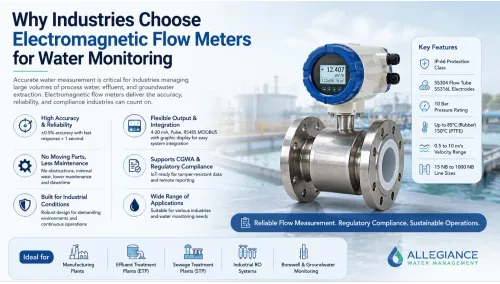
Installation of CGWA-compliant flow control devices,
including electromagnetic or ultrasonic flow meters
•
Digital telemetry systems that transmit real-time
extraction data
•
Regular water audits and usage logbooks
•
Groundwater level monitoring using digital water level
recorders or piezometers
•
Periodic renewal of the NOC within its validity period
Common Reasons Industries Face CGWA Issues
•
Operating without a valid or renewed NOC
•
Extracting groundwater beyond permitted limits
•
Missing or non-functional flow monitoring devices
•
Incomplete documentation during geohydrological surveys
•
Failure to submit periodic compliance reports
How Industries Can Stay Compliant
Staying ahead of CGWA
requirements starts with a proper groundwater consultation process. This
typically includes a rainwater harvesting feasibility survey, a geohydrological
survey to assess aquifer conditions, and installation of approved monitoring equipment
such as flow meters and water level recorders. Many industries also implement
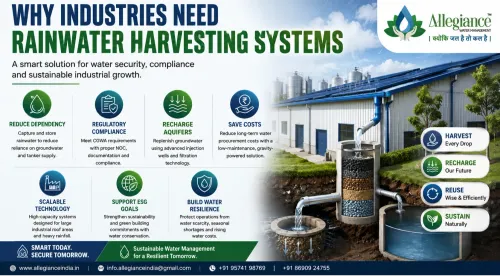
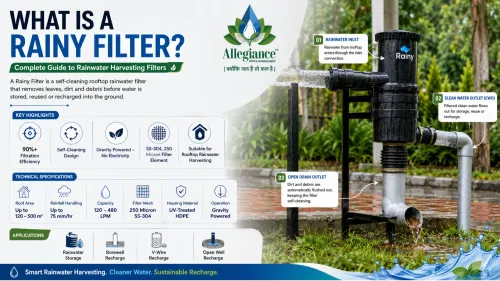
rooftop rainwater harvesting and groundwater recharge systems, which directly
support CGWA's sustainability goals and strengthen the case for NOC approval or
renewal.
The Business Case for Proactive Compliance
Beyond avoiding penalties,
proactive CGWA compliance protects business continuity. Industries with an
expired NOC or unmonitored extraction risk operational disruptions, legal
action, or restricted water access. Investing early in compliant infrastructure,
from flow meters to recharge systems, is far more cost-effective than
addressing violations after they occur.
Conclusion
CGWA compliance is now a
fundamental part of doing business for water-dependent industries in India.
Understanding what CGWA regulates, who needs approval, and what ongoing
compliance requires helps industries avoid disruptions while contributing to
long-term groundwater sustainability.