
Accurate water measurement is
critical for industries managing large volumes of process water, effluent, and
groundwater extraction. Among the available options, the electromagnetic
flow meter has become the preferred choice across manufacturing plants,
utilities, and CGWA-regulated facilities. This guide explains why industries
rely on this technology for reliable water monitoring.
What Makes Electromagnetic Flow Meters Different
An electromagnetic flow meter,
or mag meter, measures the flow rate of conductive liquids using Faraday's Law
of Electromagnetic Induction. As liquid passes through the meter's magnetic
field, it generates a voltage proportional to flow velocity, which the flow
sensor and transmitter convert into an accurate, real-time reading. Unlike
mechanical meters, it has no moving parts inside the flow path, which reduces
wear, blockages, and maintenance needs over the meter's operating life.
Reason 1: High Accuracy and Reliability
Industries cannot afford
measurement errors when tracking water usage for cost control or regulatory
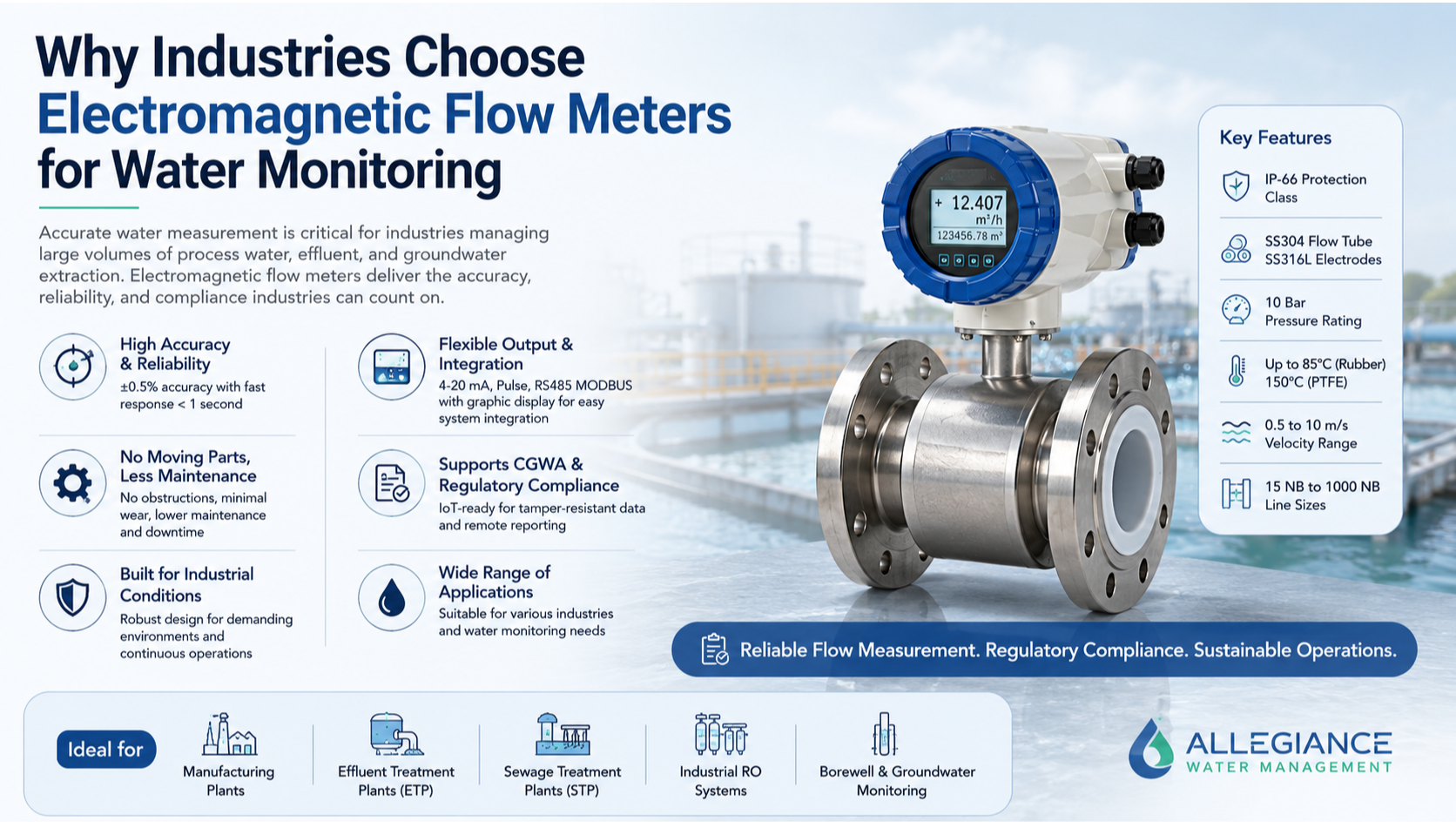
reporting. Electromagnetic flow meters offer accuracy of ±0.5% of full scale,
linearity of ±0.5%, and repeatability of ±0.2%, with a response time of less
than 1 second. This level of precision makes them suitable for critical
processes where even small measurement gaps can lead to significant losses over
time.
Reason 2: No Moving Parts, Less Maintenance
Because electromagnetic flow
meters have no internal obstructions or moving components, they experience
minimal pressure loss and are far less prone to mechanical failure than turbine
or Woltman type meters. This translates into lower long-term maintenance costs,
which is a major reason industries with continuous operations prefer this
technology over mechanical alternatives.
Reason 3: Built for Industrial Conditions
Electromagnetic flow meters are
engineered to withstand demanding industrial environments. Key construction
features include:
•
Cast aluminium transmitter housing with IP-66
protection class
•
Flow tube in SS304 with SS316L grounding and process
electrodes
•
Process pressure rating of 10 Bar
•
Process temperature tolerance up to 85 degrees Celsius
for rubber lining and 150 degrees Celsius for PTFE lining
•
Liquid velocity range from 0.5 m/s to 10 m/s
•
Line sizes from 15 NB to 1000 NB, suitable for both
small pipelines and large industrial mains
Reason 4: Flexible Output and Integration Options
Modern industrial facilities
need flow data that integrates directly with their monitoring and control
systems. Electromagnetic flow meters support multiple output types, including
4-20 mA analog output, isolated pulse output, and RS485 MODBUS communication,
along with a graphic display showing instantaneous flow rate, totalized flow,
and diagnostic messages. This flexibility allows easy integration with SCADA
systems, data loggers, or IoT-based telemetry devices for CGWA-compliant remote
reporting.
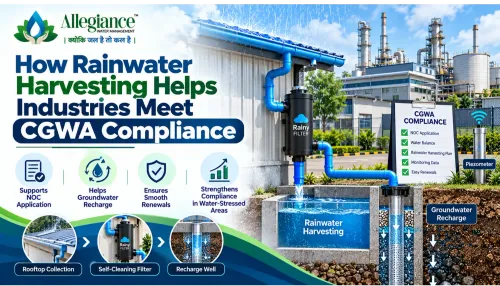
Reason 5: Supports CGWA and Regulatory Compliance
Industries extracting
groundwater are increasingly required to install approved flow control devices
as part of CGWA clearance. Electromagnetic flow meters, particularly those
paired with IoT-based telemetry, give facilities a documented, tamper-resistant
record of water extraction, supporting water audits, NOC renewals, and ongoing
regulatory compliance without manual data collection.
Reason 6: Wide Range of Applications
Beyond borewell discharge
monitoring, electromagnetic flow meters are used across effluent treatment
plants, sewage treatment plants, industrial RO systems, and process water
lines. Their compatibility with liquids having a minimum conductivity of 5 microS/cm
makes them suitable for most industrial fluids, while variants such as
battery-operated or S.S electromagnetic meters extend their use to remote or
corrosive environments.
Choosing the Right Flow Meter for Your Facility
Selecting the correct flow
meter depends on pipeline size, liquid type, installation environment, and
whether remote telemetry is required for compliance reporting. Consulting an
experienced water management provider ensures the meter matches both operational
needs and CGWA requirements specific to the site.
Conclusion
Electromagnetic flow meters
combine high accuracy, low maintenance, and robust industrial construction,
making them the technology of choice for industries serious about water
monitoring and regulatory compliance. As CGWA norms continue to tighten, investing
in reliable flow measurement is a practical step for any facility managing
significant water usage.