
Observation Wells vs Piezometers: What is the Difference?
By Allegiance Water Management, Vadodara
If you have
read a CGWA NOC, a hydrogeology report or a tender for groundwater monitoring,
you have probably seen the words "observation well" and
"piezometer" used almost as if they mean the same thing. Sometimes
they do. Sometimes they don't. And when you are spending money on drilling and
instruments, that difference matters.
In this post,
we clear up the confusion in plain language: what an observation well is, what
a piezometer is, how they differ, and which one you actually need for
groundwater monitoring and CGWA compliance.
What is an Observation Well?
An observation
well is any well used to watch groundwater rather than to pump it. It is
usually screened, or open, over a long section of the aquifer, so the water
level inside reflects the general water table or an average of the
water-bearing layers it passes through.
Observation
wells can be purpose-built, or they can be old dug wells or unused borewells
converted for monitoring. They are also used during pumping tests, where
engineers watch how water levels around a pumping well drop and recover.
What is a Piezometer?
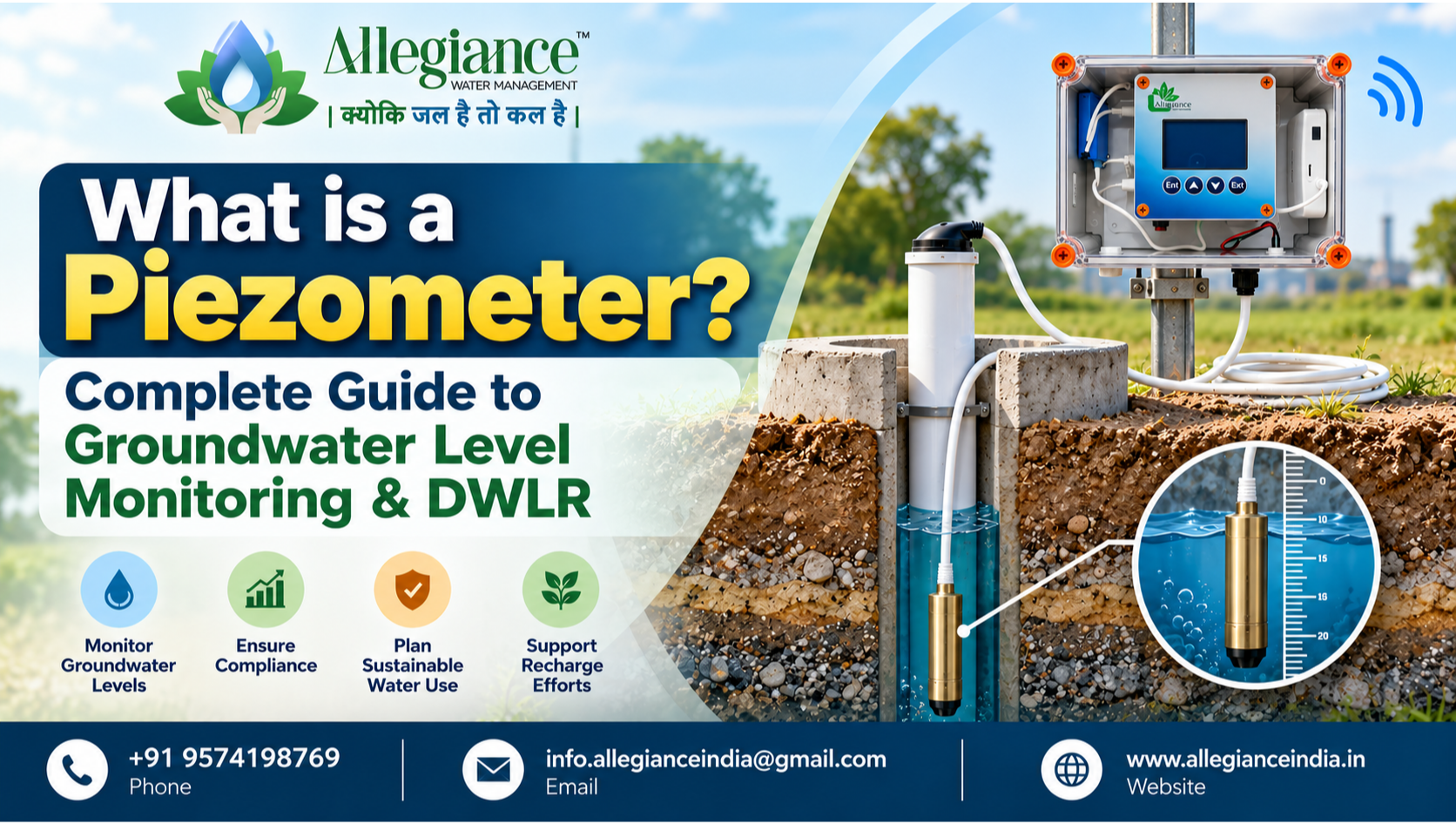
A piezometer is
a narrow pipe or well that is open to the aquifer only over a short section,
often just a metre or two at the bottom. Because of this, it measures the water
pressure, called the piezometric head, at one specific depth. Think of it as a
precise pin-point reading, rather than a general average.
Piezometers are
especially useful where there are several aquifers at different depths, or
where the aquifer is confined under a clay or rock layer and the water is under
pressure.
Observation Well vs Piezometer: Side-by-Side
|
Point |
Observation Well |
Piezometer |
|
What it measures |
General water table or average level across a long
screened section |
Piezometric head at one specific depth |
|
Screen
or open section |
Long |
Short,
often at the bottom only |
|
Diameter |
Can be wider, including converted dug wells or borewells |
Usually small diameter pipe |
|
Best
suited to |
Unconfined
aquifers and general water table trends |
Confined
aquifers, layered aquifers, precise studies |
|
Typical uses |
Long-term monitoring, pumping tests, recharge impact |
Aquifer-specific monitoring, research, dams and
foundations |
|
Cost |
Lower
if an existing well is converted |
Purpose-built,
so drilling and construction are needed |
The Difference Between an Observation Well
and a Piezometer in Practice
Here is the
simple way to think about it: every piezometer is a kind of observation well,
but not every observation well is a piezometer. The real difference lies in how
much of the aquifer the well is open to.
•
Long open section, such as an observation well,
gives you a blended reading of everything it touches.
•
Short open section, such as a piezometer, tells
you exactly what is happening in one layer.
In India,
especially in groundwater regulation, the two terms are often used together.
CGWA NOCs, for example, commonly refer to "purpose-built observation wells
(piezometers)". In that context, the key word is purpose-built: a
dedicated monitoring well that is never used for pumping.
Why a Purpose-Built Observation Well for
CGWA Matters
It can be
tempting to hang a sensor in an existing pumping borewell and call it a day.
The problem is that the water level in a pumping borewell drops sharply every
time the pump runs, then recovers when it stops. Your data ends up showing pump
cycles, not the true groundwater level.
A dedicated
groundwater monitoring well, placed away from the influence of pumping, gives
clean, reliable data that reflects what the aquifer is really doing. That is
why CGWA NOCs usually call for purpose-built piezometers, often with a digital
water level recorder (DWLR) and telemetry. Always check your own NOC for the
exact requirement.
What is a Nested Piezometer?
Where a site
has more than one aquifer, a nested piezometer setup places two or more
piezometers at different depths, either in separate boreholes close together or
in one borehole sealed between levels. This shows whether the shallow and deep
aquifers behave differently, which is valuable for large industries, mining
projects and detailed hydrogeological studies.
Which One Do You Need?
•
For CGWA compliance: a purpose-built piezometer
or observation well as specified in your NOC, usually fitted with a DWLR and
telemetry.
•
To track the general water table or recharge impact:
an observation well, including a converted unused well, can work well.
•
For layered or confined aquifers: a piezometer,
or nested piezometers, for depth-specific readings.
•
For pumping tests: one or more observation wells
at set distances from the pumping well.
DWLR Piezometer Installation: The Basics
1.
Select a location away from pumping borewells, or as
specified in your NOC.
2.
Drill and case the well, placing the screen at the
target aquifer depth.
3.
Seal the space around the casing above the screen so
surface water can't leak down.
4.
Lower the waterproof pressure sensor safely below the
lowest expected water level.
5.
Mount the recorder, set the recording interval and
configure telemetry.
6.
Cross-check the first reading with a manual water level
indicator, then lock the well cap.
Groundwater Monitoring Instruments from
Allegiance
We supply and
install the instruments that turn any monitoring well into a reliable data
source:
•
Digital water level recorders (DWLR) with a
waterproof stainless steel sensor, a range of up to 400 metres, plus or minus
0.5% full scale accuracy, 32 GB storage and cloud access.
•
DWLR with GSM telemetry so you can view data on
your phone or PC and support CGWA reporting.
•
Manual water level indicators for quick checks
and cross-verification.
•
CGWA compliant flow meters for your abstraction
borewells.
Groundwater Monitoring in Gujarat with
Allegiance
Since 2012,
Allegiance Water Management has completed more than 1,000 water management
projects, including groundwater monitoring, CGWA NOC support, geohydrological
surveys, rainwater harvesting and aquifer recharge. Our clients include
L&T, NTPC, Polycab and Torrent Power. We serve Vadodara, Ahmedabad,
Bharuch, Halol, Surat, Valsad and Vapi, along with Daman, Diu, Dadra and Nagar
Haveli and Indore, and supply instruments across India.
Frequently Asked Questions
Is a piezometer the same as an observation
well?
Not exactly. A
piezometer is a type of observation well with a short open section that
measures pressure at one depth. In regulatory language, the terms are often
used together for purpose-built monitoring wells.
Can I convert an old borewell into an
observation well?
Often yes, if
it is no longer pumped and is in good condition. Whether it meets your CGWA NOC
requirement depends on the wording of the NOC, so check before relying on it.
What is piezometric head?
It is the level
to which groundwater rises in a well or pipe because of the pressure in the
aquifer. In a confined aquifer, it can be well above the top of the aquifer
itself.
Get the Right Monitoring Setup for Your Site
Not sure whether you need an observation well, a piezometer or both?
Share your site details and NOC conditions with us, and we'll recommend the
right groundwater monitoring setup.
Allegiance
Water Management
A unit of Allegiance Enterprises
Phone: +91 9574198769
Email: info.allegianceindia@gmail.com
Website: www.allegianceindia.in
Address: 28 & 29, Aura Square, 3rd Floor, Panchvati
Circle, Gorwa Refinery Road, Panchvati, Vadodara, Gujarat 390016