
What is a Piezometer? Complete Guide to Groundwater Level
Monitoring
By Allegiance Water Management, Vadodara
Groundwater is
out of sight, which makes it easy to ignore until a borewell starts pumping
air. By then, the water table under your site may have been falling for years.
The only way to know what is really happening down there is to measure it,
regularly and accurately.
That is the job
of a piezometer. Whether you run a factory with a CGWA NOC, manage a township,
or simply want to know if your rainwater recharge is working, this guide
explains what a piezometer is, how it works, the types available, and how to
choose and install the right one.
What is a Piezometer?
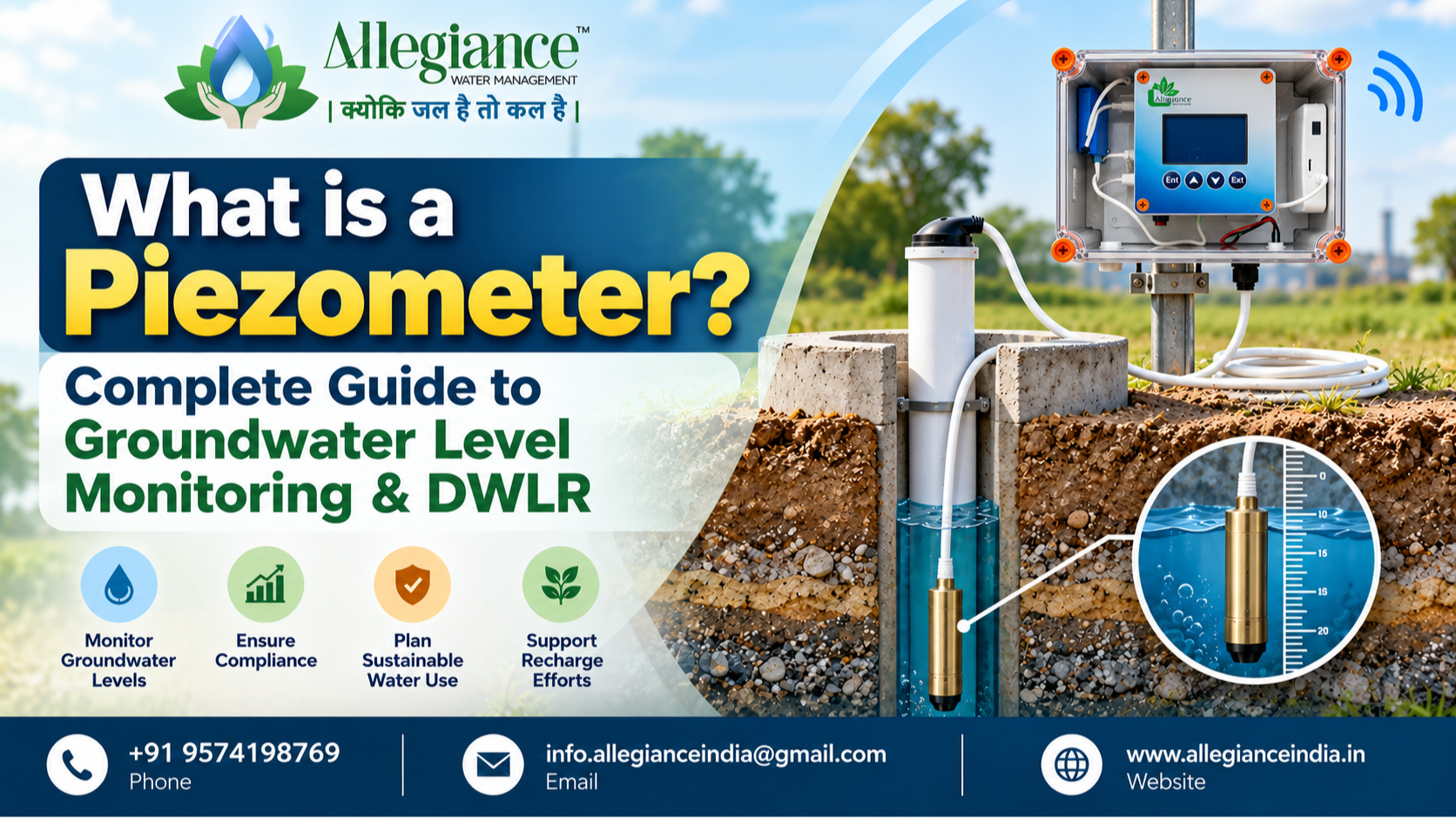
A piezometer is
an instrument used to measure the level, or pressure, of groundwater at a
specific point below the surface. In groundwater management, the word also
refers to the observation well itself: a dedicated borehole fitted with a pipe,
used only for measuring water levels and never for pumping.
Engineers also
use piezometers on dams, embankments and foundations to measure water pressure
in soil. In this guide, we focus on the most common use for industries and
buildings: groundwater level monitoring.
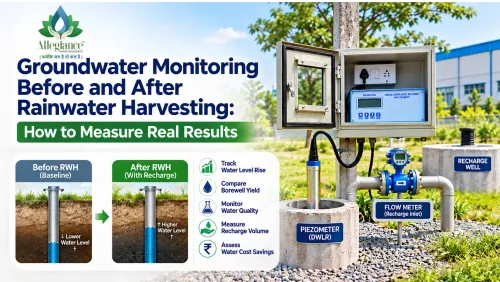
Why Groundwater Level Monitoring Matters
•
Early warning: A steady fall in water levels
tells you to act before your borewells fail.
•
Proof that recharge works: Comparing levels
before and after the monsoon shows the real effect of rainwater harvesting and
recharge wells.
•
Smarter pumping: Knowing how levels respond to
pumping helps you set safe extraction rates and protect pump motors.
•
Regulatory compliance: CGWA NOCs for industries
commonly require piezometers and regular water level data.
•
Planning: Long-term data supports decisions on
new borewells, recharge structures and water budgets.
How Does a Piezometer Work?
In a modern
digital setup, a waterproof pressure sensor is lowered into the piezometer well
and hung below the water level. The weight of the water above the sensor
creates pressure. The sensor converts that pressure into an electrical signal,
which the recorder turns into a water level reading. As the groundwater rises
or falls, the pressure changes, and every change is logged automatically.
With a manual
instrument, a probe on a marked tape is lowered into the well. When it touches
water, it beeps or lights up, and the depth is read off the tape.
Types of Piezometers for Groundwater
Monitoring
Manual Water Level Indicator
A simple,
portable probe on a graduated cable reel. It is low cost and reliable, and
ideal for periodic manual readings, cross-checking digital instruments, and
sites where only occasional data is needed.
Digital Water Level Recorder (DWLR)
A DWLR uses a
submersible pressure sensor and a data logger to record water levels
automatically at set intervals. It removes human error and builds a continuous
record that can be viewed on screen, downloaded or exported to Excel.
DWLR with Telemetry
This adds a GSM
or IoT module that sends data straight to the cloud. You can check levels from
your phone or PC, get reports without visiting the site, and upload data for
compliance. For most industrial users, this is now the preferred option.
Other Engineering Piezometers
Standpipe
(Casagrande), vibrating wire and pneumatic piezometers are mainly used in
geotechnical work such as dams, tunnels and foundations, where pore water
pressure in soil needs to be measured.
Digital Water Level Recorder: Key
Specifications
Our digital
water level recorder piezometer, available with or without telemetry, is built
for long-term use in Indian conditions:
|
Parameter |
Specification |
|
Sensor |
Waterproof stainless steel pressure sensor |
|
Measuring
range |
Up to
400 metres |
|
Accuracy |
Plus or minus 0.5% of full scale |
|
Output |
4-20 mA
or customised |
|
Housing and cable |
SS housing, PTFE cable, shielded wire |
|
Power
supply |
12 V DC |
|
Process temperature |
-20°C to 85°C |
|
Data
storage |
Up to
32 GB, plus cloud-based online storage |
|
Data access |
On-screen display, memory card or USB, PC or mobile via
GSM |
|
Mounting |
Wall
mounted |
It is compact,
easy to install and transport, needs very little maintenance, and its pressure
transducer is not affected by wind or rain. It can monitor groundwater in
borewells as well as water levels in rivers and reservoirs.
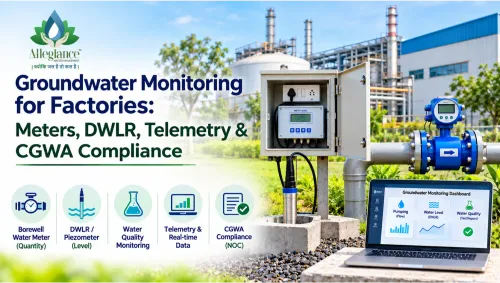
CGWA Piezometer Requirement for Industries
If your unit
holds a CGWA NOC for groundwater abstraction, piezometers are usually part of
the deal. Typical NOC conditions include:
•
Construction of purpose-built piezometers (observation
wells) on the premises
•
A DWLR with telemetry, often along with a manual
piezometer
•
Regular upload of water level data to the CGWA portal
The exact
requirement is written in your NOC, so always check it before buying
instruments. Using a dedicated observation well, rather than a pumping
borewell, gives true groundwater levels that aren't distorted by pumping.
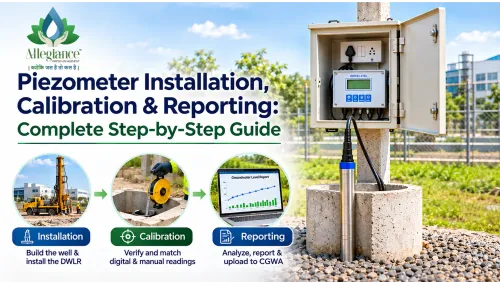
How to Install a Piezometer for Borewell
Monitoring
1.
Choose the location: a dedicated observation well away
from the influence of pumping borewells, or as specified in your NOC.
2.
Drill and construct the well with a casing pipe and a
slotted screen at the aquifer depth.
3.
Lower the water level sensor for the borewell to a
depth safely below the lowest expected water level.
4.
Mount the recorder unit on a wall or protective
enclosure and connect the cable.
5.
Set the recording interval and configure telemetry, if
used.
6.
Take a manual reading to calibrate and cross-check the
first digital reading.
7.
Lock the well cap to protect the instrument and prevent
tampering.
Piezometer Maintenance Tips
•
Cross-check the digital reading with a manual water
level indicator from time to time.
•
Inspect the cable, connectors and enclosure for damage,
especially after the monsoon.
•
Make sure the power supply and SIM or network
connection are active for telemetry.
•
Download and back up data regularly, even when it is
stored in the cloud.
Why Choose Allegiance as Your Piezometer
Supplier in Gujarat?
•
A complete range: manual water level indicators, DWLR
piezometers, and DWLRs with GSM telemetry.
•
One team for groundwater monitoring, CGWA compliant
flow meters, rainwater harvesting, recharge and CGWA NOC support.
•
More than 1,000 projects since 2012, for clients
including L&T, NTPC, Polycab and Torrent Power.
•
Service across Vadodara, Ahmedabad, Bharuch, Halol,
Surat, Valsad, Vapi, Daman, Diu, Dadra and Nagar Haveli and Indore, with
instrument supply across India.
Frequently Asked Questions about Piezometers
What is the difference between a piezometer
and a borewell?
A borewell is
used to pump water. A piezometer is used only to measure the water level, so
its readings are not distorted by pumping.
Can I install a DWLR in my existing
borewell?
Technically
yes, but readings will swing with pumping. For CGWA compliance and accurate
data, a dedicated observation well is usually required.
How often does a DWLR record data?
The interval
can be set as needed, for example hourly or a few times a day, and the data is
stored automatically.
Start Monitoring Your Groundwater Today
Need a piezometer for CGWA compliance or simply want to understand your
groundwater better? Tell us about your site and borewells, and we'll recommend
the right monitoring setup.
Allegiance
Water Management
A unit of Allegiance Enterprises
Phone: +91 9574198769
Email: info.allegianceindia@gmail.com
Website: www.allegianceindia.in
Address: 28 & 29, Aura Square, 3rd Floor, Panchvati
Circle, Gorwa Refinery Road, Panchvati, Vadodara, Gujarat 390016