
Groundwater Monitoring Before and After Rainwater Harvesting
By Allegiance Water Management, Vadodara
Most rainwater
harvesting projects start with plenty of planning: roof areas, filters, pipe
sizes, recharge wells. But one step is often skipped, and it is the one that
later proves whether the project was worth it. That step is measuring the
groundwater before anything is built.
Without a
"before" picture, there is nothing to compare the "after"
against. This guide explains how to monitor groundwater before and after
rainwater harvesting, what to measure, and how to present the results so
management, residents or auditors can see the difference clearly.
Why a Before-and-After Comparison Matters
•
It proves the investment: Real numbers show
whether the system is delivering.
•
It separates recharge from luck: A good monsoon
raises water levels everywhere. A baseline helps show what your system added.
•
It builds trust: Residents, management and
auditors believe measured results more than estimates.
•
It guides the next step: Data shows whether to
add more recharge points, clean existing ones or change pumping.
Step 1: Baseline Groundwater Survey (Before
Installation)
Ideally, start
measuring at least one full season, and preferably a full year, before the
system is commissioned. A baseline groundwater survey usually records:
•
Water levels in existing borewells and, where
possible, a dedicated piezometer, especially the pre-monsoon low and
post-monsoon high.
•
Borewell yield, or how much water each borewell
delivers and how long it lasts before running dry in summer.
•
Water quality, including TDS, hardness, pH,
chlorides and nitrates from an accredited lab.
•
Pumping records, such as daily pump hours or
flow meter readings.
•
Water purchases, such as tanker trips and their
cost.
•
Site details, including roof areas, existing
drainage and any old or defunct borewells.
Already
installed a system without a baseline? Don't worry. Older pump records, tanker
bills and residents' memories of summer shortages can serve as a rough
baseline, and accurate monitoring can start from today.
Step 2: Install Rainwater Harvesting and the
Monitoring Setup Together
The best time
to add monitoring is while the rainwater harvesting system is being built. A
practical setup includes:
•
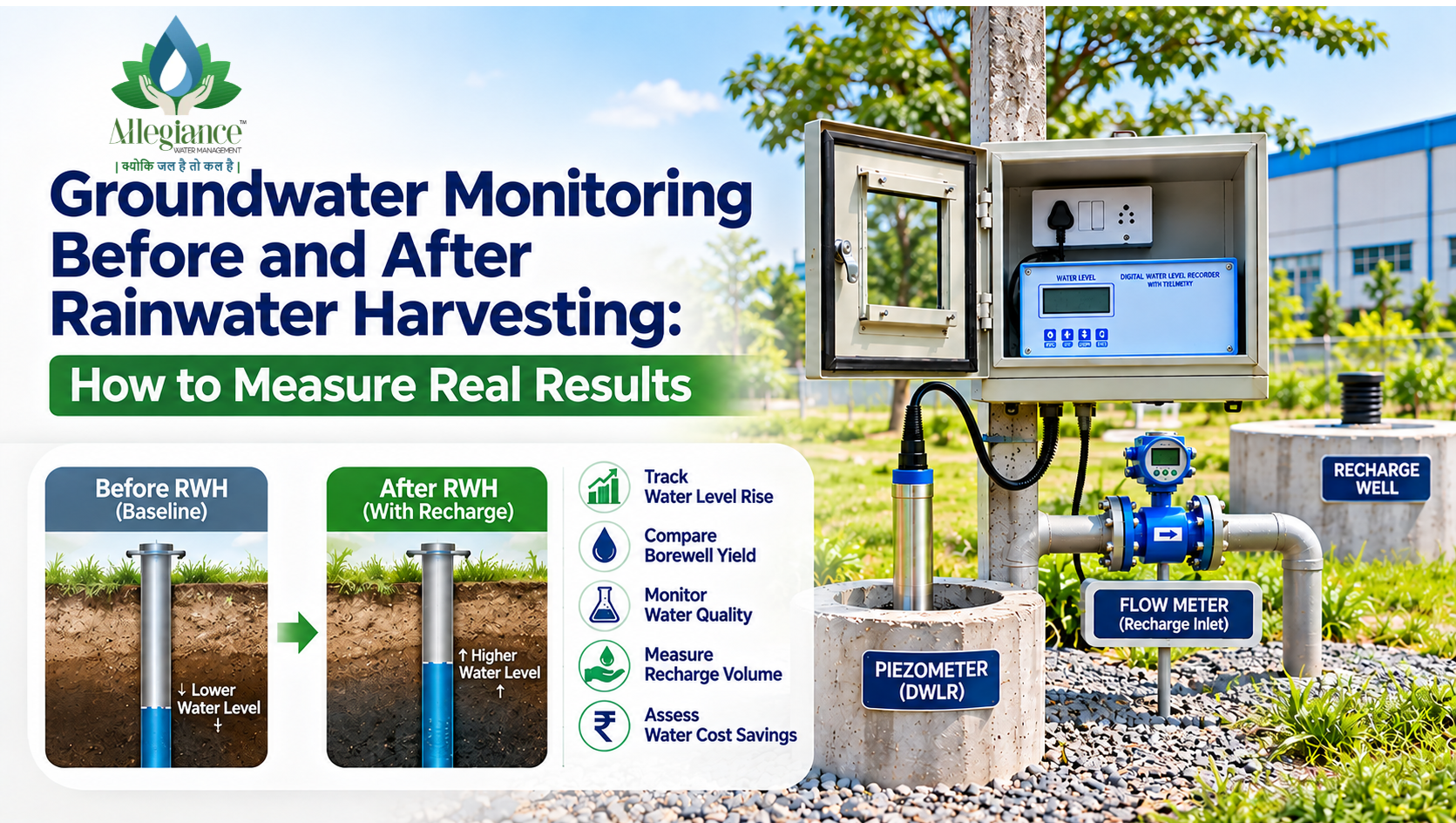
A piezometer with a digital water level recorder (DWLR)
near the recharge zone
•
A reference piezometer or observation well away from
the recharge zone, if space allows
•
A flow meter on the main recharge inlet to record how
much water goes in
•
Flow meters on pumping borewells, if not already fitted
Self-cleaning
Rainy filters and silt traps keep the recharge structure working well, so the
results you measure reflect a healthy system.
Step 3: Monitor After Rainwater Harvesting
Once the system
is running, keep measuring the same things, in the same way, at the same times
of year as the baseline. Consistency is what makes the comparison fair.
Water Table Rise After Rainwater Harvesting
Compare
pre-monsoon and post-monsoon levels each year with the baseline year. A larger
seasonal rise, or summer levels that no longer fall as low as before, are
strong signs of groundwater level improvement.
Borewell Yield Test
Repeat the same
simple yield test used at baseline. For example, pump at a steady rate and
record how far and how fast the water level drops, then how quickly it
recovers. Faster recovery and less drop usually mean a healthier aquifer around
the borewell.
Groundwater Quality Before and After
Recharge
Rainwater is
soft and low in dissolved salts, so in many areas recharge can gradually help
improve TDS and hardness in nearby borewells. Test at the same time each year,
from the same borewells, using an accredited lab.
Practical Indicators
Fewer tanker
trips, fewer pump breakdowns and borewells lasting further into summer are
simple, real-world rainwater harvesting results that everyone understands.
What to Compare: Before vs After
|
Parameter |
Before (Baseline) |
After (Each Year) |
|
Pre-monsoon water level |
Lowest level in May or June |
Is the summer low less deep? |
|
Post-monsoon
water level |
Highest
level in Oct or Nov |
Is the
seasonal rise larger? |
|
Borewell yield |
Drawdown and recovery time |
Less drawdown, faster recovery? |
|
Water
quality |
TDS,
hardness, pH, chlorides |
Stable
or improving trend? |
|
Water purchases |
Tanker trips and cost |
Fewer trips, lower cost? |
|
Recharge
volume |
Not
applicable |
Litres
recorded by inlet flow meter |
Reading the Results Honestly
•
Compare several years, not just one. A single very wet
or very dry monsoon can mislead.
•
Look at the reference well too. If it rose as much as
the recharge-zone well, much of the rise may be natural.
•
Remember neighbours matter. Heavy pumping nearby can
hide gains, and nearby recharge can add to them.
•
Groundwater responds slowly. Some sites show clear
gains in the first year, others take a few seasons.
Presenting a Rainwater Harvesting Case Study
A short, clear
impact report makes the results easy to share. It can include:
•
A site map with recharge points and monitoring wells
•
A graph of water levels from baseline year to today,
with rainfall shown
•
The before-and-after comparison table above
•
Total recharge volume from the inlet flow meter
•
Savings in tanker cost or pumping, where recorded
For industries,
the same data supports CGWA reporting and ESG disclosures. For housing
societies, it is a powerful way to show members what their investment achieved.
Rainwater Harvesting Impact Study in Gujarat
with Allegiance
Allegiance
Water Management has designed and built rainwater harvesting and recharge
systems since 2012, with more than 1,000 projects for industries, institutions,
housing societies and communities, including L&T, NTPC, Polycab and Torrent
Power. We can help with:
•
Rainwater harvesting feasibility and geohydrological
surveys
•
Rooftop rainwater harvesting, recharge wells, V-wire
injection wells and defunct borewell recharge
•
Digital water level recorders with GSM telemetry,
manual water level indicators and flow meters
•
Maintenance of rainwater harvesting systems and CGWA
NOC support
We serve
Vadodara, Ahmedabad, Bharuch, Halol, Surat, Valsad and Vapi, along with Daman,
Diu, Dadra and Nagar Haveli and Indore.
Start Measuring Before You Build
Planning a rainwater harvesting project, or want to know what your
existing system has achieved? Talk to us about setting up a simple
before-and-after monitoring plan for your site.
Allegiance
Water Management
A unit of Allegiance Enterprises
Phone: +91 9574198769
Email: info.allegianceindia@gmail.com
Website: www.allegianceindia.in
Address: 28 & 29, Aura Square, 3rd Floor, Panchvati
Circle, Gorwa Refinery Road, Panchvati, Vadodara, Gujarat 390016