
Accurate flow measurement is at
the heart of every water management, industrial, and environmental compliance
system. Among the many instruments available, the electromagnetic flow meter stands out for its precision and reliability. This beginner's guide explains
what an electromagnetic flow meter is, how it works, and why it is widely used
for CGWA-compliant flow monitoring.
What is an Electromagnetic Flow Meter?
An electromagnetic flow meter,
often called a mag meter, is a flow control device used to measure the flow
rate of conductive liquids moving through a pipe. It is commonly used in
borewell discharge monitoring, industrial water systems, and effluent treatment
plants, and is a key requirement for CGWA-compliant flow control devices in
India.
Unlike mechanical meters with
moving parts, an electromagnetic flow meter has no internal obstructions, which
means minimal pressure loss and long-term durability even in demanding
industrial environments.
How Does an Electromagnetic Flow Meter Work?
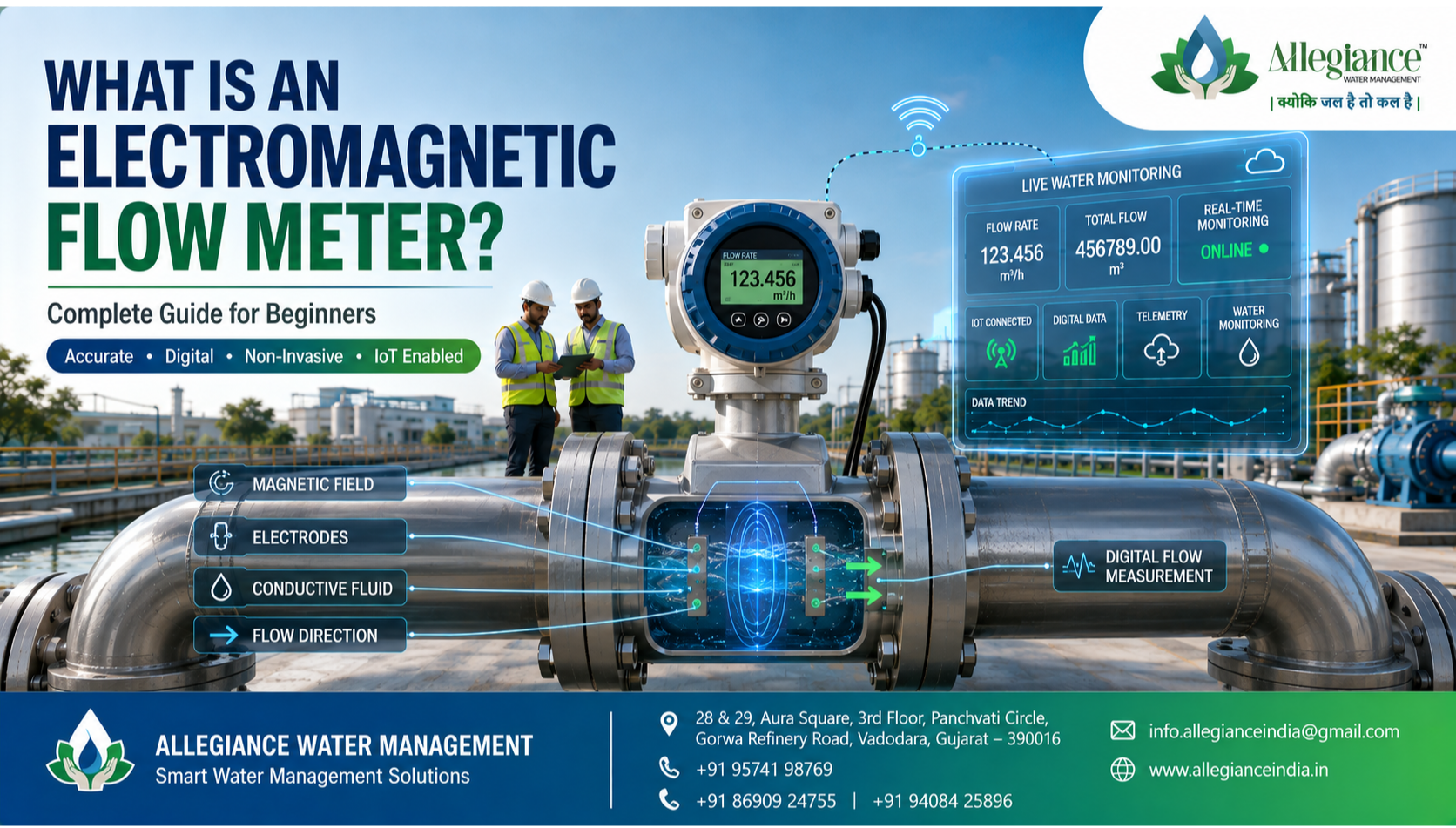
The working principle is based
on Faraday's Law of Electromagnetic Induction. As conductive liquid flows
through the meter's magnetic field, it generates a voltage proportional to the
flow velocity. This signal is captured by electrodes inside the flow sensor and
converted into an instantaneous flow rate reading by the flow transmitter.
A typical electromagnetic flow
meter system consists of two main parts:
•
Flow Sensor - installed in the pipeline, includes the
flow tube, electrodes, and grounding electrode
•
Flow Transmitter - a separate unit that displays
instantaneous flow rate, totalized flow, and diagnostic messages
Key Technical Features
Electromagnetic flow meters are
built for accuracy and long-term field performance. Common specifications
include:
•
Line sizes ranging from 15 NB to 1000 NB
•
Accuracy of ±0.5% of full scale
•
Linearity of ±0.5% of full scale
•
Repeatability of ±0.2% of full scale
•
Response time of less than 1 second
•
Outputs including 4-20 mA, isolated pulse output, and
RS485 MODBUS
•
Protection class IP-66 for outdoor and harsh
environments
•
Suitable for liquids with a minimum conductivity of 5
microS/cm
The flow tube is typically constructed from SS304, with a
grounding electrode and process electrode in SS316L, ensuring corrosion
resistance and stable readings across a liquid velocity range of 0.5 m/s to 10
m/s.
Types of Electromagnetic Flow Meters
Depending on the application,
several variants of flow meters are used alongside or instead of standard
electromagnetic types:
•
Battery Powered Electromagnetic Flow Meter - ideal for
remote sites without continuous power
•
S.S Electromagnetic Flow Meter - for corrosive or
high-purity applications
•
Clamp-on Ultrasonic Flow Meter - non-invasive
measurement without cutting the pipeline
•
Open Channel Ultrasonic Flow Meter - for canals and
open water channels
•
Woltman Type Flow Count Meter - mechanical option for
bulk water metering
•
Turbine and Vortex Flow Meters - suited for specific
industrial flow conditions
IoT-Based Telemetry for Flow Meters
Modern electromagnetic and
ultrasonic flow meters can be paired with an IoT-based telemetry device that is
CGWA compliant. This allows real-time flow data to be transmitted remotely,
supporting groundwater extraction reporting, water audits, and regulatory
submissions without manual site visits.
Why CGWA Compliance Matters
Industries and developers
extracting groundwater are increasingly required to install approved flow
control devices as part of their CGWA clearance. An electromagnetic flow meter
with telemetry capability helps organizations:
•
Maintain accurate records of groundwater extraction
•
Support water audits and geohydrological compliance
•
Avoid penalties linked to unmonitored borewell usage
•
Contribute to responsible, sustainable water management
Choosing the Right Flow Meter
Selecting the right flow
control device depends on pipe size, liquid conductivity, installation
environment, and whether remote telemetry is required. Consulting an
experienced water management provider ensures the meter selected matches both
your operational needs and CGWA compliance requirements.
Conclusion
An electromagnetic flow meter
is a reliable, low-maintenance solution for measuring conductive liquid flow
with high accuracy. Whether used for industrial process water, borewell
discharge, or CGWA-mandated monitoring, this technology plays a central role in
modern water management and sustainable groundwater use.