
Complete Guide to Industrial Rooftop Rainwater Harvesting:
Design, Installation, Maintenance & Compliance
By Allegiance Water Management, Vadodara
Every monsoon,
a typical factory roof in Gujarat sheds lakhs of litres of clean rainwater
straight into storm drains. At the same time, the same plant pays for tanker
water, struggles with falling borewell levels, and spends hours on groundwater
paperwork. Industrial rooftop rainwater harvesting fixes all three problems at
once. It cuts your water bill, puts water back into the aquifer you depend on,
and helps you meet CGWA requirements.
In this guide,
we walk you through how a rainwater harvesting system for industries is
designed, installed, maintained and kept compliant, based on what we have
learned from more than 1,000 projects since 2012.
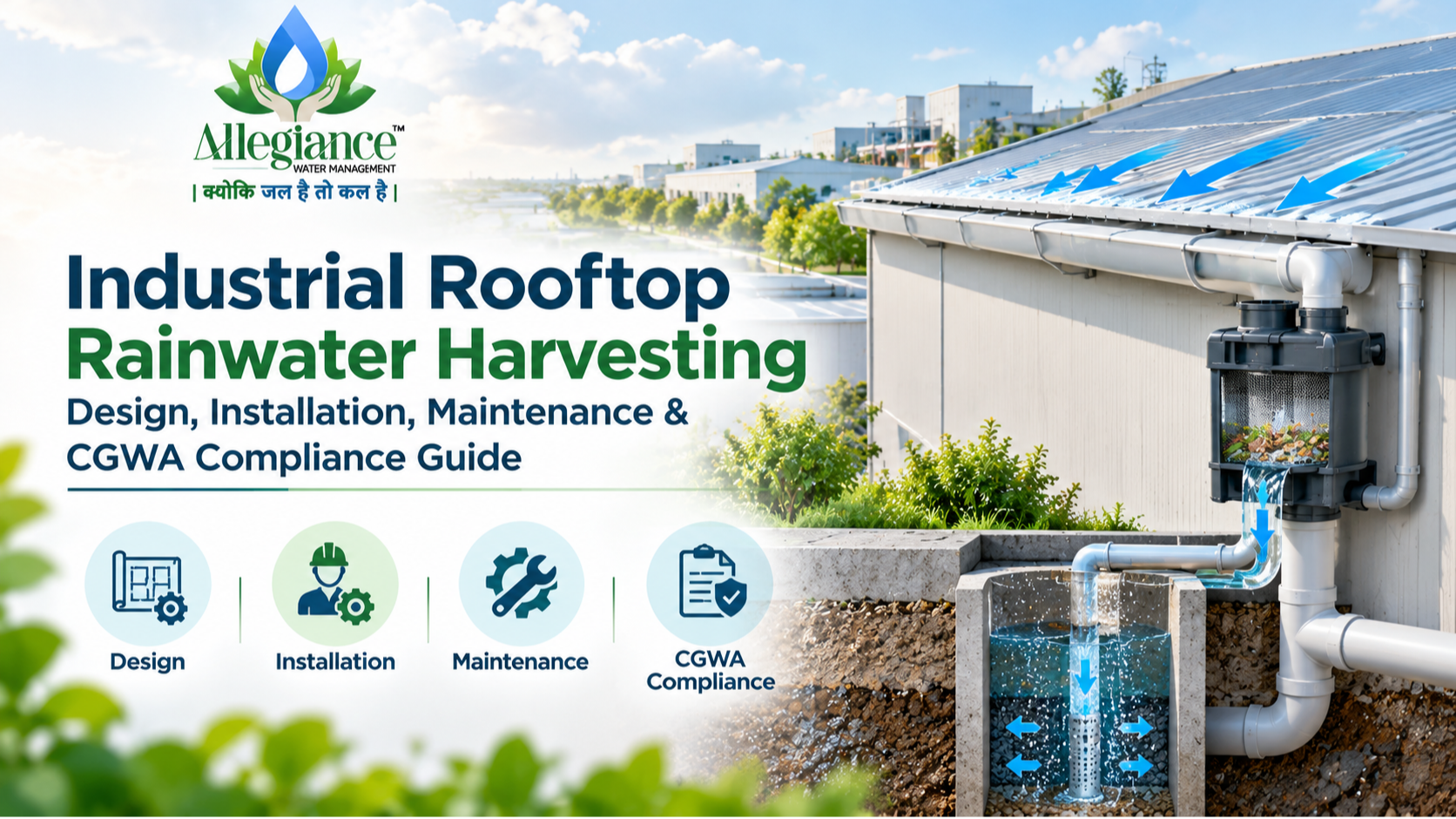
What Is Industrial Rooftop Rainwater Harvesting?
Industrial
rooftop rainwater harvesting is the process of collecting rain that falls on
factory sheds, warehouses and office blocks, filtering it, and then either
storing it for reuse or sending it underground to recharge the groundwater.
Industrial roofs are large, mostly metal or concrete, and relatively clean,
which makes them one of the best catchments you can find.
There are two
ways to use the water, and most plants use both:
•
Collection and reuse: Store filtered rainwater
in tanks or sumps for cooling towers, gardening, toilet flushing, washing or
process make-up water.
•
Groundwater recharge: Send the surplus into a
recharge well, injection well or recharge pond so it refills the aquifer below
your site.
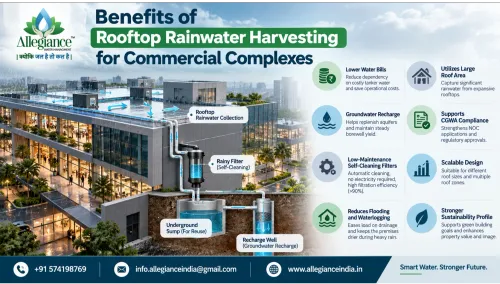
Why Industries Need a Rainwater Harvesting System Today
•
Lower water cost: Every litre you harvest is a
litre you don't buy, pump or treat.
•
Stronger borewells: Recharge slows the decline
of the water table under your own plant.
•
Regulatory compliance: Recharge and monitoring
are central to CGWA groundwater rules and to most building approvals.
•
Less waterlogging: Diverting roof runoff reduces
flooding in yards, roads and loading areas.
•
ESG and green ratings: Rainwater harvesting
earns credit in sustainability reports and green building certifications.
Rooftop Rainwater Harvesting Design: Getting the Basics Right
Good rooftop
rainwater harvesting design starts on paper, not on site. A system that is
undersized overflows in the first heavy shower; one that is oversized wastes
capital. Here is how we approach it.
Step 1: Site and Feasibility Survey
We study the
roof area, roof material, drainage layout, available open land, soil type and
depth to groundwater. A geohydrological survey tells us whether the ground can
actually absorb water and at what depth the permeable layers sit.
Step 2: Calculate Your Harvesting Potential
The basic
formula is simple:
Harvestable water (m³) = Roof area (m²) x Annual rainfall
(m) x Runoff coefficient
For example, a
10,000 m² metal roof in Vadodara receiving around 900 mm of rain a year, with a
runoff coefficient of 0.85, can yield roughly 7,650 m³, that is about 76 lakh
litres every monsoon. That is water your plant is currently letting go.
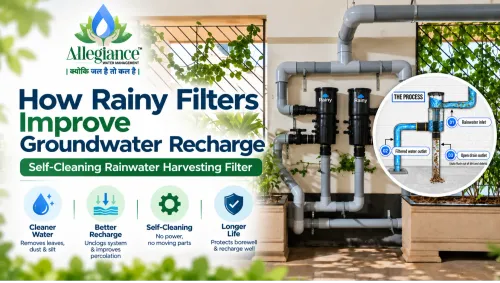
Step 3: Choose the Right Rainwater Harvesting Filter
The filter
protects your tank and your recharge well from leaves, dust and silt. We use
self-cleaning, dual-intensity filters with SS-304 food-grade screens of 250
microns that work on gravity alone, with no power needed and filtration
efficiency above 90%. Sizing depends on the roof area each downpipe serves:
|
Filter Model |
Suitable Roof Area |
Inlet Size |
Max Discharge |
|
Rainy FL-80 |
Up to 120 m² |
90 mm |
120 LPM |
|
Rainy
FL-150 |
Up to
180 m² |
110 mm |
180 LPM |
|
Rainy FL-250 |
Up to 250 m² |
110 mm |
250 LPM |
|
Rainy
FL-300 |
Up to
350 m² |
110 mm |
340 LPM |
|
Rainy FL-500 |
Up to 500 m² |
110 mm |
480 LPM |
Step 4: Select Storage or Recharge Structures
•
Storage tanks and sumps for direct reuse within
the plant.
•
Groundwater recharge well using RCC rings, a
filter media of gravel, coarse sand, charcoal and activated carbon, and a
V-wire screen injection pipe that carries water down to the weathered zone.
•
Defunct borewell recharge, which turns an old,
dry borewell into a recharge point.
•
Recharge ponds where larger open land is
available.
V-wire
injection wells are compact and modular, need very little land, and do not clog
easily, which makes them ideal for crowded industrial campuses.
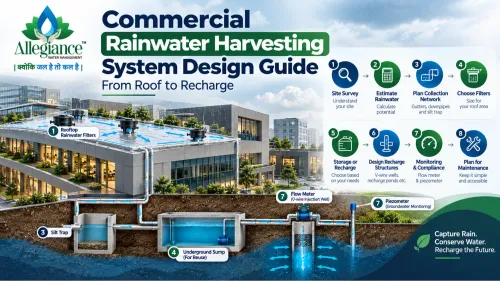
Rainwater Harvesting Installation: Step by Step
A clean
rainwater harvesting installation usually follows this sequence:
1.
Mark downpipes, collection lines and recharge or
storage points on the site plan.
2.
Connect roof downpipes to a common conveyance line with
the right slope.
3.
Install rainwater filters at the inlet of each
collection branch.
4.
Build a silt trap or desilting chamber ahead of the
recharge structure.
5.
Construct the recharge well or injection well, or
install the storage tank.
6.
Provide an overflow to the storm drain for extreme
rainfall events.
7.
Test the full system with water before the monsoon
arrives.
Timing matters.
The ideal window is between January and May, so the system is ready for the
first rain.
Rainwater Harvesting Maintenance Checklist
Even the best
system loses efficiency without care. Regular rainwater harvesting maintenance
keeps it working for years:
•
Before monsoon: Clean the roof and gutters,
check downpipes for cracks, and flush filters.
•
During monsoon: Inspect filters and silt traps
after heavy showers and clear any debris.
•
After monsoon: Desilt the silt trap and recharge
chamber and check the filter media.
•
Once a year: Review water level records to
confirm the recharge is actually reaching the aquifer.
We offer annual
maintenance contracts so your plant team doesn't have to track this on their
own.
CGWA NOC Compliance for Industries
If your unit
draws groundwater, you need a No Objection Certificate (NOC) from the Central
Ground Water Authority (CGWA). The CGWA guidelines expect industries to do
their part in putting water back and to prove how much they are taking out. In
practice, CGWA NOC compliance commonly involves:
•
Rainwater harvesting and artificial recharge structures
on the premises.
•
CGWA compliant flow meters on every abstraction
borewell, with digital, tamper-proof recording and telemetry.
•
Piezometers with a Digital Water Level Recorder
(DWLR) to monitor groundwater levels.
•
Water audits and periodic reporting, depending
on the volume your unit uses.
The exact
conditions depend on your location, the category of the area and how much water
you extract, so it is worth getting the details checked for your specific site
before applying or renewing. We supply and install electromagnetic, ultrasonic
and battery-operated flow meters, IoT telemetry devices and DWLR piezometers,
and we handle the NOC process, so the harvesting, monitoring and paperwork are
all managed by one team.
Why Choose Allegiance Water Management?
•
Working in water management and conservation since
2012, with more than 1,000 successful projects.
•
One team for feasibility surveys, geohydrological
studies, design, installation, CGWA NOC and maintenance.
•
Trusted by industrial names including L&T, NTPC,
Polycab, Torrent Power, Hitachi Hi-Rel and Yazaki, along with many others.
•
Indian Green Building Council (IGBC) member.
•
Services across Gujarat including Vadodara, Ahmedabad,
Bharuch, Halol, Surat, Valsad and Vapi, plus Daman, Diu, Dadra and Nagar Haveli
and Indore, with instrument supply across India.
Frequently Asked Questions
How much does an industrial rooftop rainwater harvesting system cost?
Cost depends on
roof area, the number of recharge or storage points and site soil conditions. A
site survey gives you an accurate estimate.
Is rainwater harvesting mandatory for industries?
For industries
extracting groundwater, recharge measures are typically part of CGWA NOC
conditions, and many local building rules also require it. Check what applies
to your site.
How long does installation take?
Most industrial
projects are completed within a few weeks, depending on size and site access.
Can harvested rainwater be used in industrial processes?
Yes. After
suitable filtration, and treatment where needed, it can be used for cooling
towers, boiler feed make-up, washing and gardening.
Start Your Rainwater Harvesting Project Today
Every monsoon
you wait is another season of free water lost. Talk to our team for a site
survey and a design that suits your plant, your budget and your compliance
needs.
Allegiance Water Management
A unit of Allegiance Enterprises
Phone: +91 9574198769
Email: info.allegianceindia@gmail.com
Website: www.allegianceindia.in
Address: 28 & 29, Aura Square, 3rd
Floor, Panchvati Circle, Gorwa Refinery Road, Panchvati, Vadodara, Gujarat
390016