
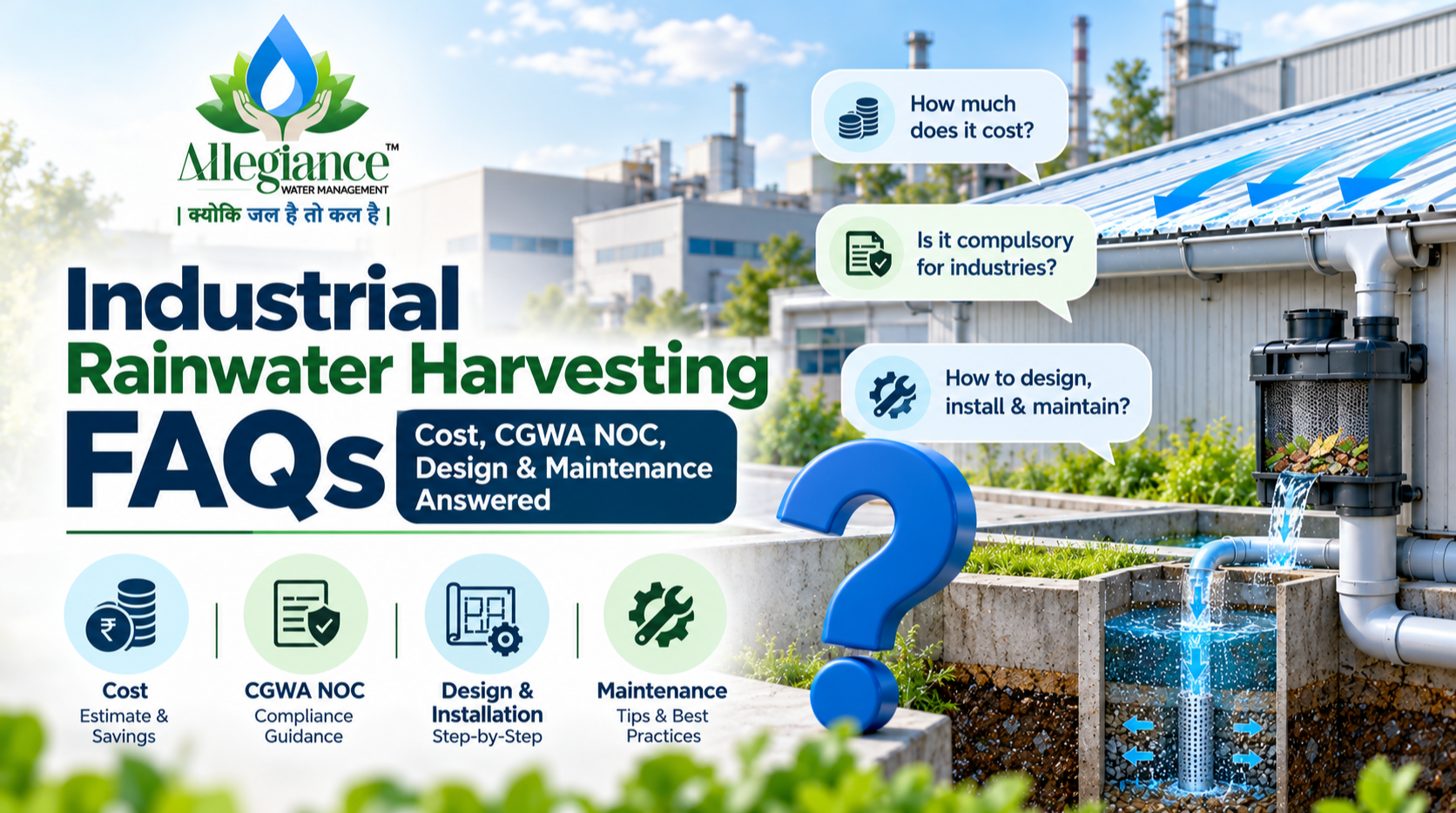
Industrial Rainwater Harvesting FAQs: Your Questions Answered
By Allegiance Water Management, Vadodara
Plant heads,
EHS managers and project engineers ask us many of the same questions before
starting a rainwater harvesting project. How much will it cost? Is it
compulsory? Will it actually help our borewells? We have pulled together the
most common questions from more than 1,000 projects since 2012 and answered
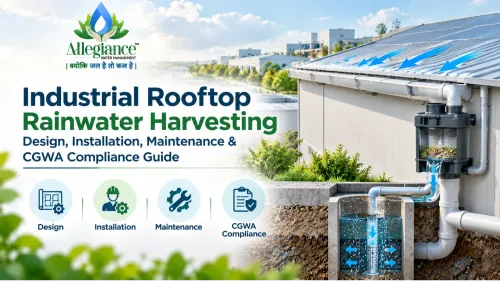
them simply. If you want the full technical walkthrough, read our complete
guide to industrial rooftop rainwater harvesting.
General Questions on Rainwater Harvesting for Factories
What is industrial rainwater harvesting?
It is the
collection of rain falling on factory roofs, sheds and paved areas, which is
then filtered and either stored for reuse or sent underground to recharge the
aquifer. Large industrial roofs make excellent catchments, so even a
medium-sized plant can capture lakhs of litres each monsoon.
What are the main benefits of rainwater harvesting for industries?
•
Lower water bills because you buy, pump and
treat less water.
•
Healthier borewells because recharge slows the
fall of the water table under your site.
•
Easier compliance with CGWA and local building
rules.
•
Less waterlogging in yards, roads and loading
bays during heavy rain.
•
Better ESG and green building scores, which
matter more each year to buyers and investors.
Can harvested rainwater be used in our process?
Yes, in many
cases. After filtration, and treatment where your process needs it, rainwater
works well for cooling tower make-up, boiler feed make-up, floor and vehicle
washing, gardening and toilet flushing. Rainwater is naturally soft, so it can
also reduce scaling.
Rainwater Harvesting Cost for Industry
How much does an industrial rainwater harvesting system cost?
There is no
fixed price, because cost depends on roof area, number of recharge or storage
points, depth to groundwater, soil type and how far the water has to travel on
site. A feasibility survey gives you an exact estimate. As a rule,
recharge-based systems cost less than large storage tanks, because the aquifer
itself becomes your tank.
What is the payback period?
For plants that
buy tanker water or pay high municipal charges, savings show up from the first
monsoon. Recharge systems also protect the long-term yield of your borewells,
which is harder to put a number on but often worth more than the bill savings.
Is Rainwater Harvesting Mandatory for Industries?
Do we legally need rainwater harvesting?
For industries
that extract groundwater, artificial recharge measures are usually part of the
conditions in the CGWA No Objection Certificate. Many municipal and development
authorities also require rainwater harvesting for building plan approval. The
exact rules depend on your location and water use, so it is best to have your
site checked.
What is a CGWA NOC for industries?
It is the
permission an industrial unit needs from the Central Ground Water Authority to
draw groundwater. Depending on your location and how much you extract,
conditions commonly include recharge structures, CGWA compliant digital flow
meters with telemetry on every borewell, piezometers to monitor water levels
and periodic water audits. We handle NOC applications, renewals and the
instruments needed to meet them.
What happens if we don't comply?
Non-compliance
can lead to rejected NOC renewals, penalties or environmental compensation. It
is far cheaper to put the system in place than to fix a compliance problem
later.
Design and Installation Questions
How do you decide the size of the system?
We start with a
site survey and, where needed, a geohydrological study. Then we work out how
much water your roof can yield using a simple formula:
Roof area (m²) x Annual rainfall (m) x Runoff coefficient
= Harvestable water (m³)
From that, we
size the filters, pipelines, silt traps and recharge or storage structures.
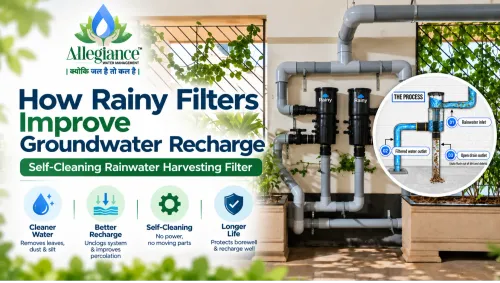
Which industrial rainwater harvesting filter do you use?
We use
self-cleaning, dual-intensity Rainy FL series filters with SS-304 food-grade
250 micron screens. They run on gravity alone, need no power, and deliver more
than 90% filtration efficiency. Models range from the FL-80 for roofs up to 120
m² to the FL-500 for roofs up to 500 m², so each downpipe gets the right size.
What is a groundwater recharge well for industries?
It is a
structure that sends filtered rainwater deep into the ground. Our design uses
heavy-duty RCC rings, a filter bed of gravel, coarse sand, charcoal and
activated carbon, and a V-wire screen injection pipe that delivers water into
the weathered zone. It takes very little land, is modular and resists clogging,
which suits busy industrial campuses.
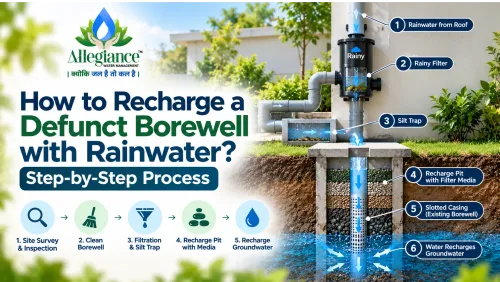
Can we use our old dry borewell?
Often, yes. A
defunct borewell can be turned into a recharge point with a proper filter and
silt trap in front of it. It is one of the most cost-effective ways to start
recharging.
How long does installation take, and when should we start?
Most industrial
projects take a few weeks, depending on size and site access. The best time to
start is between January and May, so the system is tested and ready before the
monsoon.
Maintenance and Monitoring
How much maintenance does the system need?
•
Before monsoon: clean roofs and gutters, check
downpipes, flush filters.
•
During monsoon: inspect filters and silt traps
after heavy showers.
•
After monsoon: desilt chambers and check the
filter media.
We offer annual
maintenance contracts so your team doesn't have to track this.
How do we know recharge is actually working?
By measuring
it. A digital water level recorder piezometer (DWLR) records the groundwater
level in your borewell, stores the data and can send it to your phone or PC
through GSM telemetry. Looking at levels before and after the monsoon shows the
real effect of your recharge system and gives you data for CGWA reporting.
Which flow meters meet CGWA requirements?
CGWA expects
digital, tamper-proof flow meters with telemetry on abstraction borewells. We
supply electromagnetic, ultrasonic, battery-operated and Woltman meters along
with IoT telemetry devices, and we can advise which one fits your pipe size and
site.
Why Choose Allegiance as Your Rainwater Harvesting Consultant in Gujarat?
What makes Allegiance different?
•
More than 1,000 successful projects since 2012.
•
One team for feasibility surveys, geohydrological
studies, design, installation, CGWA NOC, instruments and maintenance.
•
Trusted by industries including L&T, NTPC, Polycab,
Torrent Power, Hitachi Hi-Rel and Yazaki, along with many others.
•
Indian Green Building Council (IGBC) member.
Which areas do you cover?
We serve all
major districts of Gujarat, including Vadodara, Ahmedabad, Bharuch, Halol,
Surat, Valsad and Vapi, plus Daman, Diu, Dadra and Nagar Haveli and Indore. Our
flow meters and monitoring instruments are supplied across India.
Still Have Questions? Talk to Our Team
Every site is
different, and a quick conversation usually answers more than any FAQ can. Call
us, write to us, or book a site survey, and we'll tell you exactly what your
plant needs.
Allegiance Water Management
A unit of Allegiance Enterprises
Phone: +91 9574198769
Email: info.allegianceindia@gmail.com
Website: www.allegianceindia.in
Address: 28 & 29, Aura Square, 3rd
Floor, Panchvati Circle, Gorwa Refinery Road, Panchvati, Vadodara, Gujarat
390016