

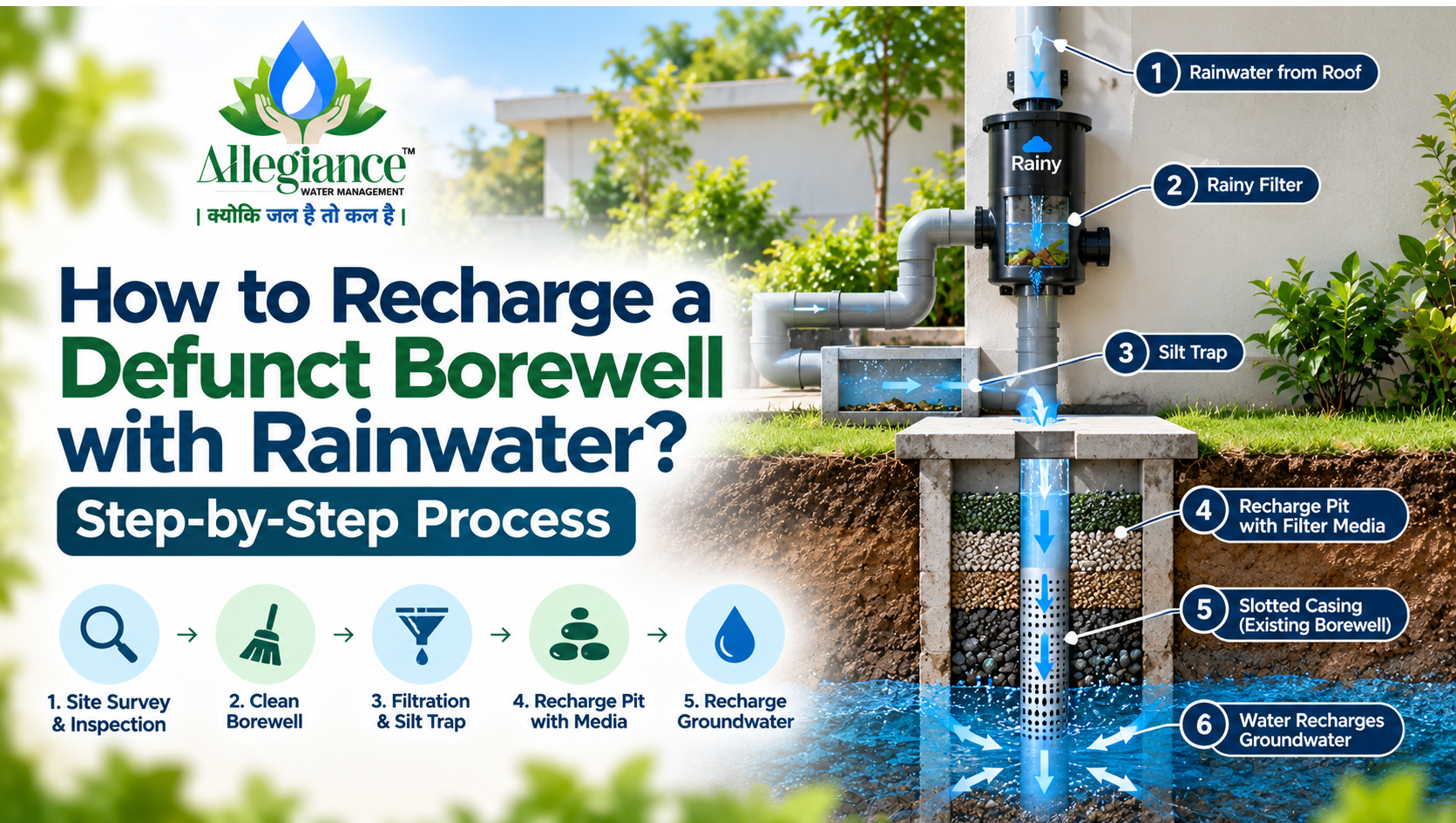
Step-by-Step Process of Recharging Rainwater Through a
Defunct Borewell
By Allegiance Water Management, Vadodara
Almost every
industrial campus, housing society and farm in Gujarat has one: an old borewell
that went dry years ago and now just sits there, capped and forgotten. Most
people see it as a failure. We see it as an opportunity.
A defunct
borewell is already drilled deep into the ground, often right down to the
layers that once held water. With the right setup, it can become one of the
cheapest and most effective ways to send rainwater back into the aquifer. Here
is exactly how defunct borewell recharge works, step by step.
Why Dry Borewell Recharge Makes Sense
•
The hard work is already done: Drilling is the
most expensive part of any deep recharge structure, and you have already paid
for it.
•
Water goes straight to the aquifer: Instead of
slowly soaking through clay or rock, filtered water reaches the deeper
water-bearing layers directly.
•
Very little land needed: The recharge pit sits
right around the existing borewell.
•
Helps nearby working borewells: Recharge in the
same area can help improve water levels in the borewells you still use.
•
A safer site: An open or poorly covered borewell
is a hazard. A recharge structure seals it properly.
How to Recharge a Borewell: The Step-by-Step
Process
Step 1: Site Survey and Borewell Inspection
We start by
checking the borewell itself: its depth, casing condition, diameter, history of
yield and why it went dry. We also look at the ground conditions and the roof
or open area that will feed it. Not every borewell is suitable. One that is
damaged, collapsed or near a source of contamination such as a septic tank or
chemical storage area may need a different approach.
Step 2: Calculate How Much Water You Can
Recharge
Using the
catchment area and local rainfall, we work out how much water will flow to the
borewell during the monsoon:
Catchment area (m²) x Annual rainfall (m) x Runoff
coefficient = Recharge potential (m³)
This decides
the size of the pipelines, filter, silt trap and recharge pit.
Step 3: Clean and Flush the Borewell
Old borewells
often have silt, stones or debris settled at the bottom. Flushing the borewell
clears the path so water can move freely into the aquifer.
Step 4: Set Up Collection, Filtration and a
Silt Trap
Rainwater from
the roof or clean catchment is collected through downpipes and a conveyance
line. It then passes through a self-cleaning Rainy filter, which removes
leaves, dust and debris with more than 90% efficiency, and then a silt trap or
desilting chamber, which lets fine particles settle before the water moves on.
Clean water is the single most important factor in keeping a borewell recharge
system working for years.
Step 5: Build the Borewell Recharge Pit
A pit is dug
around the borewell casing and lined with RCC rings or masonry. The casing pipe
inside the pit is perforated with slots so water can enter, and the slotted
section is wrapped with a fine mesh to keep sand out.
Step 6: Fill the Graded Filter Media
The pit is
filled in layers that do the final cleaning before water reaches the borewell.
A typical arrangement uses crushed stones or boulders at the bottom, gravel in
the middle and coarse sand on top, with charcoal and activated carbon added
where extra polishing is needed. Each layer traps finer particles than the one
before it.
Step 7: Cover, Overflow and Safety
The pit is
closed with a strong RCC cover slab with an inspection opening for maintenance.
An overflow line takes excess water safely to the storm drain during very heavy
rain, so the pit never floods the area around it.
Step 8: Test, Commission and Monitor
Before the
monsoon, we run water through the full system to check flow, filtration and
overflow. Once it is running, a piezometer or digital water level recorder
(DWLR) can track groundwater levels, so you can actually see the effect of
recharge season after season.
Borewell Recharge Method at a Glance
|
Component |
Purpose |
|
Downpipes and conveyance line |
Carry rainwater from the catchment to the recharge point |
|
Rainy
filter |
Removes
leaves, dust and debris at the start |
|
Silt trap or desilting chamber |
Lets fine silt settle before water moves on |
|
Recharge
pit with RCC rings |
Holds
water around the borewell and supports the media |
|
Slotted casing with mesh |
Lets clean water into the borewell and keeps sand out |
|
Graded
filter media |
Final
filtration through stones, gravel, sand and carbon |
|
RCC cover and overflow |
Safety, inspection access and flood control |
Important Precautions for Groundwater
Recharge Through a Borewell
•
Use only clean rooftop or clean surface runoff. Never
send sewage, industrial effluent or oily yard water into a borewell.
•
Keep a safe distance from septic tanks, soak pits and
chemical storage.
•
Industries with a risk of contaminating groundwater may
not be allowed to recharge inside their premises under CGWA NOC conditions, so
check your NOC first.
•
Never leave a borewell open or loosely covered. It is a
serious safety risk, especially for children.
•
If water overflows from the borewell itself, the ground
below is not taking it fast enough, and a separate recharge well may be a
better choice.
Maintenance Tips for a Borewell Recharge
System
•
Before the monsoon, clean the roof, gutters and Rainy
filter.
•
Desilt the silt trap before and after every monsoon.
•
Check the top layer of sand in the recharge pit every
year and replace it if it is clogged.
•
Inspect the cover slab, overflow and pipe joints for
damage.
Aquifer Rejuvenation Projects by Allegiance
Rejuvenating
aquifers by recharging rainwater through defunct borewells is one of our core
services. Allegiance Water Management has been working in groundwater recharge
and conservation since 2012, with more than 1,000 projects completed for
industries, institutions and communities. Along with defunct borewell recharge,
we design and build V-wire injection wells, recharge ponds and rooftop
rainwater harvesting systems, and we supply CGWA compliant flow meters and
piezometers.
We offer
borewell recharge in Vadodara, Ahmedabad, Bharuch, Halol, Surat, Valsad and
Vapi, along with Daman, Diu, Dadra and Nagar Haveli and Indore.
Bring Your Dry Borewell Back to Life
Have an old borewell on your site? Send us its details and your roof
area, and we'll tell you whether it is suitable for recharge and what the
system will need, ideally well before the next monsoon.
Allegiance
Water Management
A unit of Allegiance Enterprises
Phone: +91 9574198769
Email: info.allegianceindia@gmail.com
Website: www.allegianceindia.in
Address: 28 & 29, Aura Square, 3rd Floor, Panchvati
Circle, Gorwa Refinery Road, Panchvati, Vadodara, Gujarat 390016