Thank you for writing to us. One of our executive will reach back to you through your submitted medium. In case there’s an urgency, feel free to connect over WhatsApp for faster response.
Prefer calling? Dial +918048074381 (International callers) or 08048074381 (Indian callers).
Percolation well is Known as Rain Water Harvesting System
It is a shallow excavated trench filled with gravel or crushed stone that is designed to infiltrate stormwater though permeable soils into the groundwater aquifer. A percolation trench is similar to a dry well, which is typically an excavated hole filled with gravel.
we are engaged to offer the best Percolating Well Service. The provided service is executed using the progressive techniques under the supervision of our brilliant professionals. Offered service is highly demanded among our clients, owing to their various associated features like promptness and on time execution.
It is a shallow excavated trench filled with gravel or crushed stone that is designed to infiltrate stormwater though permeable soils into the groundwater aquifer. A percolation trench is similar to a dry well, which is typically an excavated hole filled with gravel.
we are engaged to offer the best Percolating Well Service. The provided service is executed using the progressive techniques under the supervision of our brilliant professionals. Offered service is highly demanded among our clients, owing to their various associated features like promptness and on time execution.
“Rainy“ Rainwater Harvesting Filters
Completely Indigenous and Patented Technology for Dual Intensity Rainwater Harvesting Filters called 'Rainy'. For groundwater recharging, our innovation uses an injection well equipped with “V-Wire Screens“ that enables replenishment of groundwater source.
Rainwater is one of the purest source of water with less then 50mg/ litre of Total Dissolved Solids (TDS).
Minimalistic, easy-to-install and easy to maintain Products.
Reduction of Carbon Footprint and Recharge water source to avail clean water for consumption.
Working Principle:
When the rainwater along with dirt & debris flows by gravity through the downtake pipes, it enters into the filter and starts rotating in anticlockwise direction at the periphery of the upper housing, this enables it to flow into the SS-304 filter element placed in the lower housing in angular motion at specific speed & velocity, which creates cohesive force at low intensity & centrifugal force at high intensity of rainfall. In both situations, involving low & high intensity of rainfall, the working principle of the filter based on cohesive & centrifugal force respectively, aids the filter element to flush out dirt & debris automatically. The water then passes through the drain outlet and simultaneously diverts clean water into the sump/ recharging well through the clean water outlet, which can be used for reutilization or recharging of groundwater source.
Special Features :
What makes 'Rainy' unique?
Dual Intensity Filters works on the principle of Cohesive & Centrifugal force.
The open drain design does not allow stagnation of water and dirt particles.
Works on Gravitation force (No external energy required).
Cost effective and affordable.
Compact in size and wall mounted.
Inbuilt self-cleaning mechanism.
Automatic flush out of dirt and debris.
No consumables required.
Flexibility in pipe connection to any angle.
Tough UV stabilized high density polyethylene housing.
Filter Element SS-304 Multi-Surface Screen food grade.
All the material used are food grade and recyclable.
Filter Pipe connections can be turned up to 360 Degrees allowing it to suit the given site conditions.
Simple in connection, which any local plumber can easily install.
The filter efficiency remains unchanged even with the variation of intensity of rainfall.
The filters do not have any moving parts; there is no wear & tear of the filter allowing for long life span.
Technology works on the Gravitational Principle so saves power (reduces the pumping of water from distant places & depths).
Swirling movement of water is formed while ‘Rainy’ filters are under operation, this leads to aeration of water. Thus, increases the water quality.
Dual Intensity Filters works on the principle of Cohesive & Centrifugal force.
The open drain design does not allow stagnation of water and dirt particles.
Works on Gravitation force (No external energy required).
Cost effective and affordable.
Compact in size and wall mounted.
Inbuilt self-cleaning mechanism.
Automatic flush out of dirt and debris.
No consumables required.
Flexibility in pipe connection to any angle.
Tough UV stabilized high density polyethylene housing.
Filter Element SS-304 Multi-Surface Screen food grade.
All the material used are food grade and recyclable.
Filter Pipe connections can be turned up to 360 Degrees allowing it to suit the given site conditions.
Simple in connection, which any local plumber can easily install.
The filter efficiency remains unchanged even with the variation of intensity of rainfall.
The filters do not have any moving parts; there is no wear & tear of the filter allowing for long life span.
Technology works on the Gravitational Principle so saves power (reduces the pumping of water from distant places & depths).
Swirling movement of water is formed while ‘Rainy’ filters are under operation, this leads to aeration of water. Thus, increases the water quality.
Water Conservation, Ground Water Rejuvenation and Development via Rainwater Management and Harvesting Rainwater through Ponds and Borewell Recharging Structures to Support Increasing Demand of Water for Daily usage for Domestic, Industrial and Agricultural purposes. Water Conservation and Harvesting Structures in Naturally Water Scarce Regions creates Geo-Hydrological Opportunity and Economic Viability. Ponds recharging structure, farm pond, stop Dam, and small pond etc. It is seen that different Geographical Location and unique Geophysical and Hydrological Nature and every situation needs to be addressed, separately, the groundwater recharge capacity of the varies regions may vary depending upon area specific geophysical nature of earth strata. Recharge Wells provide an opportunity to extract sub-surface flow of the region without exploiting the Groundwater reserve.
Rainwater Harvesting Filters. FL 100 (Rooftop Area upto 1200 Sq. Ft)
The characteristic features of FL Series Dual Intensity RWH Filter is its capacity to take up the load up to 10 to 110 square meters of Roof area with variable intensity of rainfall of 5 to 75 mm/ hour with a discharge capacity of 10 to 105 Liters per minute. This filter can be conveniently used for Harvesting Rainwater for Individual households, Schools, and Smaller Roof area Buildings.
• Item Code: FL-100
Suitable up to area: 110 SQMTRS
Max: Intensity of Rainfall: 75 mm/hr
Working Principle : Cohesive Force & Centrifugal force
Operating Pressure: Less than 2 feet of head (0.060kg/cm2)
Capacity: 105 LPM
Filter Element: SS-304 Screen
Mesh Size: 250 Microns
Inlet: 90 MM
Clean Water Outlet: 63 MM
Drain Outlet: 90 MM
Housing: High Density Polyethylene
Efficiency of Filter: Above 90%
Source of Power: Gravity
Percolation Pit is also like Rainwater Harvesting System
A percolation pit, in its most low-tech form, is a simple hole dug into the ground. It facilitates groundwater recharge through infiltration of surface runoff into the soil or rock. Differences to contour trenches: Better water storage capability due to greater depth.
Percolation tank is an artificially created surface water body, submerging in its reservoir a highly permeable land so that surface runoff is made to percolate and recharge the ground water storage. The percolation tanks are mostly earthen dams with masonry structure only for spillway.
Percolation tank is an artificially created surface water body, submerging in its reservoir a highly permeable land so that surface runoff is made to percolate and recharge the ground water storage.
Percolation tank should be constructed preferable on second to third order streams, located on highly fractured and weathered rocks which have lateral continuity down stream.
The recharged area down stream should have sufficient number of wells and cultivable land to benefit from the augmented ground water.
The size of percolation tank should be governed by percolation capacity of strata in the tank bed. Normally percolation tanks are designed for storage capacity of 0.1 to 0.5 MCM. It is necessary to design the tank to provide a ponded water column generally between 3 & 4.5 m.
The percolation tanks are mostly earthen dams with masonry structure only for spillway. The purpose of the percolation tank is to recharge the ground water storage and hence seepage below the seat of the bed is permissible. for dams upto 4.5 m. height, cut off trenches are not necessary and keying and benching between the dam seat and the natural ground is sufficient.
Rooftop Harvesting Filters. FL 200/250 (Rooftop Area upto 2500 Sq.ft.)
The characteristic features of FL Series Dual Intensity Rain Water Harvesting Filter is its capacity to take up the load up to 10 to 225 square meters of roof area with variable intensity of rainfall of 5 to 75 mm/hour with a discharge capacity of 10 to 225 liters per minute.
This filter can be conveniently used for harvesting rainwater for individual households, schools, apartments, institutions, and commercial buildings of medium sizes.
• Item Code: FL-200
Suitable up to area: 225 SQMTRS
Max: Intensity of Rainfall: 75 mm/hr
Working Principle : Cohesive Force & Centrifugal force
Operating Pressure: Less than 2 feet of head (0.060kg/cm2)
Capacity: 225 LPM
Filter Element: SS-304 Screen
Mesh Size: 250 Microns
Inlet: 110 MM
Clean Water Outlet: 75 MM
Drain Outlet: 90 MM
Housing: High Density Polyethylene
Efficiency of Filter: Above 90%
Source of Power: Gravity
‘V’ Wire Injection Well Technology to Recharge Groundwater Source:
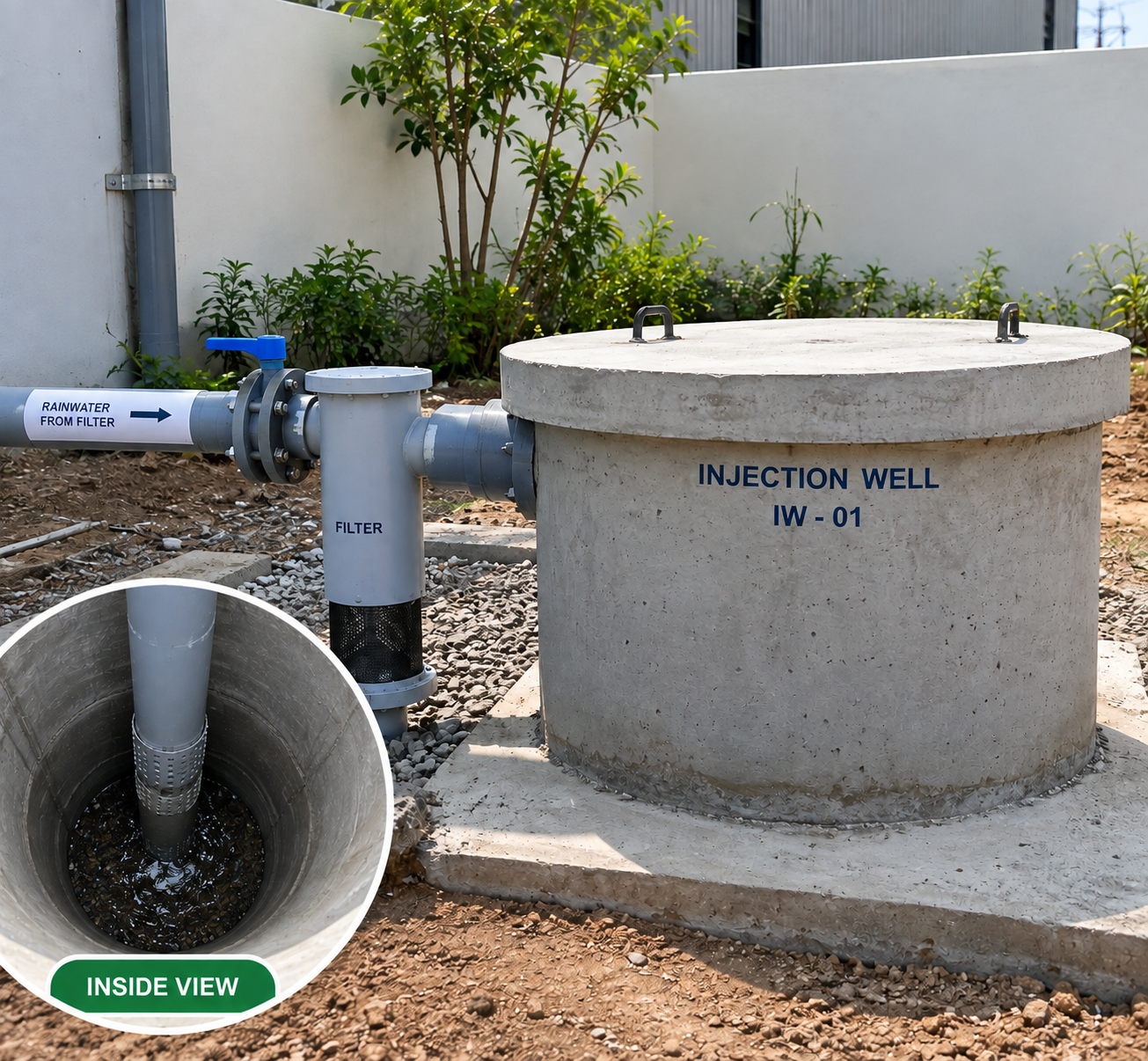
• The Rain Water is lead through water channel and first reaches the silt trap, which allows for silt to accumulate in the chamber. The overflow water is lead into the injection well, passing through multilayer’s of Filtration media placed at the top of the injection well. The water is accommodated in a specially designed storage well, which creates water column, injecting large quantities of water into the deeper layers of the semi impervious earth’s strata through the Non Clogging V-Wire screens attached to the specifically designed percolator pipe, placed to a depth of 30 meters below the ground. The water column and the dual V-Wire Screen allow for the water to reach the dry joints, cracks, aquifers and recharge the ground water source.
• This technology does not employ moving parts; the assured life span of the material is a minimum of twenty years. The maintenance cost involves desalting of the silt trap and replacement of filtration media once in five years.
• The technology was adaptable to harvest rain water, irrespective of the presence of any bore well in place and also irrespective of terrain. The technology gave maximum flexibility to be used either in low lying areas or in upland conditions.
• All materials used in this Technology are eco-friendly and recyclable.
• Technology works on the Gravitational Principal Geomorphic profiling through vertical electrical Sounding of the soil strata is done to ascertain enormous quantity of water, quickly penetrating the rainwater into groundwater source.
• The Provisioning of silt Trap fitted with Horizontal V wire Screen Filter eliminated the need of periodic maintenance and also facilitating significant volumes of rainwater to get into the recharging well.
V -WIRE FILTER SCREEN
V-Wire Filter Screen/ Rainwater Filters are the best Rainwater Harvesting Filters which are used for Filtration purpose. These filters have Continuous slots, which are Non Choking & Non Clogging and makes Filtration process smooth.
There is no wastage of rain water after using this RWH filter. V -WIRE SCREENS is a Proven Product of Proven Technology Trusted Widely for RAINWATER HARVESTING.
we are proud to Offer one of the Most Modern Filtration Systems for Rainwater Harvesting (Absolutely Zero Maintenance Cost) with the sole aim of increasing awareness about the Long Term benefits of Rainwater Harvesting using Filter Screens instead of the Conventional Method normally adopted.
V-Wire Screen Filter“/ Rainwater Harvesting Filter Screen is a Highly Acceptable Modern Technology in Rain Water Harvesting. It eliminates conventional filtration system, SAVES -Precious Space, Construction Cost and Construction Time for Filtration Tank. Scientific Design helps Cleaning Very Easy and SAVES Maintenance Cost.
Rainy Rainwater Harvesting Filter. FL 300 (Rooftop Area upto 3600 sq.ft)
The characteristic features of FL Series Dual Intensity Rain Water Harvesting Filter is its capacity to take up the load up to 10 to 350 square meters of roof area with variable intensity of rainfall of 5 to 75 mm/hour with a discharge capacity of 10 to 340 liters per minute.
This filter can be conveniently used for harvesting rainwater for individual households, schools, apartments, institutions, hospitals and commercial buildings of medium and small sizes.
• Item Code: FL-300
Suitable up to area: 350 SQMTRS
Max: Intensity of Rainfall: 75 mm/hr
Working Principle : Cohesive Force & Centrifugal force
Operating Pressure: Less than 2 feet of head (0.060kg/cm2)
Capacity: 340 LPM
Filter Element: SS-304 Screen
Mesh Size: 250 Microns
Inlet: 110 MM
Clean Water Outlet: 90 MM
Drain Outlet: 90 MM
Housing: High Density Polyethylene
Efficiency of Filter: Above 90%
Source of Power: Gravity
Roof Top Rain Water Harvesting
What is Roof Top Rain Water Harvesting?
Rooftop Rain Water Harvesting is the technique through which rain water is captured from the roof catchments and stored in reservoirs. Harvested rain water can be stored in sub-surface ground water reservoir by adopting artificial recharge techniques to meet the household needs through storage in tanks.
The Main Objective of rooftop rain water harvesting is to make water available for future use. Capturing and storing rain water for use is particularly important in dryland, hilly, urban and coastal areas. In alluvial areas energy saving for 1m.
rise in ground water level is around 0.40 kilo watt per hour.
Need for Rooftop Rain Water Harvesting
1. To meet the ever increasing demand for water
2. To reduce the runoff which chokes storm drains
3. To avoid flooding of roads
4. To augment the ground water storage and control decline of water levels
5. To reduce ground water pollution
6. To improve the quality of ground water
7. To reduce the soil erosion
8. To supplement domestic water requirement during summer, drought etc.
Advantages of Rain Water Harvesting
1. Provides self-sufficiency to your water supply
2. Reduces the cost for pumping of ground water
3. Provides high quality water, soft and low in minerals
4. Improves the quality of ground water through dilution when recharged to ground water
5. Reduces soil erosion in urban areas
6. The rooftop rain water harvesting is less expensive
7. Rainwater harvesting systems are simple which can be adopted by individuals
8. Rooftop rain water harvesting systems are easy to construct, operate and maintain
9. In hilly terrains, rain water harvesting is preferred
10. In saline or coastal areas, rain water provides good quality water and when recharged to ground water, it reduces salinity and also helps in maintaining balance between the fresh-saline water interface
11. In Islands, due to limited extent of fresh water aquifers, rain water harvesting is the most preferred source of water for domestic use
12. In desert, where rain fall is low, rain water harvesting has been providing relief to people
Rooftop Rainwater Harvesting Filters. for Industries Use FL 500 (Rooftop Area 5000 Sq.ft.)
The characteristic features of FL Series Dual Intensity Rain Water Harvesting Filter is its capacity to take up the load up to 10 to 500 square meters of roof area with variable intensity of rainfall of 5 to 75 mm/hour with a discharge capacity of 10 to 480 liters per minute.
This filter can be conveniently used for harvesting rainwater for apartments, institutions, hospitals, commercial buildings, industries, corporate houses of medium and large sizes.
• Item Code: FL-500
Suitable up to area: 500 SQMTRS
Max: Intensity of Rainfall: 75 mm/hr
Working Principle : Cohesive Force & Centrifugal force
Operating Pressure: Less than 2 feet of head (0.060kg/cm2)
Capacity: 480 LPM
Filter Element: SS-304 Screen
Mesh Size: 250 Microns
Inlet: 110 MM
Clean Water Outlet: 90 MM
Drain Outlet: 110 MM
Housing: High Density Polyethylene
Efficiency of Filter: Above 90%
Source of Power: Gravity
The concept of watershed development is based on the idea that rainwater can be harvested, the direct run-off of water reduced and the groundwater recharged. Watershed management has been a comprehensive approach aimed at optimizing the use of water, land and vegetation in any area. It is highly effective in channelizing water availability that helps to alleviate drought, moderate floods, prevent soil erosion, increase fuel, fodder and agricultural production on a sustained basis while keeping the inherent productivity of the soil resource intact.
Suitable for Area Upto 1000 Sq Ft
Intensity of Rainfall 5 mm/Hour to 75 mm/Hour
Filter Type Open ended, Non-clog
Working Principle Cohesive Force & Centrifugal Force
Operating Pressure > 1 foot of Gravity Head (0.060kg/cm2)
Max Discharge at (CWO) 120 Liters per minute
Filter Element SS-304 Multi-Surface Screen - Food Grade
Mesh Size 250 Microns
Inlet Size 90 MM
Clean Water Outlet size (CWO) 63 MM
Drain Outlet size 90 MM
Filter Housing UV Stabilized - HDPE
Filter Efficiency Above 90%*
Source of Power Gravity
Injection well Technology is the most effective in capturing surface run off both from plain open loose area or from storm line and filtering in two stages by filtering rainwater through 4 stages of filtration through Silt Trap and Injection well. The silt traps takes care of most impurities in the first stage itself, as it has 40 mm gravels, 10 mm pebbles, charcoal, activated carbon and coarse send and horizontally fixed V wire non clogging SS screen of 500 mm length and 150 mm dia. Rainwater then flows through main Injection well where it flows by gravity through 40 mm gravels, 10 mm pebbles, charcoal, activated carbon and coarse send and vertically placed V wire non clogging SS screen of 500 mm length and 200 mm dia. on the recharge bore well. Air vent from bore well and main well is kept at center. The main well is designed to do maintenance whenever is required. As such the filtration media only needs cleaning once in a year Silt Trap and Injection well. The best technology to have head pressure by the way of water column to ensure fast recharge of ground water and recover the water levels in Aquifer. Allegiance water Management; India's passionate Rainwater Company.
Water audit is a systematic process of objectively obtaining a water balance by measuring flow
of water from the site of water withdrawal or treatment, through the distribution system, and into
areas where it is used and finally discharged. Conducting a water audit involves calculating
water balance, water use and identifying ways for saving water.
Water audit involves preliminary water survey and detailed water audit. Preliminary water
survey is conducted to collect background information regarding plant activities, water
consumption and water discharge pattern and water billing, rates and water cess. After the
analysis of the secondary data collected from the industry, detailed water audit is conducted,
which involves the following steps:
On site training and discussion with facility manager and personnel
Water system analysis
Quantification of baseline water map
Monitoring and measurements using pressure and flow meters and various other devices
Quantification of inefficiencies and leaks
Quantification of water quality loads and discharges
Quantification of variability in flows and quality parameters
Strategies for water treatment and reuse or direct use
A detailed water balance is finally developed. Water quality requirement at various user areas is
mapped, which helps in developing „recycle‟ and „reuse‟ opportunities.
The detailed water audit report contains the following:
Water consumption and wastewater generation pattern
Specific water use and conservation
Complete water balance of the facility
Water saving opportunities
Method of implementing the proposals
Full description and figures
Investment required
Industries can undertake following measures for water conservation:
Setting up of norms for water budgeting
Modernization of industrial process to reduce water consumption
Recycling water with a re-circulating cooling system
Ozonation cooling water approach which can result in five fold reduction in blow down
when compared to traditional chemical treatment
Reduction in reuse of de-ionized water by eliminating some plenum flushes, converting
from a continuous flow to an intermittent flow system and improving control on the use
Use of wastewater for use of gardening
Proper processing of effluents to adhere to the norms of disposal.
Percolation Pit
It is a shallow excavated trench filled with gravel or crushed stone that is designed to infiltrate stormwater though permeable soils into the groundwater aquifer. A percolation trench is similar to a dry well, which is typically an excavated hole filled with gravel.
we are engaged to offer the best Percolating Well Service. The provided service is executed using the progressive techniques under the supervision of our brilliant professionals. Offered service is highly demanded among our clients, owing to their various associated features like promptness and on time execution.
“Injection well “
New & Innovative Technology for Rainwater Harvesting System
Products that are precisely coordinated, scientifically designed all-in-one Rainwater Harvesting solutions and dedicated service.
'Allegiance Water Management ' also undertakes turnkey projects in corporate sector/ industries/ government undertaking etc. and is capable of handling large projects right from Rain Water Harvesting design, supply and installation to providing end- to-end solutions. 'Allegiance' is equipped with a dedicated and experienced team of engineers, technician, workmen along with special installation equipment's, drilling rigs, civil structures etc.
Highly trained technical team conducts the Rainwater Harvesting technical survey by studying the layout of the site and building.
Existing piping system of rainwater and storm drains are studied.
Gradient and landscape of the site and building are obtained.
Designing and installation of innovative customized system is done with precise scientific approach. These solutions include: diverting existing rainwater pipes, deployment of underground storage, auto pumping system, piping, filtering, storage, utilization etc.
Designing and construction of ground water recharging structures.
Complete solutions for water neutrality establishment projects.