
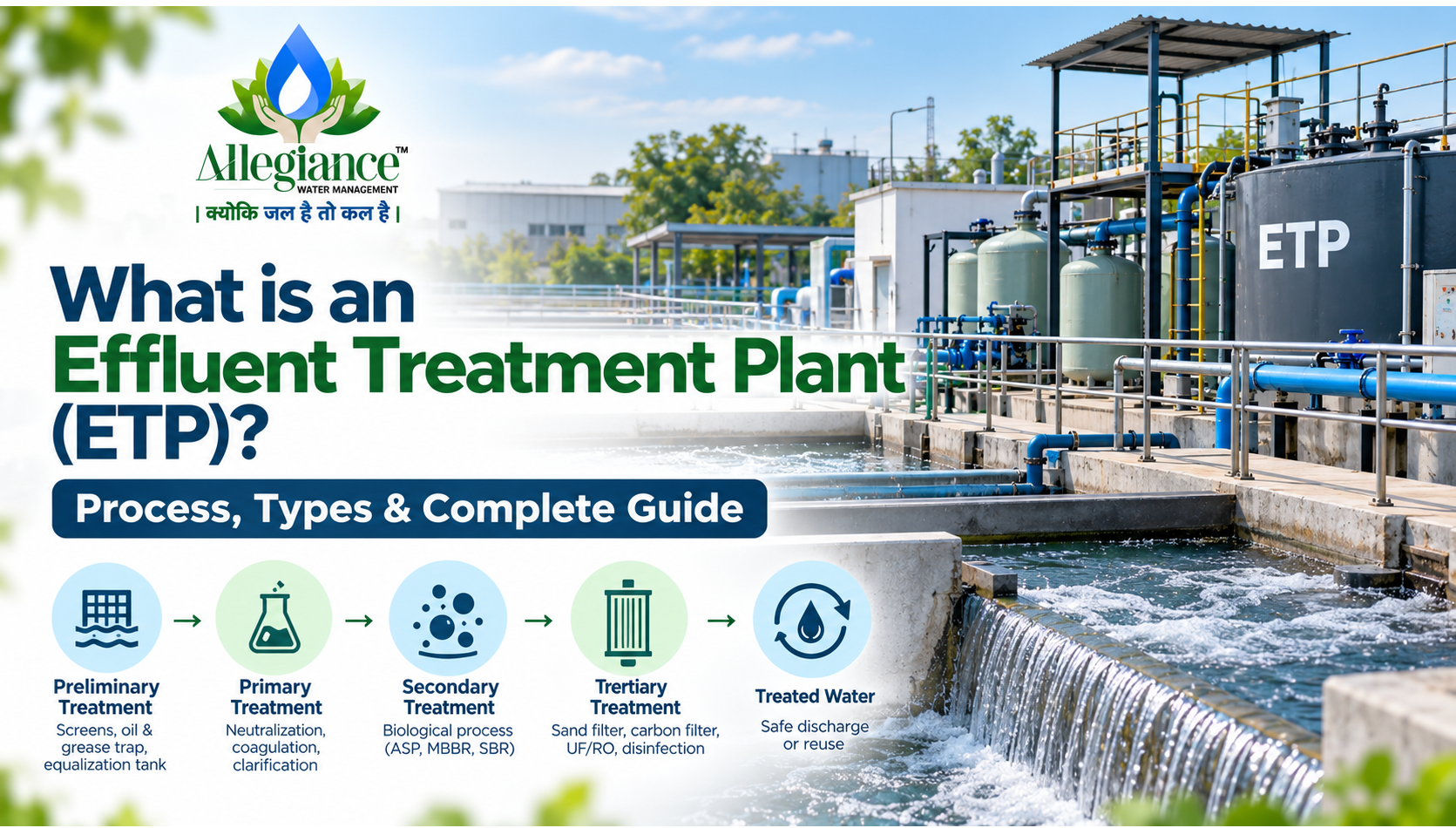
What is an Effluent Treatment Plant (ETP)? Complete Guide
By Allegiance Water Management, Vadodara
Almost every
factory produces wastewater. It might come from washing, dyeing, cooling,
chemical reactions, food processing or cleaning equipment. Left untreated, this
water can carry acids, oils, dyes, heavy metals and organic waste that harm
rivers, soil and groundwater. That is why industries need an effluent treatment
plant.
If you are
planning a new unit, upgrading an old ETP, or simply trying to understand what
your plant team keeps talking about, this guide explains what an ETP is, how it
works, the main types, and how to keep one running well.
What is ETP?
An effluent
treatment plant (ETP) is a system that treats industrial wastewater, called
effluent, so it can be safely discharged or reused. It removes harmful
pollutants through a series of physical, chemical and biological steps until
the water meets the standards set by the pollution control board.
In simple
terms, dirty process water goes in, and clean, compliant water comes out, along
with sludge that is handled separately.
Why Industrial Effluent Treatment Matters
•
Legal compliance: Industries need consent from
the State Pollution Control Board, such as GPCB in Gujarat, and must meet
discharge standards for parameters like pH, BOD, COD, suspended solids and oil
and grease.
•
Protecting the environment: Treated effluent
keeps rivers, farmland and groundwater safe for people and wildlife.
•
Saving water: Well-treated effluent can be
reused for gardening, washing, cooling and more, cutting fresh water demand.
•
Avoiding penalties: Non-compliance can lead to
fines, closure notices or loss of consent to operate.
•
Reputation: Buyers, auditors and communities
increasingly expect responsible wastewater handling.
ETP Plant Process: How an Effluent Treatment
Plant Works
Every ETP is
designed around the specific effluent it receives, but most follow these
stages:
1. Preliminary Treatment
This stage
removes the large and easy-to-separate material. Screens catch rags, plastics
and solids, oil and grease traps skim off floating oils, and an equalization
tank mixes the effluent so its flow and quality stay steady. Equalization is
often overlooked, but it protects every stage that follows.
2. Primary Treatment
Here, chemistry
does the work. The pH is corrected through neutralization, then coagulants and
flocculants are added so fine particles clump together into larger flocs. These
settle out in a primary clarifier or tube settler, removing a large share of suspended
solids.
3. Secondary (Biological) Treatment
Microorganisms
break down the dissolved organic matter that causes high BOD and COD. Common
technologies include the activated sludge process (ASP), moving bed biofilm
reactor (MBBR), sequential batch reactor (SBR) and extended aeration. After
treatment, a secondary clarifier separates the biomass from the clean water.
4. Tertiary Treatment
This is the
polishing stage. Pressure sand filters and activated carbon filters remove
remaining fine solids, colour and odour. Where reuse is planned,
ultrafiltration or an industrial RO plant can take the water to a much higher
quality. Disinfection completes the process.
5. Sludge Handling
The solids
removed along the way are thickened and dewatered using a filter press,
centrifuge or drying beds. Dewatered sludge is then disposed of as per
pollution control board rules, which often means sending it to an authorised
disposal facility.
ETP Process at a Glance
|
Stage |
Main Units |
What It Removes |
|
Preliminary |
Screens, oil and grease trap, equalization tank |
Large solids, oils, flow and load swings |
|
Primary |
Neutralization,
flash mixer, flocculator, clarifier |
Suspended
solids, pH imbalance |
|
Secondary |
Aeration tank (ASP, MBBR, SBR), secondary clarifier |
Dissolved organics, BOD and COD |
|
Tertiary |
Sand
filter, carbon filter, UF or RO, disinfection |
Fine
solids, colour, odour, dissolved salts |
|
Sludge |
Thickener, filter press or drying beds |
Separated solids for safe disposal |
Types of Effluent Treatment Plant
•
Physico-chemical ETP: Uses chemical dosing and
settling. Suited to effluent with inorganic pollutants, metals or colour.
•
Biological ETP: Relies on microorganisms. Ideal
for effluent rich in organic load, such as food, dairy and pharma.
•
Combined ETP: Physico-chemical and biological
stages together. The most common choice for mixed industrial effluent.
•
Packaged or modular ETP: Compact, prefabricated
units for smaller flows and limited space.
•
Common Effluent Treatment Plant (CETP): A shared
facility in an industrial estate that treats effluent from many small units.
ETP vs STP: What is the Difference?
|
Point |
ETP |
STP |
|
Treats |
Industrial process effluent |
Domestic sewage from toilets, kitchens and canteens |
|
Pollutants |
Chemicals,
metals, oils, dyes, high COD |
Mainly
organic matter and pathogens |
|
Design |
Customised to each industry's effluent |
More standard, based on population and flow |
|
Typical
sites |
Factories
and process industries |
Townships,
hotels, offices and factory colonies |
Many factories
need both: an ETP for process effluent and an STP for domestic sewage from
their staff areas.
How to Choose the Right ETP Plant for
Industries
•
Get your effluent tested for flow, pH, BOD, COD, TSS,
TDS, oil and grease and any specific pollutants.
•
Know your discharge norms or reuse goals before
finalising the design.
•
Plan for future expansion, not just today's flow.
•
Consider available space, power cost and the skill
level of your operators.
•
Install flow meters at the inlet and outlet so you can
track performance and support compliance reporting.
ETP Plant Maintenance Tips
•
Monitor pH, dissolved oxygen and sludge levels every
day.
•
Test treated water regularly against your consent
parameters.
•
Remove sludge on schedule so clarifiers and tanks don't
overload.
•
Service pumps, blowers, dosing systems and filters as
per their maintenance plans.
•
Keep simple logbooks of flows, chemical use and test
results. They make audits far easier.
Industrial Wastewater Treatment Plant
Solutions from Allegiance
Allegiance
Water Management offers water and wastewater treatment solutions for
industries, including effluent treatment plants (ETP), sewage treatment plants
(STP), industrial RO plants and water softeners. We back these up with
electromagnetic and open channel flow meters for effluent monitoring, rainwater
harvesting and groundwater recharge, and CGWA compliance support.
Since 2012, we
have completed more than 1,000 projects for clients including L&T, NTPC,
Polycab and Torrent Power. Looking for an ETP plant in Gujarat? We serve
Vadodara, Ahmedabad, Bharuch, Halol, Surat, Valsad and Vapi, as well as Daman,
Diu, Dadra and Nagar Haveli and Indore.
Frequently Asked Questions about Effluent
Treatment Plants
Is an ETP mandatory for every industry?
Any industry
that generates trade effluent needs to treat it to meet pollution control board
standards, either through its own ETP or, where allowed, a CETP. The exact
requirement is set in your consent conditions.
How much space does an ETP need?
It depends on
the flow and the technology. Modern options like MBBR and packaged units need
much less space than conventional systems.
Can treated ETP water be reused?
Yes. With
proper tertiary treatment, and RO where needed, treated effluent can be reused
for gardening, washing, cooling towers and some process needs.
Talk to Us About Your ETP
Whether you need a new effluent treatment plant, an upgrade or help
bringing an existing ETP back into compliance, our team can study your effluent
and suggest the right solution.
Allegiance
Water Management
A unit of Allegiance Enterprises
Phone: +91 9574198769
Email: info.allegianceindia@gmail.com
Website: www.allegianceindia.in
Address: 28 & 29, Aura Square, 3rd Floor, Panchvati
Circle, Gorwa Refinery Road, Panchvati, Vadodara, Gujarat 390016