
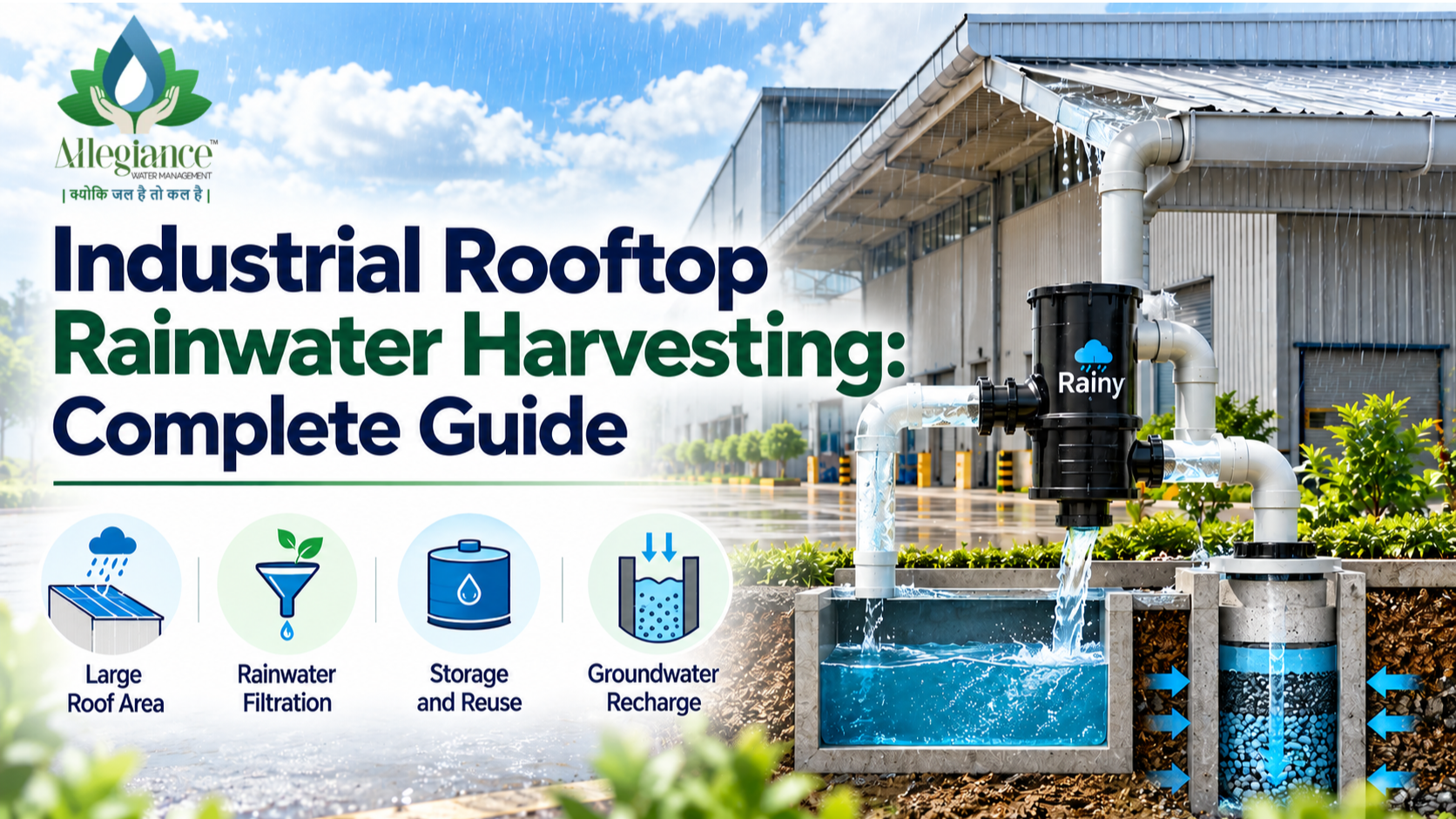
Industrial Rooftop Rainwater Harvesting: Complete Guide
By Allegiance Water Management, Vadodara
Walk around any
industrial estate in Gujarat during the monsoon and you will see the same
picture: huge sheds and warehouses with rain streaming off their roofs, down
the pipes and straight into the drain. That water is clean, it is free, and it
falls on roofs the company has already paid for.
Industrial
rooftop rainwater harvesting puts that water to work. This guide focuses on the
practical questions plant heads and project engineers ask most: what goes into
a system, which type suits your site, how big it should be, what affects the
cost, and which mistakes to avoid. For the design, installation and compliance
steps in detail, see our earlier guide on design, installation, maintenance and
compliance.
Why Industrial Roofs Are Perfect for
Rainwater Harvesting
•
Large area: A single factory shed can cover
thousands of square metres.
•
Smooth surfaces: Metal and concrete roofs shed
most of the rain that falls on them.
•
Relatively clean water: Roof water is far
cleaner than runoff from roads and yards.
•
Existing drainage: Gutters and downpipes are
usually already in place.
Components of a Rooftop Rainwater Harvesting
System
|
Component |
What It Does |
|
Roof catchment |
Collects rainfall; metal sheets and RCC slabs work best |
|
Gutters
and downpipes |
Carry
water off the roof to ground level |
|
Rainwater filter |
Removes leaves, dust and debris before storage or recharge |
|
Conveyance
pipeline |
Brings
water from many downpipes to a common point |
|
Silt trap or desilting chamber |
Lets fine particles settle out |
|
Storage
tank or sump |
Holds
water for reuse within the plant |
|
Recharge structure |
Sends surplus water into the aquifer |
|
Overflow |
Safely
diverts excess water during extreme rain |
For filtration,
we use self-cleaning Rainy filters with SS-304 food-grade 250 micron screens.
They work on gravity, need no power and give more than 90% filtration
efficiency. Models range from the FL-80 for roofs up to 120 m² to the FL-500
for roofs up to 500 m², so large industrial roofs simply use one filter per
downpipe or group of downpipes.
Types of Rainwater Harvesting for Industries
1. Storage and Reuse
Filtered water
is collected in an underground sump, above-ground tank or modular tank and used
for cooling tower make-up, gardening, washing and toilet flushing. This is the
best option where water is costly, or where recharge isn't allowed.
2. Groundwater Recharge
Filtered water
goes into the ground through recharge wells, V-wire injection wells, recharge
ponds or defunct borewells. This refills the aquifer your borewells draw from
and suits sites with suitable soil and enough depth to groundwater.
3. Hybrid Systems
Most industrial
plants do both: they fill a storage tank first and send the overflow to
recharge. This gives you usable water during the monsoon and groundwater
support for the rest of the year.
Note that
industries with a risk of groundwater contamination may be required to store
and reuse rooftop water rather than recharge it. Always check your CGWA NOC
conditions.
Rainwater Harvesting for Factory Sheds,
Warehouses and Office Blocks
•
Rainwater harvesting for factory shed roofs: Metal
sheet roofs have high runoff and need well-sized gutters, since water arrives
quickly in heavy showers.
•
Warehouse rainwater harvesting: Warehouses have
very large, clean roofs with little process dust, which makes them ideal
catchments for recharge.
•
Admin buildings and canteens: RCC roofs are easy
to connect to storage tanks for flushing and gardening nearby.
•
Roofs near process areas: Roofs exposed to dust,
chemicals or emissions may need extra filtration, or their water should be kept
for non-critical uses only.
Rainwater Harvesting Calculation: How Much
Can You Collect?
Harvestable water (m³) = Roof area (m²) x Annual rainfall
(m) x Runoff coefficient
|
Roof Area |
Approx. Annual Yield* |
Equivalent |
|
2,000 m² |
1,530 m³ |
About 15 lakh litres |
|
5,000
m² |
3,825
m³ |
About
38 lakh litres |
|
10,000 m² |
7,650 m³ |
About 76 lakh litres |
|
25,000
m² |
19,125
m³ |
About
1.9 crore litres |
*Based on about 900 mm annual
rainfall and a runoff coefficient of 0.85. Actual yield depends on local
rainfall and roof type.
Sizing a Rainwater Storage Tank for Industry
You don't need
to store the entire year's rain. A rainwater storage tank for industry is
usually sized to hold one or more heavy rainfall events, plus a few days of
your planned use. Anything beyond that goes to recharge. This keeps tank costs
reasonable while still capturing most of the useful water. Your daily
non-potable demand, available space and whether you will recharge the surplus
all shape the final size.
Rainwater Harvesting Cost Factors
Every site is
different, so costs vary. The main drivers are:
•
Total roof area and the number of downpipes
•
Length of the conveyance pipeline across the site
•
Storage volume and tank type
•
Number, type and depth of recharge structures
•
Soil and geology, which affect how easily water goes
into the ground
•
Monitoring instruments, such as flow meters and
piezometers, if needed for compliance
A site survey
is the quickest way to get an accurate figure, and a recharge-led design
usually costs less than storing large volumes.
Rainwater Harvesting Mistakes to Avoid
•
No filter or a cheap mesh filter: Debris chokes
recharge wells within a few seasons.
•
Undersized gutters and pipes: Water overflows
during heavy bursts, which is exactly when most rain falls.
•
Skipping the silt trap: Fine silt slowly seals
the soil and the well screen.
•
Mixing yard or process runoff with roof water: This
risks contaminating the aquifer.
•
No overflow arrangement: Excess water floods
pits and nearby areas.
•
Ignoring maintenance: Even a good system loses
efficiency without pre-monsoon cleaning.
•
Not checking the NOC: Building recharge where
storage is required, or vice versa, causes compliance problems.
Why Choose Allegiance as Your Rainwater
Harvesting Contractor in Gujarat?
•
More than 1,000 projects since 2012, for clients
including L&T, NTPC, Polycab, Torrent Power and Hitachi Hi-Rel.
•
Complete service: feasibility survey, geohydrological
study, design, installation, Rainy filters, recharge wells and maintenance.
•
CGWA NOC support, plus CGWA compliant flow meters and
DWLR piezometers.
•
Indian Green Building Council (IGBC) member.
•
Service across Vadodara, Ahmedabad, Bharuch, Halol,
Surat, Valsad, Vapi, Daman, Diu, Dadra and Nagar Haveli and Indore.
Let Your Roof Work for You
Share your roof area and site layout with us, and we'll suggest the
right mix of storage and recharge for your plant, ready before the next
monsoon.
Allegiance
Water Management
A unit of Allegiance Enterprises
Phone: +91 9574198769
Email: info.allegianceindia@gmail.com
Website: www.allegianceindia.in
Address: 28 & 29, Aura Square, 3rd Floor, Panchvati
Circle, Gorwa Refinery Road, Panchvati, Vadodara, Gujarat 390016