
Residential Rainwater Harvesting Benefits: Why Every Home
Should Save the Rain
By Allegiance Water Management, Vadodara
Every monsoon,
the same thing happens. Rain pours down on your terrace, gushes out of the
pipes, floods the lane outside, and disappears into the gutter. A few months
later, the borewell is struggling, the tanker is on speed dial, and the water
bill is climbing again.
Residential
rainwater harvesting breaks that cycle. It is a simple idea: catch the clean
rain that falls on your own roof, filter it, and either store it for use or
send it back into the ground to refill your borewell. Here are the real
benefits for your home, and how easy it is to get started.
How Much Rain Does Your Roof Actually
Collect?
More than most
people think. Here is a quick way to estimate it:
Roof area (m²) x Annual rainfall (m) x 0.85 = Water you
can harvest (m³)
For a typical
100 m² terrace in Vadodara, with roughly 900 mm of rain a year, that works out
to around 76,000 litres every monsoon. That is thousands of buckets of clean
water from a roof you already have.
Top Benefits of Rainwater Harvesting for
Home
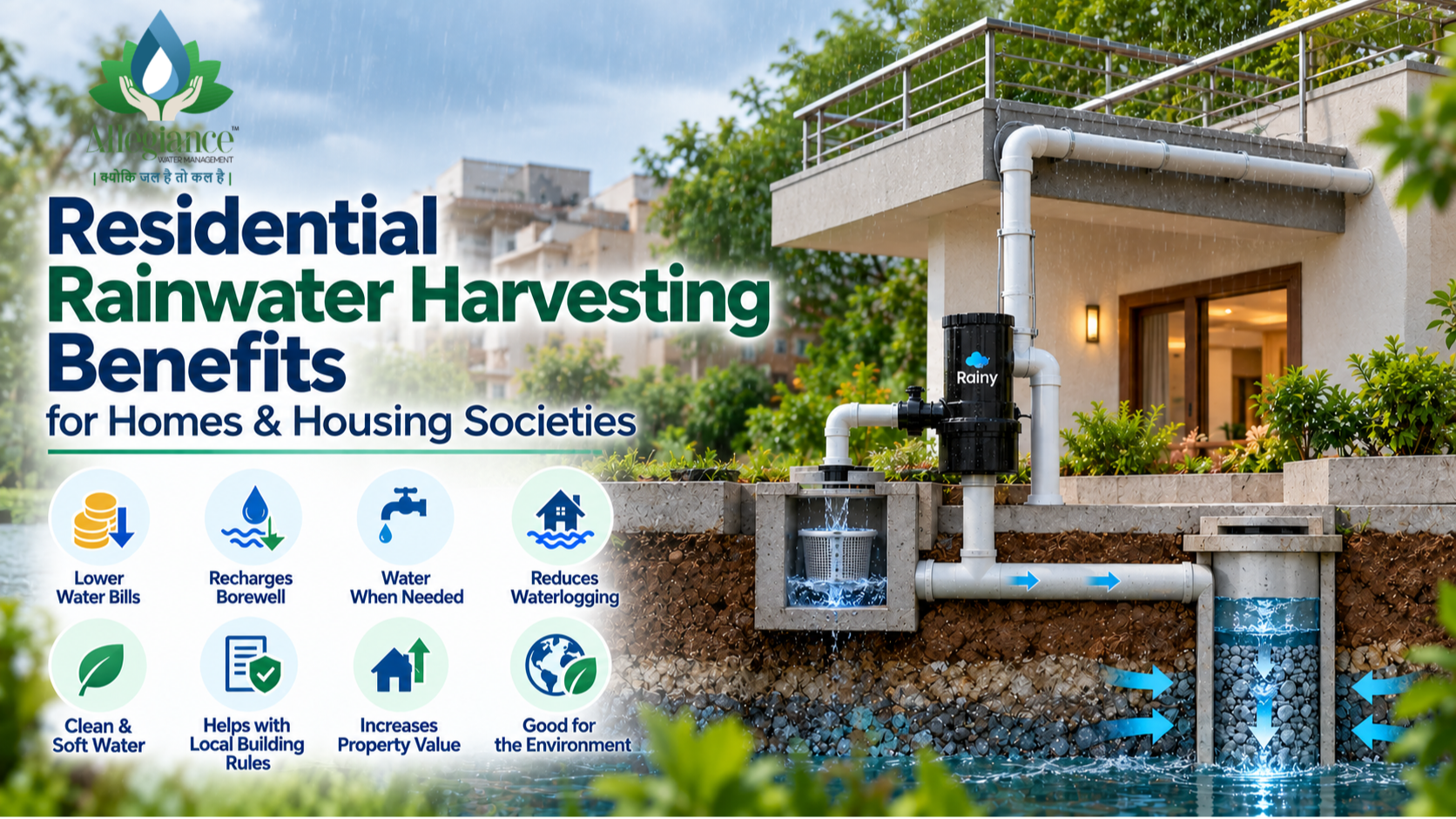
1. Lower Water Bills and Fewer Tankers
Stored
rainwater can be used for gardening, washing cars, cleaning floors and flushing
toilets. Every litre you use from the rain is a litre you don't pay for or wait
for from a tanker.
2. A Stronger Borewell Through Borewell
Recharge for Home
This is the
benefit most homeowners love. When filtered rainwater is sent into your
borewell or a recharge well, it helps refill the groundwater around it. Many
families notice better borewell performance in the summer after a few seasons
of recharge. Even an old, dry borewell can often be turned into a recharge
point.
3. Water When You Need It Most
Summer
shortages and supply cuts are stressful. A rainwater tank or a recharged
borewell gives your home a backup when municipal supply is low.
4. Less Waterlogging Around Your House
When roof water
goes into your system instead of the street, it reduces puddles, flooded
compounds and pressure on drains during heavy rain.
5. Soft, Clean Water for Daily Use
Rainwater is
naturally soft, so it is gentle on taps, geysers, washing machines and plants,
with less white scaling than hard borewell water.
6. Helps with Local Building Rules
Many cities in
Gujarat and across India require rainwater harvesting for new buildings above a
certain size. Installing a proper system keeps your home in line with local
rules, and is good to have when buying, selling or renovating.
7. Adds Value to Your Property
A home with a
reliable water source and a working recharge system is simply more attractive
to buyers and tenants, especially in water-stressed areas.
8. Doing Your Part for the Planet
Every home that
saves rain helps the whole neighbourhood. Together, recharged borewells can
lift groundwater levels for everyone around you.
Rooftop Rainwater Harvesting for House: Your
Options
Depending on
your space and needs, there are four common ways to use the rain:
•
Store it in an underground sump for reuse around
the house.
•
Recharge your borewell directly through its
casing pipe. This works well for smaller roofs of around 100 m² or less.
•
Recharge your borewell with V-wire technology for
larger roofs above about 100 m².
•
Refill an open well if you have one on your
property.
Our team checks
your roof, borewell and ground conditions and suggests the best option for you.
Why a Good Rainwater Filter for Home Matters
Roof water
carries leaves, dust and bird droppings. If it goes straight into your
borewell, it can choke it. A self-cleaning Rainy filter fits on your downpipe,
uses a stainless steel 250 micron screen, needs no electricity and cleans more
than 90% of the dirt automatically during every shower. The compact FL-80 model
suits roofs up to 120 m², which covers most homes and bungalows.
Rainwater Harvesting for Housing Society and
Apartments
Housing
societies have big terraces and shared borewells, which makes them ideal for
rainwater harvesting. A single well-planned system can:
•
Reduce the society's tanker bill every summer
•
Improve the yield of common borewells
•
Stop waterlogging in parking and common areas
•
Help meet municipal rainwater harvesting requirements
Larger roofs
are simply covered with multiple filters, and the water can be sent to one or
more recharge points.
Is It Hard to Maintain?
Not at all. A
rainwater harvesting system for a bungalow or society needs just a little
attention:
•
Clean the terrace and pipes before the monsoon.
•
Rinse the filter screen a couple of times a year.
•
Clear the silt chamber before and after the monsoon.
That is it. The
system does the rest, season after season.
Rainwater Harvesting in Vadodara and Across
Gujarat
Allegiance
Water Management has been helping homes, societies, schools and industries save
rainwater since 2012, with more than 1,000 projects completed. We handle
everything from the site visit and design to installation and maintenance, so
you don't have to worry about a thing.
We offer
rainwater harvesting in Vadodara, Ahmedabad, Bharuch, Halol, Surat, Valsad and
Vapi, along with Daman, Diu, Dadra and Nagar Haveli and Indore.
Make This Monsoon Count
The best time to install is before the rain starts. Call us or drop a
message with your roof size and borewell details, and we'll suggest the right
system for your home.
Allegiance
Water Management
A unit of Allegiance Enterprises
Phone: +91 9574198769
Email: info.allegianceindia@gmail.com
Website: www.allegianceindia.in
Address: 28 & 29, Aura Square, 3rd Floor, Panchvati
Circle, Gorwa Refinery Road, Panchvati, Vadodara, Gujarat 390016