
What is CGWA NOC? A Complete Guide for Industries
By Allegiance Water Management, Vadodara
If your factory
has a borewell, sooner or later someone will ask: "Do we have a CGWA
NOC?" It might be an auditor, a bank, a buyer, the pollution control board
or your own management. And if the answer is "not sure", it is worth
finding out quickly, because using groundwater without a valid NOC can lead to
penalties and environmental compensation.
This guide
explains in plain language what a CGWA NOC is, who needs one, who is exempt,
what documents you need, how the process works, and how to keep your NOC valid.
CGWA Full Form and What It Does
CGWA stands for
Central Ground Water Authority. It was set up under the Environment
(Protection) Act, 1986, to regulate and control the development and management
of groundwater in India. One of its main tools is the No Objection Certificate,
or NOC, which gives permission to extract groundwater.
What is CGWA NOC?
A CGWA NOC is
official permission to draw a fixed quantity of groundwater from specified
borewells or wells at your site. It states how much water you may extract per
day and per year, and lists the conditions you must follow, such as metering,
monitoring, rainwater harvesting and reporting.
Think of it as
a licence for your borewell: it allows you to use groundwater, but only within
the agreed limits and rules.
Who Needs a CGWA NOC?
In general,
these users need an NOC for groundwater extraction:
•
Industries, including new, existing and expansion
projects
•
Infrastructure projects and mining units
•
Commercial users such as hotels, hospitals, malls and
office complexes
•
Bulk water suppliers and packaged drinking water units
•
Urban group housing societies and apartments in certain
cases, such as where public supply is not enough
Some states and
union territories regulate groundwater through their own authorities. It is
always worth confirming which authority covers your district.
CGWA NOC Exemption: Who Does Not Need One?
Under the 2020
guidelines, the following categories are exempt from obtaining an NOC:
•
Individual domestic consumers in rural and urban areas,
for drinking and domestic use
•
Rural drinking water supply schemes
•
Agricultural activities
•
Armed forces and central armed police establishments
•
Micro and small enterprises drawing less than 10 cubic
metres (10,000 litres) of groundwater per day
Exemptions have
specific conditions, so check carefully before assuming your unit qualifies.
Understanding Area Categories
CGWB classifies
every assessment unit (usually a block or taluka) by how stressed its
groundwater is:
|
Category |
What It Means |
Impact on Your NOC |
|
Safe |
Groundwater use is well within recharge |
Lowest charges, easier approval |
|
Semi-critical |
Use is
getting close to recharge |
Moderate
charges |
|
Critical |
Use is very close to available recharge |
Higher charges, stricter scrutiny |
|
Over-exploited |
More
water is drawn than is recharged |
Highest
charges, strictest conditions |
Your category
affects your groundwater abstraction charges, the conditions you get and how
closely your application is examined.
CGWA NOC Documents Required
The exact list
depends on your category and project, but applications commonly need:
•
Site details with location coordinates and a site
layout plan
•
Land ownership or lease documents
•
Details of existing and proposed borewells, including
depth and pump capacity
•
Water requirement and water balance for the unit
•
Rainwater harvesting and recharge or storage plan
•
Hydrogeological report, especially for larger
abstraction or stressed areas
•
Pollution control board consent and other relevant
approvals
•
Groundwater quality report, where required
CGWA NOC Process: Step by Step
1.
Check whether you need an NOC or qualify for an
exemption.
2.
Find your assessment unit category: safe,
semi-critical, critical or over-exploited.
3.
Carry out a site survey and, where needed, a
hydrogeological study.
4.
Prepare the water balance, rainwater harvesting plan
and supporting documents.
5.
Submit the CGWA NOC online application through the
official CGWA NOC portal.
6.
Respond to any queries or site inspection from the
authority.
7.
Pay the applicable groundwater abstraction charges.
8.
Receive the NOC and start meeting its conditions within
the given timelines.
Common Conditions in a CGWA NOC
•
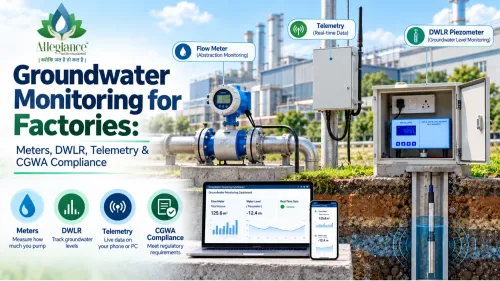
Tamper-proof digital flow meters with telemetry on
every abstraction borewell, calibrated regularly
•
Purpose-built piezometers, often with a digital water
level recorder (DWLR) and telemetry
•
Rooftop rainwater harvesting as per local building
bye-laws
•
Annual water audits for larger users
•
Yearly groundwater quality testing from an accredited
lab
•
Online compliance reports within the stated time
Groundwater Abstraction Charges
Industries pay
charges based on the volume of groundwater they are allowed to extract and the
category of their area. Charges rise from safe to over-exploited areas, so the
same quantity of water costs more where groundwater is already under stress.
Using less groundwater, through reuse and rainwater harvesting, can help you
apply for a lower approved quantity.
CGWA NOC Validity and Renewal
NOCs are issued
for a fixed period, generally ranging from two to five years depending on the
type of user and area. The exact dates are printed on your NOC. Renewal should
be applied for online well before expiry, typically at least 90 days in
advance. Drawing groundwater after the NOC expires is treated as a violation,
and environmental compensation can apply for the gap.
What Happens Without a Valid NOC?
•
Environmental compensation on the groundwater extracted
without permission
•
Penalties for not meeting NOC conditions, which can
range from Rs 50,000 to Rs 10 lakh
•
Possible sealing of borewells and problems with other
approvals and audits
CGWA NOC in Gujarat: How Allegiance Can Help
Allegiance
Water Management has supported industries with groundwater and water
conservation work since 2012, with more than 1,000 projects completed for
clients including L&T, NTPC, Polycab and Torrent Power. For CGWA NOC, we
offer:
•
CGWA clearance, NOC applications, renewals and
compliance support
•
Rainwater harvesting feasibility and geohydrological
surveys, topography and water audits
•
CGWA compliant flow meters with IoT telemetry and DWLR
piezometers
•
Rooftop rainwater harvesting, recharge wells and
borewell recharge
We serve
Vadodara, Ahmedabad, Bharuch, Halol, Surat, Valsad and Vapi, along with Daman,
Diu, Dadra and Nagar Haveli and Indore.
Frequently Asked Questions
What is the full form of CGWA?
Central Ground
Water Authority.
Is CGWA NOC mandatory for all industries?
Most industries
that extract groundwater need one. Micro and small enterprises drawing less
than 10 m³ a day are exempt, subject to conditions.
How long does it take to get a CGWA NOC?
It depends on
the completeness of your application, your area category and any queries
raised. A complete, well-prepared application moves much faster.
Can I apply if I am already using
groundwater?
Yes, existing
users should apply as soon as possible. Environmental compensation may apply
for past unauthorised use.
Get Your CGWA NOC Sorted
Whether you are applying for the first time, renewing or trying to meet
existing conditions, our team can review your site and guide you through every
step.
Allegiance
Water Management
A unit of Allegiance Enterprises
Phone: +91 9574198769
Email: info.allegianceindia@gmail.com
Website: www.allegianceindia.in
Address: 28 & 29, Aura Square, 3rd Floor, Panchvati
Circle, Gorwa Refinery Road, Panchvati, Vadodara, Gujarat 390016