
As water scarcity becomes a
growing concern for businesses across India, commercial rooftop rainwater
harvesting has emerged as one of the most practical and cost-effective
sustainability solutions. This guide explains how rooftop rainwater harvesting
works for commercial buildings, the technology involved, and why it should be
part of every facility's water management strategy.
What is Rooftop Rainwater Harvesting?
Rooftop rainwater harvesting is
the process of collecting rainwater from a building's roof and channeling it
through filters into storage, reuse systems, or groundwater recharge
structures. For commercial properties such as factories, offices, warehouses,
and institutional campuses, this system reduces dependency on municipal or
groundwater supply while supporting long-term water conservation.
How Commercial Rooftop Rainwater Harvesting Works
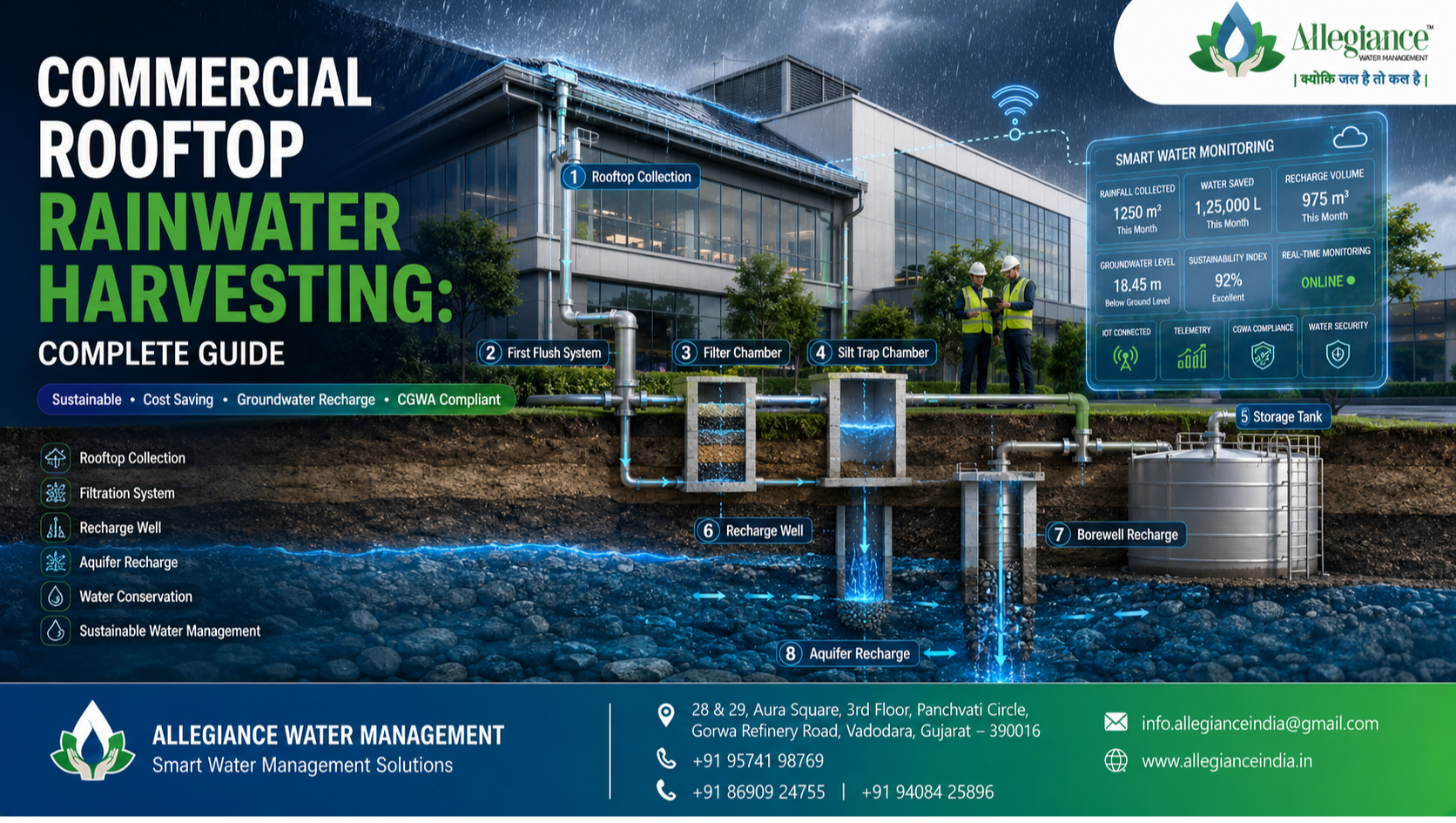
Rainwater falling on a
commercial rooftop is directed through downpipes into a rainwater filter, which
removes dirt, leaves, and debris before the water is used or recharged.
Depending on the site layout and roof area, commercial buildings typically use
one of the following applications:
•
Storing filtered rainwater in an underground sump for
reuse in flushing, gardening, or cooling systems
•
Recharging the borewell by connecting filtered water
directly to the casing pipe
•
Recharging the borewell through a V-wire technology system
when roof area exceeds 100 square metres
•
Recharging an open well with filtered rainwater
Since rainwater intake depends on roof characteristics and
borewell conditions, larger commercial rooftops often benefit from a dedicated
recharging well rather than direct borewell connection.
Key Technology in Commercial Rainwater Filters
Modern rooftop rainwater filters
used in commercial applications are designed for high-volume, low-maintenance
performance. Key highlights include:
•
Self-cleaning dual intensity filter for continuous
operation
•
High filtration efficiency, typically above 90 percent
•
Extremely versatile and compact design suitable for
varied roof layouts
•
SS-304 multi-surface, food-grade filter element
•
UV-treated high-density polyethylene filter housing
•
Gravity-powered operation with no electricity required
Commercial-grade filters are typically rated by roof area
coverage, ranging from around 120 square metres up to 500 square metres per
unit, with rainfall intensity handling of up to 75 mm per hour and discharge
capacities from 120 LPM to over 480 LPM depending on the model.
Groundwater Recharge for Large Commercial Sites
For larger commercial and
industrial properties, rooftop rainwater harvesting is often integrated with a
groundwater recharge system using a V-wire injection well and recharge pond.
Run-off water is diverted through a silt trap to remove sediment, then
percolated into the aquifer through layers of gravel, coarse sand, crushed
stone, and activated carbon. This scientific approach offers several
advantages:
•
Compact and modular design requiring minimal land
•
Low maintenance with no water clogging issues
•
Highest filtration performance before water reaches the
aquifer
•
Reusable space, allowing the area above the system to
serve other purposes
Benefits of Commercial Rooftop Rainwater Harvesting
•
Reduces dependency on municipal water supply and tanker
water costs
•
Supports CGWA compliance and green building
certifications such as IGBC
•
Recharges depleting aquifers around industrial and
commercial zones
•
Lowers long-term operational water costs for large
facilities
•
Improves sustainability credentials for corporate ESG reporting
Planning a Commercial Rainwater Harvesting System
A successful commercial rooftop
rainwater harvesting project typically begins with a rainwater harvesting
feasibility survey, followed by a geohydrological survey to assess soil and
aquifer conditions. Based on roof area, rainfall intensity, and site
topography, the right combination of filters, storage, and recharge wells can
be designed for maximum efficiency and long-term reliability.
Conclusion
Commercial rooftop rainwater
harvesting is a proven, low-maintenance solution for businesses looking to
reduce water costs, meet compliance requirements, and contribute to groundwater
sustainability. With the right filtration technology and recharge design, any
commercial building can turn its rooftop into a valuable water resource.