

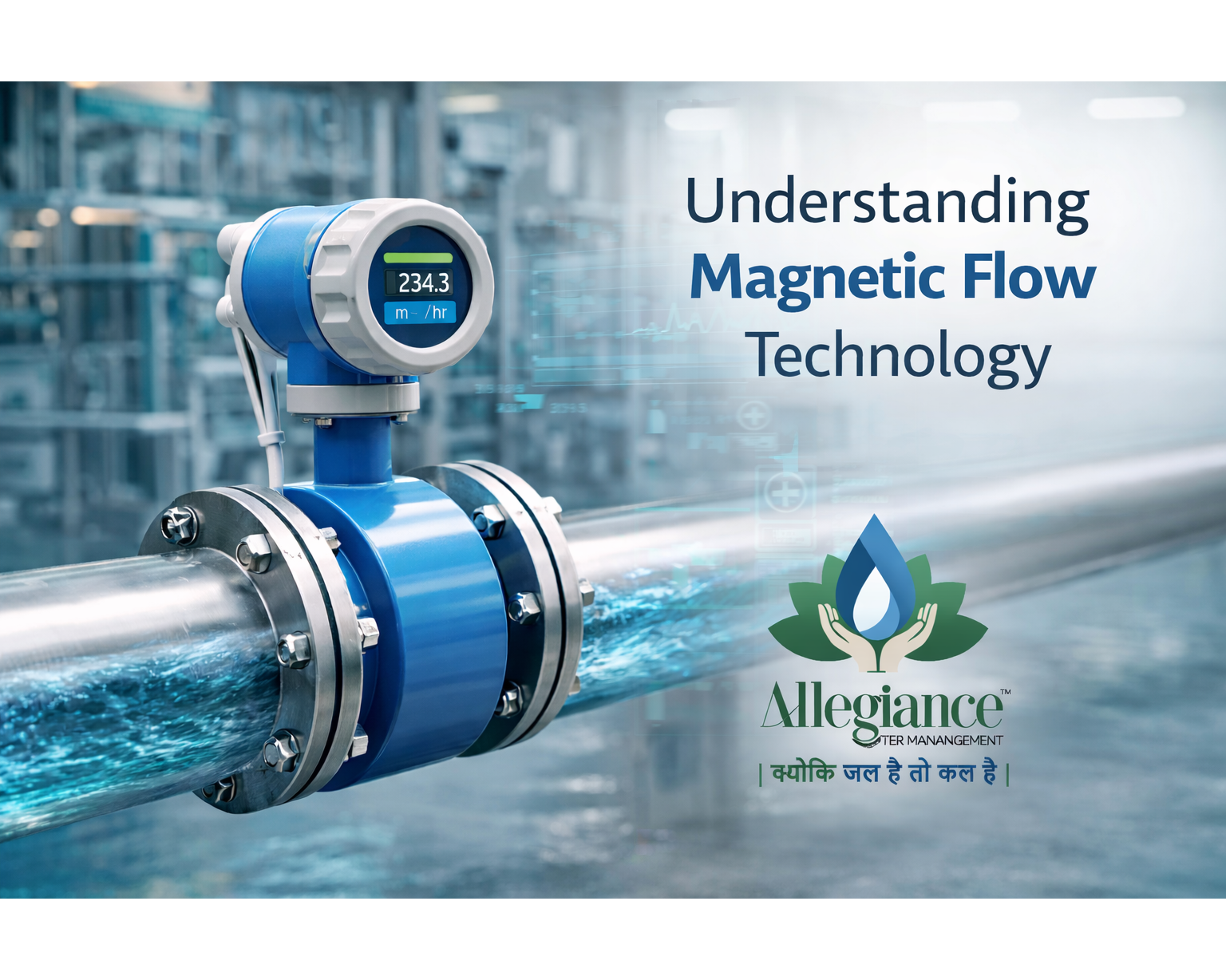
How Does an Electromagnetic Flow Meter Work?
Electromagnetic Flow Meters (EMF), also known as Magnetic Flow Meters, are highly accurate instruments used to measure the flow of electrically conductive liquids. Widely applied in water supply systems, wastewater treatment plants, industrial utilities, chemical processing, food and beverage production, and irrigation networks, these meters provide reliable performance with minimal maintenance.
At Allegiance Water Management, electromagnetic flow meters play a key role in scientifically designed water monitoring solutions, enabling precise data collection, operational efficiency, and sustainable resource management. Unlike mechanical meters, EMFs have no moving parts, create no pressure loss, and perform effectively even with dirty, corrosive, or slurry-based fluids.
Working Principle
Electromagnetic flow meters operate based on Faraday’s Law of Electromagnetic Induction. When a conductive liquid passes through a magnetic field generated inside the flow tube, a voltage is induced. This voltage is proportional to the velocity of the liquid and is detected by electrodes positioned within the meter. The transmitter processes this signal and converts it into a volumetric flow rate.
Key Components
The main components of an electromagnetic flow meter include electromagnetic coils that generate the magnetic field, a lined flow tube for smooth fluid passage, electrodes to detect induced voltage, a transmitter for signal processing, and optional grounding rings for improved measurement stability.
Step-by-Step Operation
The coils create a stable magnetic field across the pipe diameter. As conductive liquid flows through the field, an electrical voltage is generated. Electrodes sense this voltage and transmit it to the electronic unit, where the signal is filtered and converted into readable flow data. The final output can be displayed locally or transmitted to automation systems such as PLC, SCADA, or IoT platforms.
Applications
Electromagnetic flow meters are extensively used in water and wastewater monitoring, chemical and pharmaceutical processes, food and beverage production, and agricultural irrigation systems. Their ability to handle difficult fluids makes them ideal for modern industrial environments.
Advantages
These meters offer high accuracy, low maintenance, zero pressure drop, and long operational life. Their non-intrusive design ensures energy efficiency and consistent performance in demanding applications.
Conclusion
Electromagnetic flow meters are a smart choice for modern water and industrial systems. Their robust design and reliable measurement capabilities support efficient operations and sustainable water management. Allegiance Water Management provides high-performance magnetic flow meter solutions tailored for municipal, industrial, and infrastructure projects.
Learn more at: https://allegianceindia.in/
FAQs:
1. What liquids can electromagnetic flow meters measure?
They measure electrically conductive liquids such as water, wastewater, chemicals, slurries, and beverages.
2. Do electromagnetic flow meters cause pressure loss?
No. Their full-bore design ensures zero pressure drop during operation.
3. Why are electromagnetic flow meters highly accurate?
They directly measure flow velocity using electromagnetic induction, reducing mechanical errors.
4. Are electromagnetic flow meters suitable for dirty or corrosive fluids?
Yes. They perform reliably even with abrasive or contaminated liquids.
5. Where are electromagnetic flow meters commonly used?
They are widely used in water treatment plants, industrial utilities, chemical processing, irrigation systems, and food and beverage industries.