
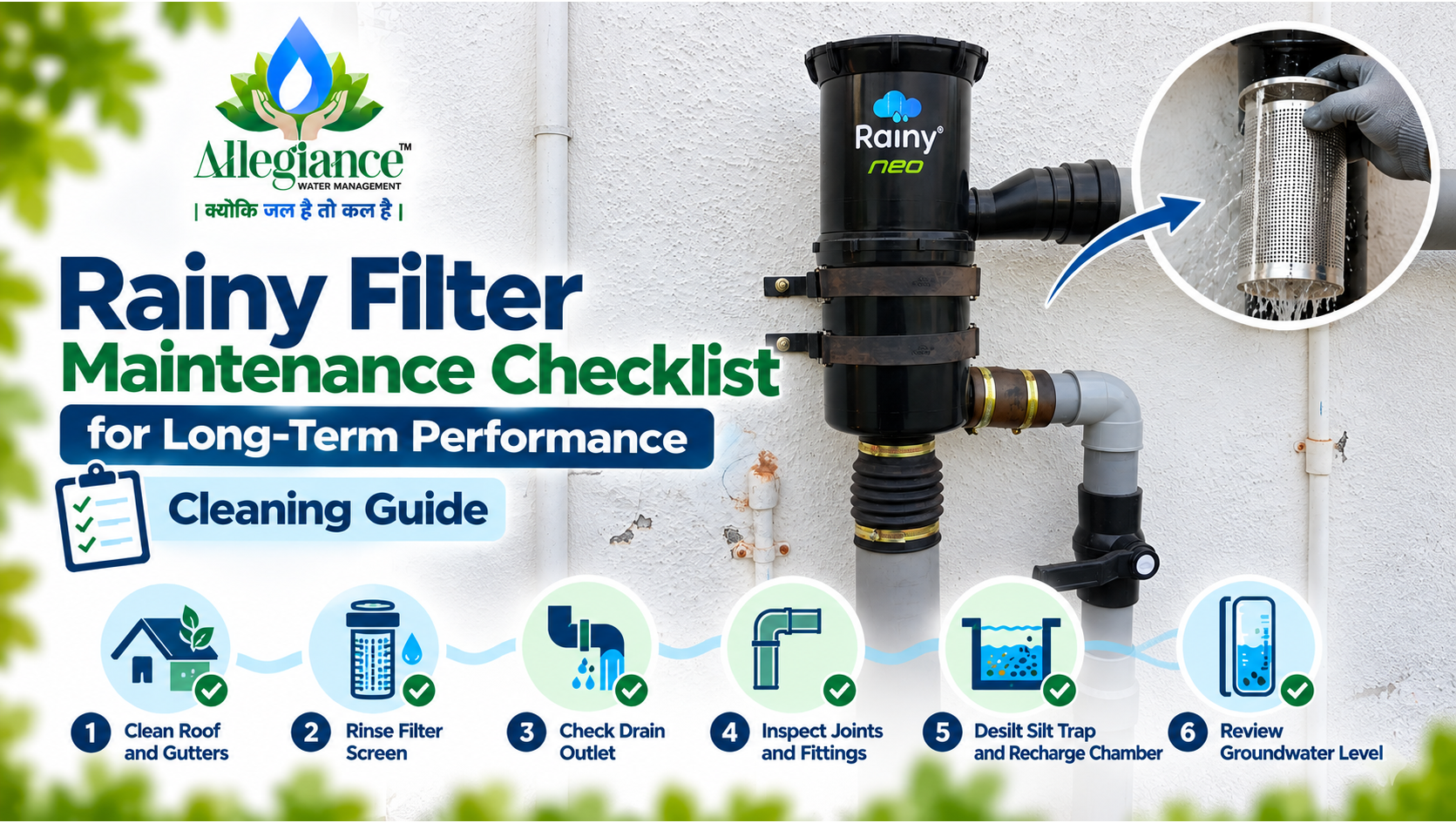
Rainy Filter Maintenance Checklist for Long-Term Performance
By Allegiance Water Management, Vadodara
A Rainy filter
is built to look after itself. Its self-cleaning design washes away leaves and
dust with every shower, so it needs far less care than an ordinary mesh filter.
But less care is not no care. A roof full of dry leaves, a blocked drain outlet
or a loose joint can quietly cut the amount of water reaching your borewell or
recharge well.
The good news
is that keeping a Rainy filter in top shape takes only a few minutes at the
right times of year. If you are new to the product, start with our post on how
Rainy filters work. Otherwise, here is the simple checklist we follow on our
own maintenance visits.
Why Rainy Filter Maintenance Matters
•
More water reaches the ground: A clean screen
passes more water, so less overflows into the drain.
•
Protects your borewell: Good filtration keeps
silt out of your recharge structure, which is very hard to clean once dirty.
•
Longer filter life: Regular checks catch small
issues like loose fittings before they become costly.
•
Steady efficiency: The filter is designed to
deliver above 90% efficiency, and regular care helps it stay there year after
year.
Pre-Monsoon Rainwater Harvesting Maintenance (April to May)
This is the
most important visit of the year. Do it before the first rain, because the
first shower carries the most dirt.
1.
Clean the roof: sweep away dry leaves, dust, bird
droppings and any loose material.
2.
Clear gutters and downpipes so water flows freely into
the filter.
3.
Open the filter as per the manual and rinse the
stainless steel screen with clean water.
4.
Use only a soft brush on the screen, never a wire brush
or harsh chemicals.
5.
Check that the drain outlet is open and its pipe leads
safely to the storm drain.
6.
Inspect the inlet, clean water outlet and all pipe
joints for cracks or leaks.
7.
Make sure the filter is firmly mounted and the housing
is not damaged.
8.
Check the silt trap and recharge chamber, and desilt if
needed.
Rainy Filter Cleaning During the Monsoon
•
After the first heavy shower, check the screen and
drain outlet for trapped leaves or plastic.
•
After storms or strong winds, look for debris blown
onto the roof and clear it.
•
Once a month, take a quick look at the filter while it
rains. Clean water should come out of the clean water outlet, and debris should
leave through the drain.
•
If water is overflowing from the top or skipping the
filter, inspect it straight away.
Post-Monsoon Rainwater Filter Cleaning (October to November)
•
Give the screen a thorough rinse to remove fine silt
left over from the season.
•
Desilt the silt trap and inspect the filter media in
the recharge well.
•
Note how your borewell water level has changed. A
piezometer or DWLR makes this easy and shows whether recharge is working.
•
Cover open drain points if needed so insects or debris
don't collect over the dry months.
Quick Rainwater Harvesting Maintenance Checklist
|
Task |
When |
Who |
|
Clean roof and gutters |
Before monsoon, then monthly in season |
Site team |
|
Rinse
filter screen |
Before
and after monsoon, after heavy storms |
Site
team |
|
Check drain outlet is clear |
Every inspection |
Site team |
|
Inspect
joints, fittings and mounting |
Before
monsoon |
Site
team or service provider |
|
Desilt silt trap and recharge chamber |
Before and after monsoon |
Service provider |
|
Check
filter media in recharge well |
Once a
year |
Service
provider |
|
Review groundwater level data |
After monsoon |
Plant or EHS team |
Common Rainwater Filter Problems and Simple Fixes
Water is overflowing instead of passing through
Usually the
screen is covered with fine silt or leaves. Rinse it with clean water. If it
happens often, check whether the roof area draining into the filter is larger
than the model is rated for. For example, the FL-80 suits roofs up to 120 m²,
while the FL-500 handles up to 500 m².
Very little clean water is coming out
Check for
blockage in the downpipe before the filter, and make sure the filter has enough
gravity head, a little over one foot, to work properly.
Leakage at joints
Tighten or
reseal the fittings. Cracked pipes should be replaced before the monsoon.
Borewell recharge has slowed down
This is often a
recharge structure issue rather than a filter issue. Silt may have built up in
the recharge chamber or filter media. Borewell recharge maintenance by a
specialist team can restore the flow.
Dos and Don'ts for Rainy Filter Cleaning
•
Do use clean water and a soft brush.
•
Do follow the manufacturer's manual when opening
the filter.
•
Do keep the area around the filter clear so it
is easy to inspect.
•
Don't use wire brushes, acids or strong
detergents on the screen.
•
Don't block or cap the drain outlet, as the
filter needs it to self-clean.
•
Don't connect extra roof area to a filter
without checking its capacity.
Rainwater Harvesting AMC: Let Us Handle It
Busy plant and
facility teams often don't have time to track filters, silt traps and recharge
wells across a large site. Our rainwater harvesting AMC (annual maintenance
contract) covers scheduled pre-monsoon and post-monsoon visits, filter
cleaning, desilting, inspection of the full recharge system and a short report
after every visit.
Allegiance
Water Management has been designing, installing and maintaining rainwater
harvesting systems since 2012, with more than 1,000 projects completed. We
provide rainwater harvesting service in Vadodara, Ahmedabad, Bharuch, Halol,
Surat, Valsad and Vapi, as well as Daman, Diu, Dadra and Nagar Haveli and
Indore.
Book Your Pre-Monsoon Maintenance Visit
Don't wait for
the first rain to find out your filter is choked. Get in touch to book a
maintenance visit or ask about an AMC for your site.
Allegiance Water Management
A unit of Allegiance Enterprises
Phone: +91 9574198769
Email: info.allegianceindia@gmail.com
Website: www.allegianceindia.in
Address: 28 & 29, Aura Square, 3rd
Floor, Panchvati Circle, Gorwa Refinery Road, Panchvati, Vadodara, Gujarat
390016