
How Borewell Recharge Supports CGWA Compliance
By Allegiance Water Management, Vadodara
For many
industries, CGWA compliance feels like a list of boxes to tick: get the NOC,
install the meters, upload the data, renew on time. But behind every one of
those boxes is a simple question the authority is really asking: are you taking
care of the groundwater you depend on?
Borewell
recharge is one of the clearest ways to answer that question with a yes. It
puts rainwater back into the aquifer, shows up in your monitoring data, and
supports several NOC conditions at once. Here is how it works, and where it
fits in your wider CGWA compliance plan.
A Quick Look at CGWA Compliance for
Industries
Industries that
draw groundwater need a No Objection Certificate (NOC) from the Central Ground
Water Authority. The NOC sets how much water you can extract and lists
conditions you must follow. While every NOC is site-specific, common CGWA NOC
conditions include:
•
Tamper-proof digital flow meters with telemetry on
abstraction borewells
•
Purpose-built piezometers, often with a digital water
level recorder (DWLR), and regular data upload
•
Rooftop rainwater harvesting as per local building
bye-laws
•
Annual water audits for larger users, with targets to
reduce groundwater use
•
Yearly groundwater quality testing and online
compliance reports
•
Payment of groundwater abstraction charges
Rainwater
harvesting and recharge touch more of these conditions than most people
realise.
CGWA Rainwater Harvesting Requirement: Where
Borewell Recharge Fits
Rooftop
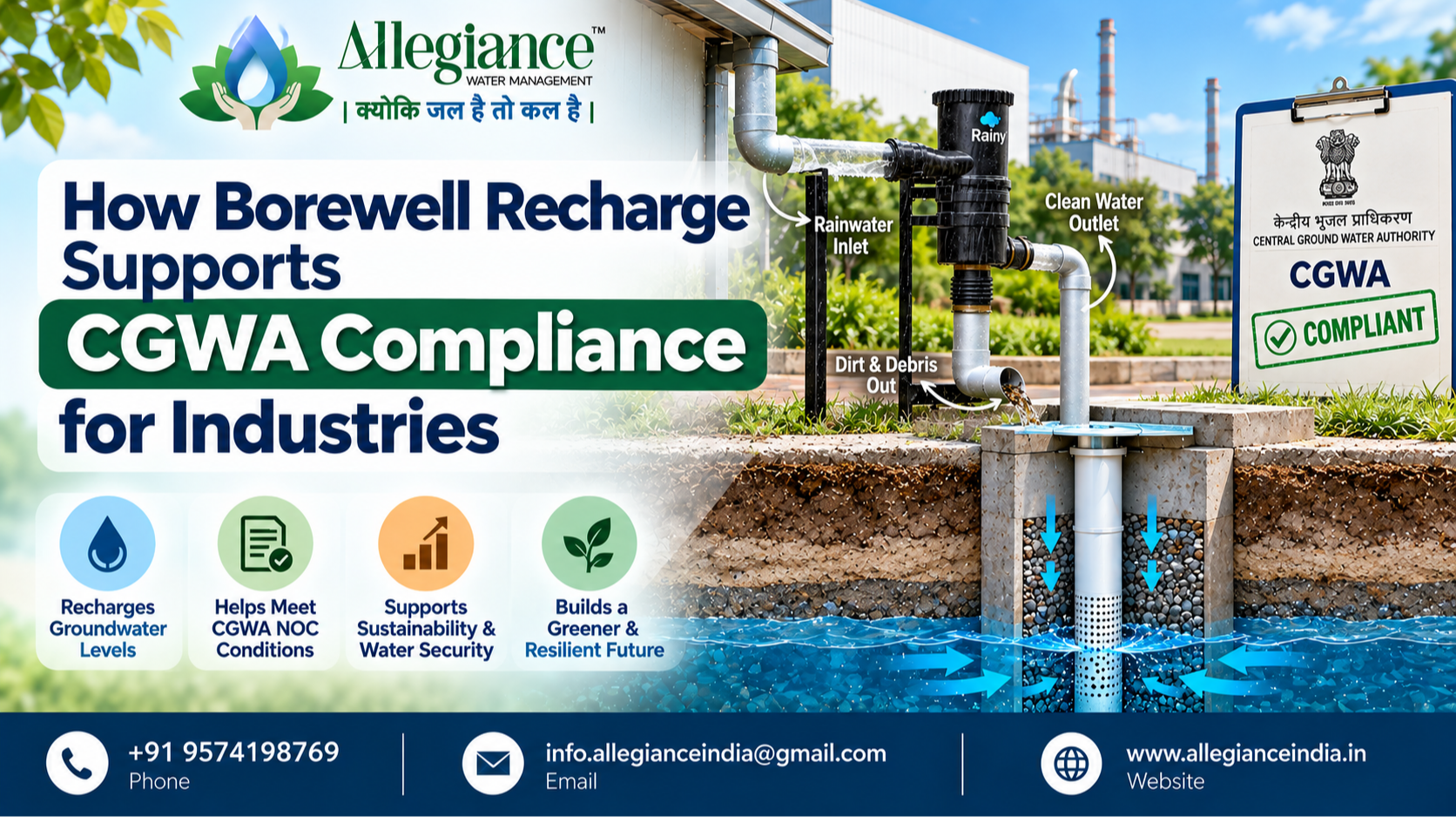
rainwater harvesting is a standard condition in industrial NOCs. Rooftop water
can be stored for reuse or sent underground through artificial recharge of
groundwater. For sites with an existing defunct or low-yield borewell, borewell
recharge is often the most practical way to do this: the bore is already
drilled, it reaches the water-bearing layers, and it needs very little land.
Other
groundwater recharge structures, such as recharge wells, V-wire injection wells
and recharge ponds, can be used alongside or instead of borewell recharge,
depending on soil, depth to water and available space.
How Borewell Recharge Supports CGWA
Compliance
1. Meets the Rooftop Rainwater Harvesting
Condition
A properly
designed system collects roof runoff, filters it and sends it into the aquifer,
giving you a working rainwater harvesting structure that you can show during
inspections and record in compliance reports.
2. Improves What Your Piezometer Shows
Your piezometer
data goes to the CGWA portal. When recharge is working, you can often see
groundwater levels respond after the monsoon. That is real, measurable evidence
that your site is putting water back, not just taking it out.
3. Supports Water Audit and Reduction Goals
Water audits
look at where your water comes from and how efficiently you use it. Harvested
and recharged rainwater shows up as a positive step in your water balance, and
alongside reuse and conservation it helps you move towards reduction targets.
4. Protects Your Own Borewells
Recharge near
your abstraction borewells can help support local water levels, keeping your
approved supply more reliable through dry seasons.
5. Makes Renewals Smoother
At renewal
time, a site with working rainwater harvesting, clean monitoring data and
documented recharge simply presents a stronger compliance record than one with
gaps.
What Borewell Recharge Does and Does Not Do
It is important
to be clear about the limits, so there are no surprises:
|
Borewell recharge does |
Borewell recharge does not |
|
Help meet the rooftop rainwater harvesting condition |
Replace the need for a CGWA NOC |
|
Add
measurable water to the aquifer |
Remove
groundwater abstraction charges |
|
Support better piezometer and audit results |
Replace flow meters, piezometers or reports |
|
Strengthen
your record at renewal |
Allow
you to draw more than your approved quantity |
Important: Not Every Industry Can Recharge
CGWA takes
groundwater contamination very seriously. Industries that carry a risk of
polluting groundwater may not be permitted to recharge inside their premises,
and are instead expected to store and reuse rooftop water. Even where recharge
is allowed, only clean rooftop runoff should go into a borewell. Never sewage,
effluent or oily yard water. Always check the exact wording in your NOC before
designing a system.
Designing Borewell Recharge for Industries
the Right Way
1.
Review your NOC conditions and local bye-laws.
2.
Survey the site, the roof catchment and the condition
of existing borewells.
3.
Calculate recharge potential from roof area and
rainfall.
4.
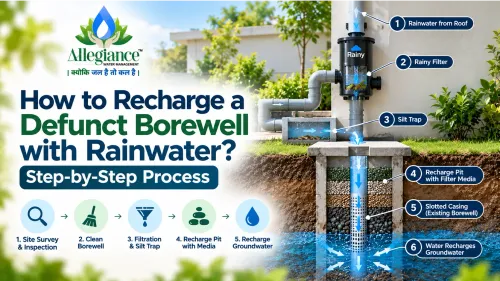
Install self-cleaning Rainy filters and a silt trap so
only clean water reaches the bore.
5.
Build a recharge pit with slotted casing and graded
filter media around the borewell.
6.
Add an overflow, a safe cover slab and inspection
access.
7.
Link the system to your piezometer and flow meter
monitoring so the results are on record.
For a detailed
walkthrough of the construction, see our step-by-step recharge process guide.
Keep Your Recharge Well for Factory Use in
Good Shape
•
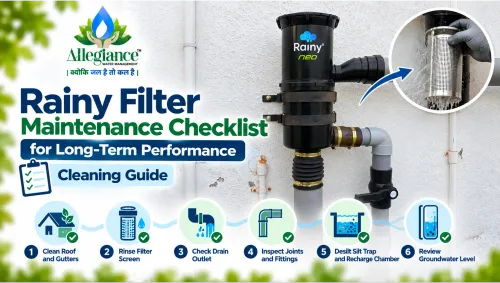
Clean roofs, gutters and filters before the monsoon.
•
Desilt the silt trap before and after every monsoon.
•
Check the top filter layer of the recharge pit every
year.
•
Keep maintenance records, photos and piezometer data
together for compliance reporting.
Groundwater Sustainability for Industries
Starts Here
Compliance is
the minimum. The bigger goal is groundwater sustainability for industries:
making sure your plant has water for decades, not just for the next NOC cycle.
Borewell recharge, together with water reuse, efficient use and good
monitoring, is one of the most practical steps in that direction.
Why Choose Allegiance as Your Borewell
Recharge Contractor in Gujarat?
•
More than 1,000 projects since 2012, including aquifer
rejuvenation through defunct borewells, V-wire injection wells and recharge
ponds.
•
One team for CGWA NOC, geohydrological surveys,
recharge design, Rainy filters, flow meters, DWLR piezometers and maintenance.
•
Trusted by industries including L&T, NTPC, Polycab
and Torrent Power.
•
Service across Vadodara, Ahmedabad, Bharuch, Halol,
Surat, Valsad, Vapi, Daman, Diu, Dadra and Nagar Haveli and Indore.
Make Your Borewell Part of Your Compliance
Plan
Share your NOC and site details with us, and we'll check whether
borewell recharge is allowed and suitable for your site, and design a system
that supports your CGWA compliance from day one.
Allegiance
Water Management
A unit of Allegiance Enterprises
Phone: +91 9574198769
Email: info.allegianceindia@gmail.com
Website: www.allegianceindia.in
Address: 28 & 29, Aura Square, 3rd Floor, Panchvati
Circle, Gorwa Refinery Road, Panchvati, Vadodara, Gujarat 390016