

Understanding exactly how a
Rainy filter works helps homeowners, facility managers, and industries
choose and maintain rainwater harvesting systems with confidence. A Rainy
filter is a self-cleaning rooftop rainwater filter that separates clean water
from dirt and debris using nothing but gravity. This guide breaks down its
working process step by step.
What is a Rainy Filter?
A Rainy filter is a compact,
open-ended, non-clog rooftop rainwater filter installed inline with a
building's downpipe. It captures rainwater as it flows off the roof and
separates usable, filtered water from dirt, leaves, and debris before the water
reaches storage, reuse points, or groundwater recharge structures.
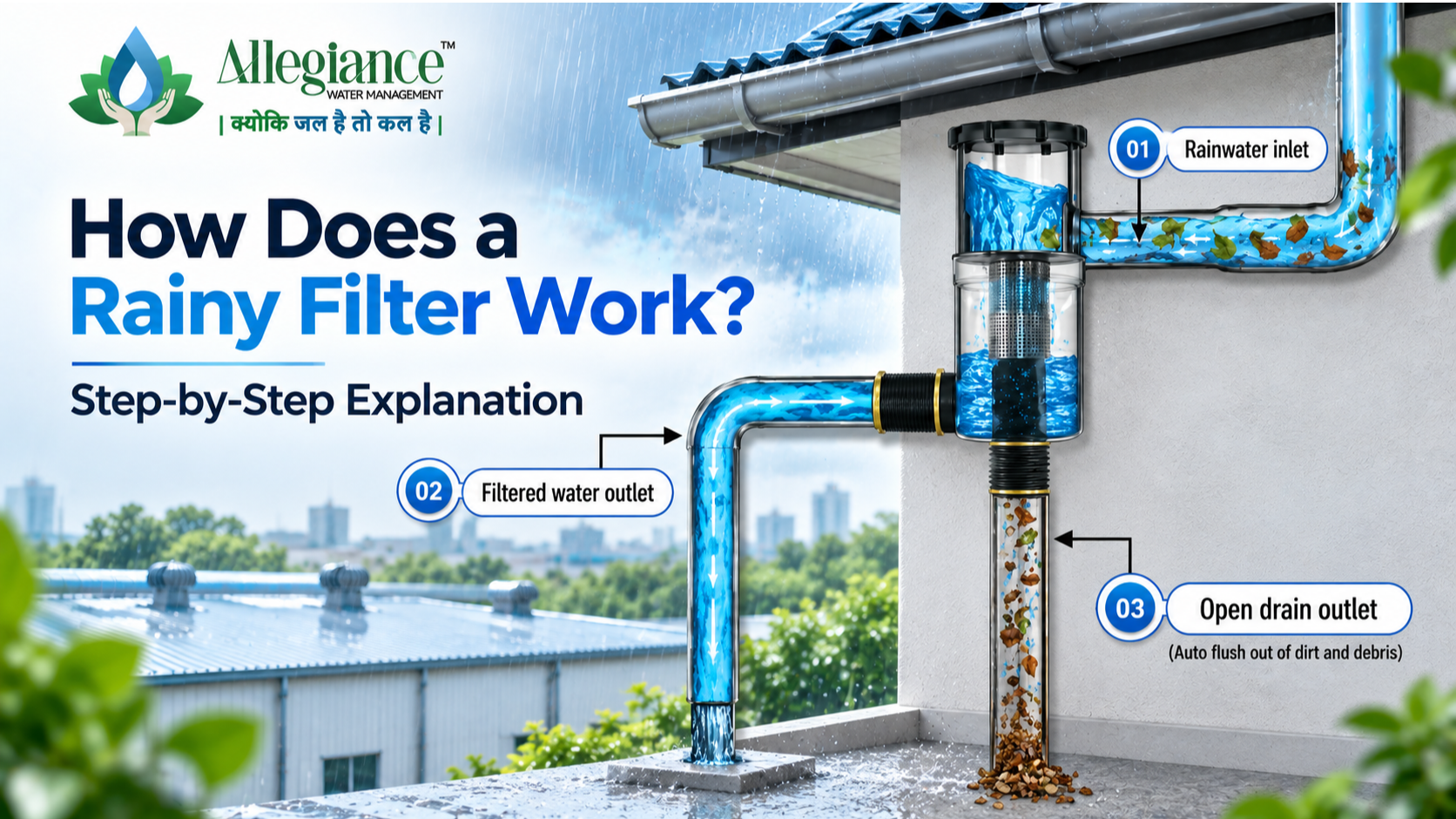
Step 1: Rainwater Enters Through the Inlet
The process begins when
rainwater flowing off the rooftop enters the filter through its inlet
connection, which links directly to the building's downpipe. No pump or
external power is needed at this stage, since the filter relies entirely on the
natural flow of water under gravity.
Step 2: Cohesive and Centrifugal Force Separate Debris
Inside the filter housing,
incoming water passes over an SS-304 multi-surface, food-grade filter element
with a 250-micron mesh size. As water moves through this element, cohesive
force and centrifugal force work together to separate fine particles, dirt, and
organic debris from the clean water, without the mesh becoming blocked over
time.
Step 3: Filtered Water Exits Through the Clean Water Outlet
Once separated, the clean,
filtered water exits through the Clean Water Outlet (CWO), ready to be directed
toward its intended use, whether that is storage in an underground sump, direct
recharge into a borewell casing pipe, or delivery to a recharge well through
V-wire technology for larger roof areas.
Step 4: Dirt and Debris Flush Out Automatically
At the same time, the separated
dirt, leaves, and debris continue moving through the filter housing and exit
through the open drain outlet. This self-cleaning action happens continuously
during rainfall, which is what allows the filter to keep operating without
manual cleaning between rain events.
Step 5: The Cycle Repeats With Every Rainfall
This four-part cycle, inlet,
filtration, clean water discharge, and debris flush, repeats automatically
every time it rains, requiring a minimum operating pressure of just over 1 foot
of gravity head to function. Because the design is open-ended and non-clog, the
filter continues performing at above 90 percent filtration efficiency under
standard operating conditions, season after season.
Why This Design Works So Well
•
No electricity or moving mechanical parts required
•
Self-cleaning action prevents clogging even during
heavy rainfall
•
UV-treated, high-density polyethylene housing
withstands long-term outdoor exposure
•
Compact and easy to install on existing downpipes
•
Versatile enough for residential, commercial, and
industrial roof areas
Matching the Filter to Your Roof
Rainy filters are available in
multiple models to match different roof sizes, covering areas from around 120
square metres up to 500 square metres per unit, with discharge capacities
ranging from 120 LPM to over 480 LPM. Selecting the right model ensures the
filter processes the expected rainfall intensity, up to 75 mm per hour, without
overflow or reduced filtration performance.
Conclusion
A Rainy filter works through a
simple but effective sequence: water enters, debris and clean water separate
through cohesive and centrifugal force, filtered water exits for use or
recharge, and waste flushes out automatically. This gravity-powered, self-cleaning
process is what makes it one of the most reliable components in any rainwater
harvesting system.
Contact Us
Phone: 9574198769
Email: info.allegianceindia@gmail.com
Website: www.allegianceindia.in