
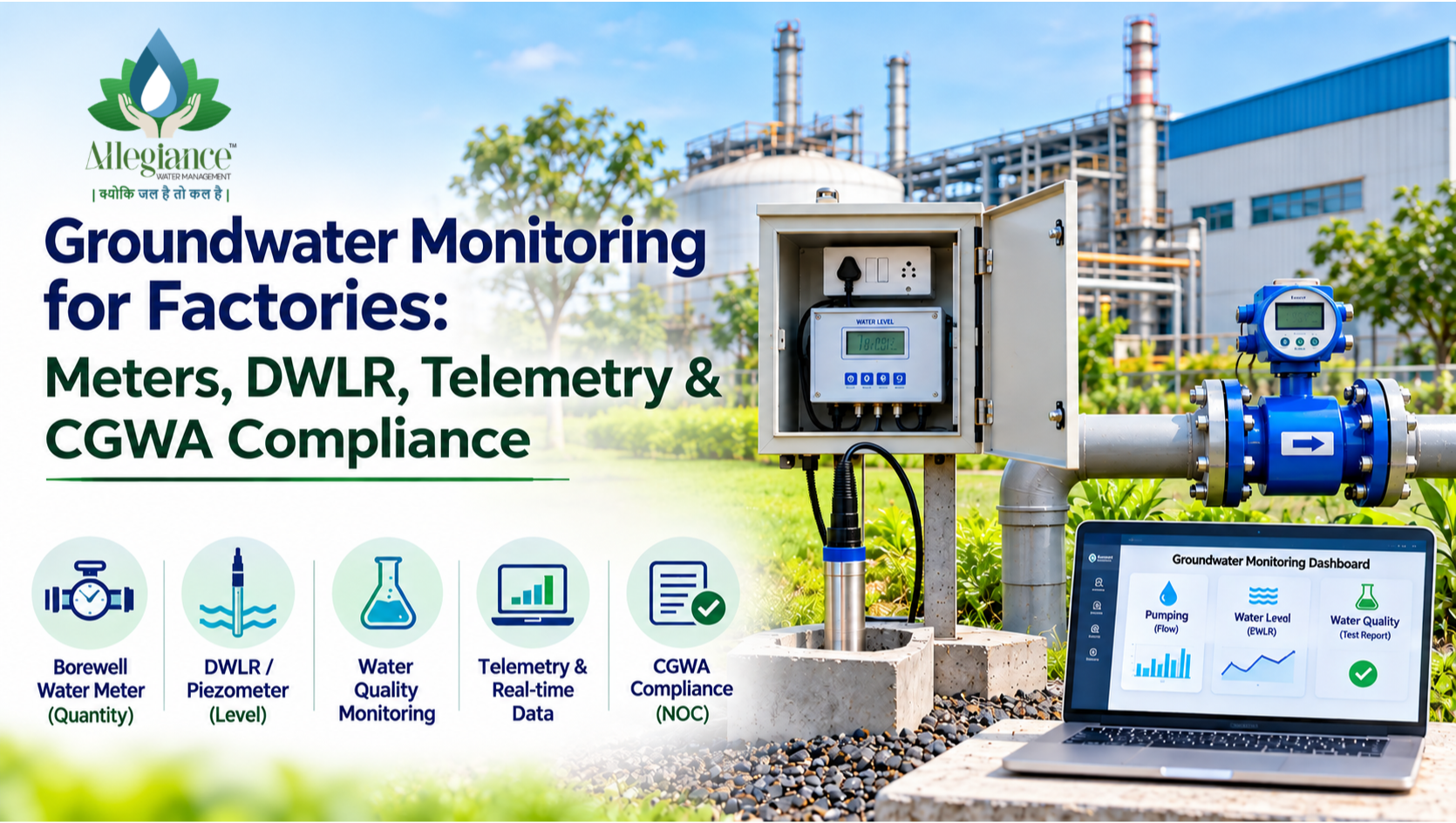
Groundwater Monitoring for Factories: A Practical Guide
By Allegiance Water Management, Vadodara
Ask a factory
manager how much power the plant used last month and you will get an exact
number within minutes. Ask how much groundwater it pumped, or whether the water
table under the site is rising or falling, and the room often goes quiet.
That gap is
becoming expensive. Borewells are going deeper, CGWA wants hard data, and water
shortages can stop production as surely as a power cut. Groundwater monitoring
for factories closes that gap by measuring three things: how much you pump,
what is happening to the water level, and how good the water is. Here is how to
set it up properly.
Why Industrial Groundwater Monitoring
Matters
•
Water security: Spot a falling water table
early, before a borewell fails in the middle of summer.
•
Compliance: CGWA NOCs for industries come with
clear monitoring and reporting conditions.
•
Cost control: Accurate abstraction data helps
you find waste, plan pumping and keep within your approved limit.
•
Asset protection: Knowing water levels protects
pumps from running dry and helps plan borewell maintenance.
•
Proof of good practice: Data shows auditors,
buyers and ESG reviewers that you manage water responsibly.
The Three Pillars of a Groundwater
Monitoring System
1. Quantity: Borewell Water Meter for
Factory Use
The first
question is always how much water you are drawing. A tamper-proof digital flow
meter on every abstraction borewell records instant flow and total volume.
Electromagnetic flow meters are a popular choice because they have no moving
parts, stay accurate (plus or minus 0.5% of full scale) and offer 4-20 mA,
pulse and RS485 Modbus outputs for telemetry. Battery-operated versions suit
remote borewells with no power supply.
2. Level: Groundwater Level Monitoring for
Industries
The second
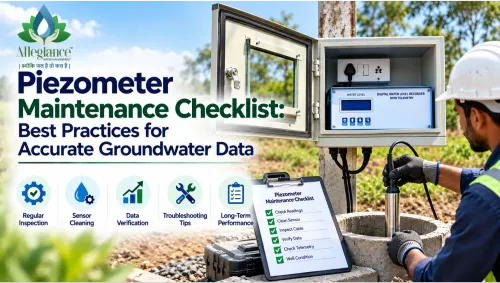
question is what your pumping is doing to the aquifer. A purpose-built
piezometer, which is a dedicated observation well that is never pumped, fitted
with a digital water level recorder (DWLR) tracks groundwater levels
automatically. Our DWLR uses a waterproof stainless steel pressure sensor with
a range of up to 400 metres, stores up to 32 GB of data, and can export
readings to Excel or the cloud. A manual water level indicator is handy for
cross-checks.
3. Quality: Groundwater Quality Monitoring
The third
question is whether the water is still safe and suitable for your use. Regular
sampling and lab testing track parameters such as pH, TDS, hardness, chlorides,
nitrates and, near industrial areas, heavy metals. CGWA NOCs commonly require
testing at least once a year from an accredited lab, with samples typically
taken before the monsoon.
Groundwater Telemetry System: Bringing It
All Together
Meters and
loggers are only useful if someone looks at the data. A groundwater telemetry
system sends readings from every flow meter and DWLR to the cloud through GSM
or IoT devices. That means:
•
Live and historical data on your phone or PC, without
visiting each borewell
•
Alerts for unusual pumping, sudden level drops or
device faults
•
Ready-made daily and monthly reports for audits and
CGWA submissions
•
One dashboard for multiple borewells, or even multiple
plants
CGWA Monitoring Requirements at a Glance
Every NOC is
site-specific, but these monitoring conditions appear in many industrial NOCs:
|
What to Monitor |
Typical Requirement |
Instrument |
|
Groundwater abstraction |
Tamper-proof digital flow meter with telemetry on every
abstraction structure |
Electromagnetic or ultrasonic flow meter with IoT
telemetry |
|
Groundwater
level |
Purpose-built
piezometer with data uploaded to the CGWA portal |
DWLR
with telemetry, plus manual piezometer |
|
Groundwater quality |
Annual testing from an accredited lab |
Sampling from borewell, lab analysis |
|
Water
use efficiency |
Annual
water audit for larger users |
Flow
meter data across the plant |
Always check
the exact conditions and timelines written in your own NOC.
How to Set Up Groundwater Monitoring for
Your Factory
1.
List every borewell on site and note which are used for
pumping.
2.
Read your NOC conditions, or plan for them if you are
applying.
3.
Choose the right flow meter for each borewell based on
pipe size and power availability.
4.
Construct a purpose-built piezometer away from pumping
influence and fit a DWLR.
5.
Connect meters and loggers to a telemetry system and
set up alerts.
6.
Schedule water quality sampling with an accredited lab.
7.
Review the data every month, not just at renewal time.
Turning Groundwater Data into Decisions
Good monitoring
pays off when you use what it tells you:
•
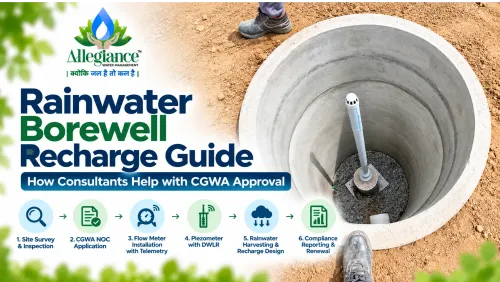
Falling levels? Plan rainwater harvesting and
borewell recharge to put water back.
•
Pumping close to your limit? Look at reuse from
your STP or ETP and fix leaks found in the water audit.
•
Quality changing? Investigate nearby sources and
adjust treatment, such as softeners or RO.
•
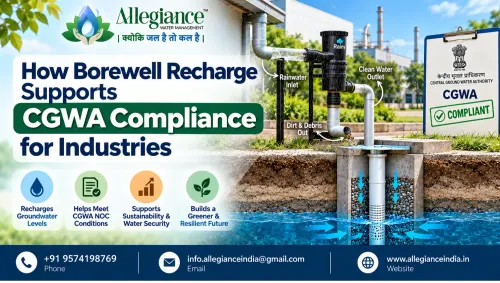
Levels rising after the monsoon? That is
evidence that your recharge system is working.
Why Choose Allegiance as Your Groundwater
Monitoring Company in Gujarat?
•
A complete monitoring range: electromagnetic,
ultrasonic, battery-operated and other flow meters, IoT telemetry devices, DWLR
piezometers and manual water level indicators.
•
One team for monitoring, CGWA NOC support,
geohydrological surveys, water audits, rainwater harvesting and recharge.
•
More than 1,000 projects since 2012, for clients
including L&T, NTPC, Polycab and Torrent Power.
•
Service across Vadodara, Ahmedabad, Bharuch, Halol,
Surat, Valsad, Vapi, Daman, Diu, Dadra and Nagar Haveli and Indore, with
instrument supply across India.
Start Monitoring What Lies Beneath Your
Factory
Whether you need to meet CGWA conditions or simply want to protect your
water supply, we can design a groundwater monitoring system that fits your site
and budget. Get in touch with our team today.
Allegiance
Water Management
A unit of Allegiance Enterprises
Phone: +91 9574198769
Email: info.allegianceindia@gmail.com
Website: www.allegianceindia.in
Address: 28 & 29, Aura Square, 3rd Floor, Panchvati
Circle, Gorwa Refinery Road, Panchvati, Vadodara, Gujarat 390016