Thank you for writing to us. One of our executive will reach back to you through your submitted medium. In case there’s an urgency, feel free to connect over WhatsApp for faster response.
Prefer calling? Dial +9108048074381 (International callers) or 08048074381 (Indian callers).
Geophysical survey for Rainwater Harvesting, a number of years of experience and technical knowledge we are able to provide you the most suitable locations to drill a Borewell on your site. By using technically advanced equipment like Resistivity meters & Electromagnetic (EM) VLF instruments we provide high quality service with excellent execution.
Before any Rainwater Harvesting System construction is done, we help you in identifying the nature of Soil Structure & what is the actual Depth to recharge Rainwater.
“Injection well “
New & Innovative Technology for Rainwater Harvesting System
Products that are precisely coordinated, scientifically designed all-in-one Rainwater Harvesting solutions and dedicated service.
'Allegiance Water Management ' also undertakes turnkey projects in corporate sector/ industries/ government undertaking etc. and is capable of handling large projects right from Rain Water Harvesting design, supply and installation to providing end- to-end solutions. 'Allegiance' is equipped with a dedicated and experienced team of engineers, technician, workmen along with special installation equipment's, drilling rigs, civil structures etc.
Highly trained technical team conducts the Rainwater Harvesting technical survey by studying the layout of the site and building.
Existing piping system of rainwater and storm drains are studied.
Gradient and landscape of the site and building are obtained.
Designing and installation of innovative customized system is done with precise scientific approach. These solutions include: diverting existing rainwater pipes, deployment of underground storage, auto pumping system, piping, filtering, storage, utilization etc.
Designing and construction of ground water recharging structures.
Complete solutions for water neutrality establishment projects.
Roof Top Rain Water Harvesting
What is Roof Top Rain Water Harvesting?
Rooftop Rain Water Harvesting is the technique through which rain water is captured from the roof catchments and stored in reservoirs. Harvested rain water can be stored in sub-surface ground water reservoir by adopting artificial recharge techniques to meet the household needs through storage in tanks.
The Main Objective of rooftop rain water harvesting is to make water available for future use. Capturing and storing rain water for use is particularly important in dryland, hilly, urban and coastal areas. In alluvial areas energy saving for 1m.
rise in ground water level is around 0.40 kilo watt per hour.
Need for Rooftop Rain Water Harvesting
1. To meet the ever increasing demand for water
2. To reduce the runoff which chokes storm drains
3. To avoid flooding of roads
4. To augment the ground water storage and control decline of water levels
5. To reduce ground water pollution
6. To improve the quality of ground water
7. To reduce the soil erosion
8. To supplement domestic water requirement during summer, drought etc.
Advantages of Rain Water Harvesting
1. Provides self-sufficiency to your water supply
2. Reduces the cost for pumping of ground water
3. Provides high quality water, soft and low in minerals
4. Improves the quality of ground water through dilution when recharged to ground water
5. Reduces soil erosion in urban areas
6. The rooftop rain water harvesting is less expensive
7. Rainwater harvesting systems are simple which can be adopted by individuals
8. Rooftop rain water harvesting systems are easy to construct, operate and maintain
9. In hilly terrains, rain water harvesting is preferred
10. In saline or coastal areas, rain water provides good quality water and when recharged to ground water, it reduces salinity and also helps in maintaining balance between the fresh-saline water interface
11. In Islands, due to limited extent of fresh water aquifers, rain water harvesting is the most preferred source of water for domestic use
12. In desert, where rain fall is low, rain water harvesting has been providing relief to people
Water Conservation, Ground Water Rejuvenation and Development via Rainwater Management and Harvesting Rainwater through Ponds and Borewell Recharging Structures to Support Increasing Demand of Water for Daily usage for Domestic, Industrial and Agricultural purposes. Water Conservation and Harvesting Structures in Naturally Water Scarce Regions creates Geo-Hydrological Opportunity and Economic Viability. Ponds recharging structure, farm pond, stop Dam, and small pond etc. It is seen that different Geographical Location and unique Geophysical and Hydrological Nature and every situation needs to be addressed, separately, the groundwater recharge capacity of the varies regions may vary depending upon area specific geophysical nature of earth strata. Recharge Wells provide an opportunity to extract sub-surface flow of the region without exploiting the Groundwater reserve.
Rainwater Harvesting Filters. FL 100 (Rooftop Area upto 1200 Sq. Ft)
The characteristic features of FL Series Dual Intensity RWH Filter is its capacity to take up the load up to 10 to 110 square meters of Roof area with variable intensity of rainfall of 5 to 75 mm/ hour with a discharge capacity of 10 to 105 Liters per minute. This filter can be conveniently used for Harvesting Rainwater for Individual households, Schools, and Smaller Roof area Buildings.
• Item Code: FL-100
Suitable up to area: 110 SQMTRS
Max: Intensity of Rainfall: 75 mm/hr
Working Principle : Cohesive Force & Centrifugal force
Operating Pressure: Less than 2 feet of head (0.060kg/cm2)
Capacity: 105 LPM
Filter Element: SS-304 Screen
Mesh Size: 250 Microns
Inlet: 90 MM
Clean Water Outlet: 63 MM
Drain Outlet: 90 MM
Housing: High Density Polyethylene
Efficiency of Filter: Above 90%
Source of Power: Gravity
Digital Water Level Recorder (DWLR) which can be used in piezometer wells as well as tubewells for measurement of water level data. Non-contact devices in Water level measurement are the next generation products in the water sector. Statometer uses an indigenously designed patented signal processing algorithms of acoustic waves for accurate measurements.
Ideal solution for
*Real-time measurement of fluctuations in water table
*Central Ground Water Board(CGWB) NOC compliances
*Determining efficiency of rain water harvesting systems
*Planning crops and drought forecasting in agriculture
Data communications GPRS/GSM
Data visualization - Graphs & list view of data collected
- Analytical tools for trend analysis
- Location of wells on Google maps
User configurable features - Roles and accessibility
- Frequency setup*
- Remote triggering*
Data download options - CSV and xlsx format
- Reports
Percolation Pit is also like Rainwater Harvesting System
A percolation pit, in its most low-tech form, is a simple hole dug into the ground. It facilitates groundwater recharge through infiltration of surface runoff into the soil or rock. Differences to contour trenches: Better water storage capability due to greater depth.
Percolation tank is an artificially created surface water body, submerging in its reservoir a highly permeable land so that surface runoff is made to percolate and recharge the ground water storage. The percolation tanks are mostly earthen dams with masonry structure only for spillway.
Percolation tank is an artificially created surface water body, submerging in its reservoir a highly permeable land so that surface runoff is made to percolate and recharge the ground water storage.
Percolation tank should be constructed preferable on second to third order streams, located on highly fractured and weathered rocks which have lateral continuity down stream.
The recharged area down stream should have sufficient number of wells and cultivable land to benefit from the augmented ground water.
The size of percolation tank should be governed by percolation capacity of strata in the tank bed. Normally percolation tanks are designed for storage capacity of 0.1 to 0.5 MCM. It is necessary to design the tank to provide a ponded water column generally between 3 & 4.5 m.
The percolation tanks are mostly earthen dams with masonry structure only for spillway. The purpose of the percolation tank is to recharge the ground water storage and hence seepage below the seat of the bed is permissible. for dams upto 4.5 m. height, cut off trenches are not necessary and keying and benching between the dam seat and the natural ground is sufficient.
Digital water flow meter as per CGWA Compliance ELECTROMAGNETIC FLOW METER
Digital Flow Meter With Telemetry As Per CGWA Guidelines
Installation of Digital Water Flow Meter on Ground water abstraction structures
Whereas the Central Government constituted the Central Ground Water Authority
(hereinafter referred to as the Authority) vide notification Number S.O. 38(E), dated 14th
January, 1997, followed by notification number S.O. 1124(E) dated 6th November, 2000
and S.O. 1121 (E) dated 13th May, 2010 of the Government of India in the Ministry of
Environment & Forests, for the purposes of regulation and control of ground water
development and management in the whole of India and to issue necessary regulatory
directions.
And whereas the Authority has issued ‘Guidelines to control and regulate ground water
extraction in India’ vide notification number 3289(E) dated 24th September, 2020, wherein
under Section 9 (i) “Installation of digital water flow meter (conforming to BIS/ IS standards)
having telemetry system in the abstraction structure(s) shall be mandatory for all users
seeking No Objection Certificate and intimation regarding their installation shall be
communicated to the CGWA within 30 days of grant of No Objection Certificate through the
web-portal.”
THIS IS TO BRING TO THE NOTICE OF ALL GROUND WATER USERS THAT:
All the project proponents/users drawing ground water and seeking/having NOC
shall have to mandatorily install tamper-proof digital water flow meters with telemetry
on all the ground water abstraction structures within their premises.
All the Micro and Small Enterprises drawing less than 10 cum/day shall also be
mandatorily required to install digital water flow meters on all the ground water
abstraction structures within their premises. Such enterprises shall be subjected to
randomised inspections.
The afore-mentioned conditions need to be strictly followed by all the users and any
ground water withdrawal without the installation of tamper-proof digital water
flow meters and telemetry (wherever applicable) shall be construed as illegal.
Non-compliance of these conditions shall invite a Penalty provision and/or
Environmental Compensation against the proponent for illegal withdrawal of ground
water as per the CGWA Guidelines and may result in cancellation/rejection of NOC
and sealing of ground water abstraction structures.
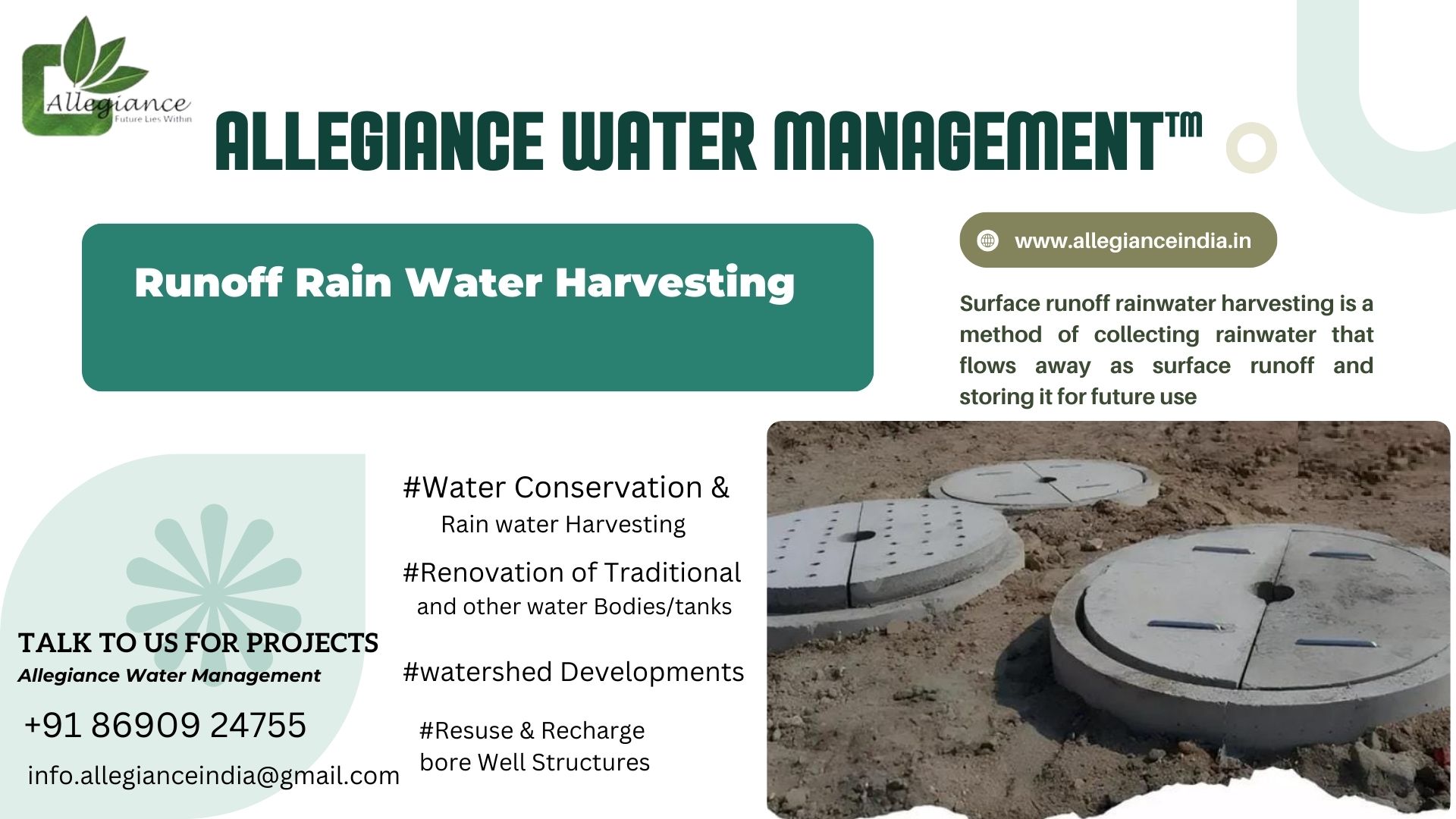
Percolation well is Known as Rain Water Harvesting System
It is a shallow excavated trench filled with gravel or crushed stone that is designed to infiltrate stormwater though permeable soils into the groundwater aquifer. A percolation trench is similar to a dry well, which is typically an excavated hole filled with gravel.
we are engaged to offer the best Percolating Well Service. The provided service is executed using the progressive techniques under the supervision of our brilliant professionals. Offered service is highly demanded among our clients, owing to their various associated features like promptness and on time execution.