Thank you for writing to us. One of our executive will reach back to you through your submitted medium. In case there’s an urgency, feel free to connect over WhatsApp for faster response.
Prefer calling? Dial +918690924755 (International callers) or +918690924755 (Indian callers).
Digital Water Level Recorder (DWLR) with Telemetry which can be used in piezometer wells for measurement of water level data. Devices in Water level measurement are the next-generation products in the water sector.
Ideal solution for
*Real-time measurement of fluctuations in water table
*Central Ground Water Board(CGWB) NOC compliances
*Determining efficiency of rain water harvesting systems
*Planning crops and drought forecasting in agriculture
Data communications GPRS/GSM
Data visualization - Graphs & list view of data collected
- Analytical tools for trend analysis
- Location of wells on Google maps
User configurable features - Roles and accessibility
- Frequency setup*
- Remote triggering*
Data download options - CSV and xlsx format
- Reports
Digital Water Level Recorder (DWLR) which can be used in piezometer wells as well as tubewells for measurement of water level data. Non-contact devices in Water level measurement are the next generation products in the water sector. Statometer uses an indigenously designed patented signal processing algorithms of acoustic waves for accurate measurements.
Ideal solution for
*Real-time measurement of fluctuations in water table
*Central Ground Water Board(CGWB) NOC compliances
*Determining efficiency of rain water harvesting systems
*Planning crops and drought forecasting in agriculture
Data communications GPRS/GSM
Data visualization - Graphs & list view of data collected
- Analytical tools for trend analysis
- Location of wells on Google maps
User configurable features - Roles and accessibility
- Frequency setup*
- Remote triggering*
Data download options - CSV and xlsx format
- Reports
Digital Water Level Recorder (DWLR) Non-Telemetry which can be used in piezometer wells for measurement of water level data. devices in Water level measurement are the next-generation products in the water sector.
Ideal solution for
*Real-time measurement of fluctuations in water table
*Central Ground Water Board(CGWB) NOC compliances
*Determining efficiency of rain water harvesting systems
*Planning crops and drought forecasting in agriculture
Data download options - CSV and xlsx format
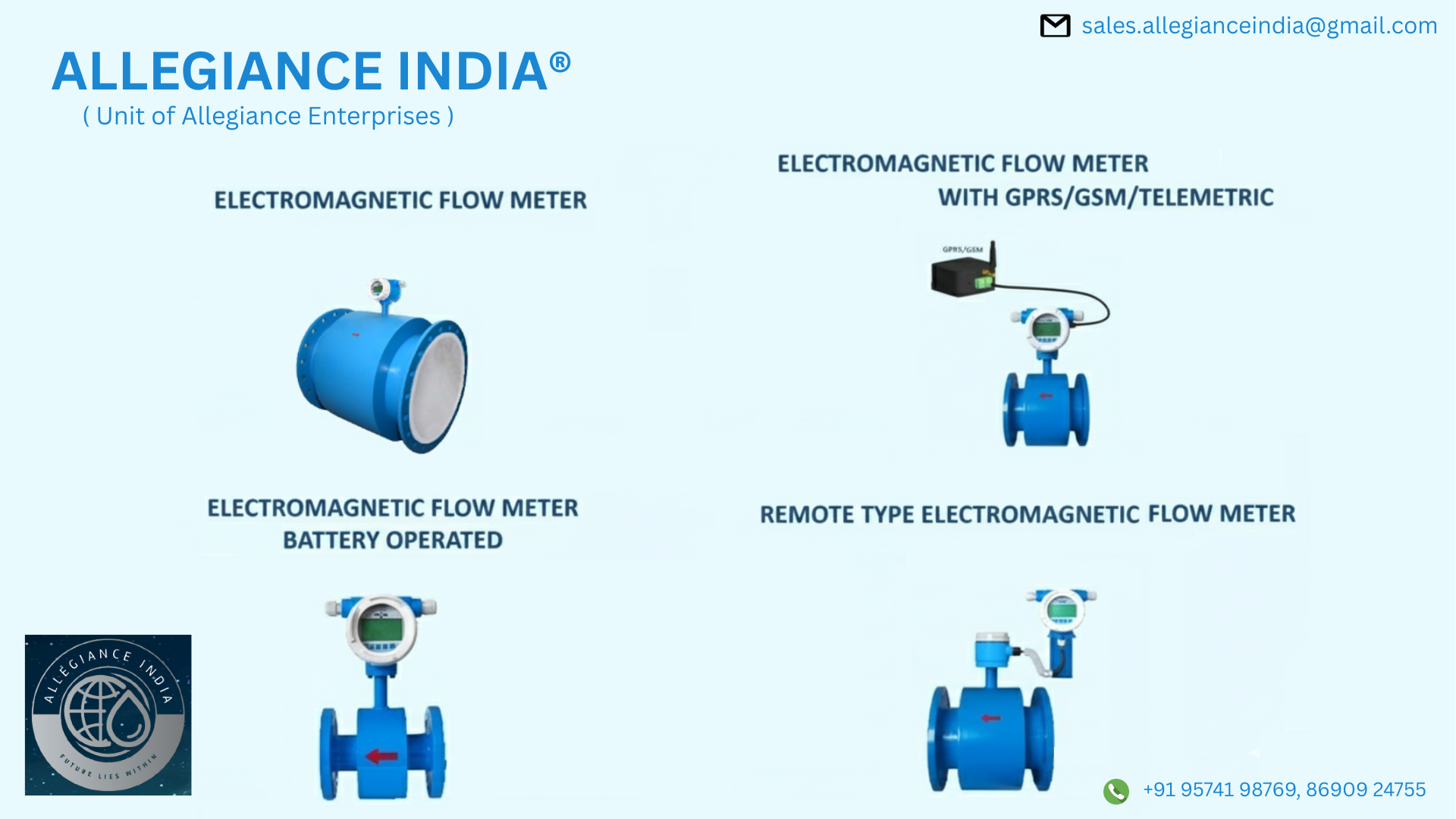
The Allegiance Digital Electromagnetic Flow Meters
At Allegiance India®, we deliver advanced Digital Electromagnetic Flow Meters designed for accuracy, reliability, and long service life across diverse water management applications.
Why Choose Allegiance Electromagnetic Flow Meters?
**High Accuracy & Reliability—Based on Faraday’s Law of Electromagnetic Induction, our meters ensure precise volumetric flow measurement.
**No Moving Parts—Minimal wear and tear, low maintenance, and long-term durability.
**Low Pressure Drop—Ideal for wastewater, industrial water, and other conductive liquids.
Versatile Applications—Widely used in water supply, wastewater management, process industries, and rainwater harvesting systems.
Product Variants Available
SS Electromagnetic Flow Meters – Rugged stainless-steel design for long-lasting performance in harsh conditions.
Battery Operated Mag Flow Meters – Independent, portable, and ideal for remote locations with no power supply.
Telemetry-Based Flow Meters – Secure GSM/GPRS connectivity for real-time online data transmission to web servers.
Server-Connected Flow Meters – Seamless integration with central monitoring systems for smart water management.
Remote Display Flow Meters – Convenient external display for quick and easy data viewing.
Key Benefits
Accurate Data Logging & Monitoring
Telemetry & Server Connectivity Options
User-Friendly Operation with Remote Display
Durable Construction with Low Maintenance Needs
Environmentally Friendly – No Hydrocarbons or Distilled Water Applications
Contact Allegiance India®
Looking for the best Electromagnetic Flow Meter suppliers in Gujarat and across India?
Get in touch with us today for expert guidance and reliable new solutions.
📞 +91 9574198769 / 86909 24755, 94084 25896
📧 sales.allegianceindia@gmail.com
🌐 www.allegianceindia.com
An observation well means a non-pumping, non-potable well used for measuring groundwater levels or potentiometric surface.
Observation wells can be used to show that a well is obtaining water from an isolated aquifer, or perhaps that the aquifer is connected to other aquifers or surface water.
Piezometers are excellent for capturing water flow, strata permeability, and depth of water pressure.
Geophysical survey for Rainwater Harvesting, a number of years of experience and technical knowledge we are able to provide you the most suitable locations to drill a Borewell on your site. By using technically advanced equipment like Resistivity meters & Electromagnetic (EM) VLF instruments we provide high quality service with excellent execution.
Before any Rainwater Harvesting System construction is done, we help you in identifying the nature of Soil Structure & what is the actual Depth to recharge Rainwater.
Water Conservation, Ground Water Rejuvenation and Development via Rainwater Management and Harvesting Rainwater through Ponds and Borewell Recharging Structures to Support Increasing Demand of Water for Daily usage for Domestic, Industrial and Agricultural purposes. Water Conservation and Harvesting Structures in Naturally Water Scarce Regions creates Geo-Hydrological Opportunity and Economic Viability. Ponds recharging structure, farm pond, stop Dam, and small pond etc. It is seen that different Geographical Location and unique Geophysical and Hydrological Nature and every situation needs to be addressed, separately, the groundwater recharge capacity of the varies regions may vary depending upon area specific geophysical nature of earth strata. Recharge Wells provide an opportunity to extract sub-surface flow of the region without exploiting the Groundwater reserve.
Earthen Pond
An earthen pond is an artificial lake or pond created by shaping and building an earthen or dirt embankment around a depression or low-lying area.
These ponds are commonly used for recreational or ornamental purposes and can also serve as water sources for livestock or irrigation.
Regular Monitoring: Keep an eye on water levels.
Debris Removal: Clean out leaves, branches, and other debris.
Aquatic Vegetation Control: Manage plant growth.
Long-Term Sustainability: With care, earthen ponds can thrive as safe habitats for both wildlife and humans
Water audit is a systematic process of objectively obtaining a water balance by measuring flow
of water from the site of water withdrawal or treatment, through the distribution system, and into
areas where it is used and finally discharged. Conducting a water audit involves calculating
water balance, water use and identifying ways for saving water.
Water audit involves preliminary water survey and detailed water audit. Preliminary water
survey is conducted to collect background information regarding plant activities, water
consumption and water discharge pattern and water billing, rates and water cess. After the
analysis of the secondary data collected from the industry, detailed water audit is conducted,
which involves the following steps:
On site training and discussion with facility manager and personnel
Water system analysis
Quantification of baseline water map
Monitoring and measurements using pressure and flow meters and various other devices
Quantification of inefficiencies and leaks
Quantification of water quality loads and discharges
Quantification of variability in flows and quality parameters
Strategies for water treatment and reuse or direct use
A detailed water balance is finally developed. Water quality requirement at various user areas is
mapped, which helps in developing „recycle‟ and „reuse‟ opportunities.
The detailed water audit report contains the following:
Water consumption and wastewater generation pattern
Specific water use and conservation
Complete water balance of the facility
Water saving opportunities
Method of implementing the proposals
Full description and figures
Investment required
Industries can undertake following measures for water conservation:
Setting up of norms for water budgeting
Modernization of industrial process to reduce water consumption
Recycling water with a re-circulating cooling system
Ozonation cooling water approach which can result in five fold reduction in blow down
when compared to traditional chemical treatment
Reduction in reuse of de-ionized water by eliminating some plenum flushes, converting
from a continuous flow to an intermittent flow system and improving control on the use
Use of wastewater for use of gardening
Proper processing of effluents to adhere to the norms of disposal.
CGWA NOC Permission Service
Still searching for remote borewell and piezometer monitoring?