
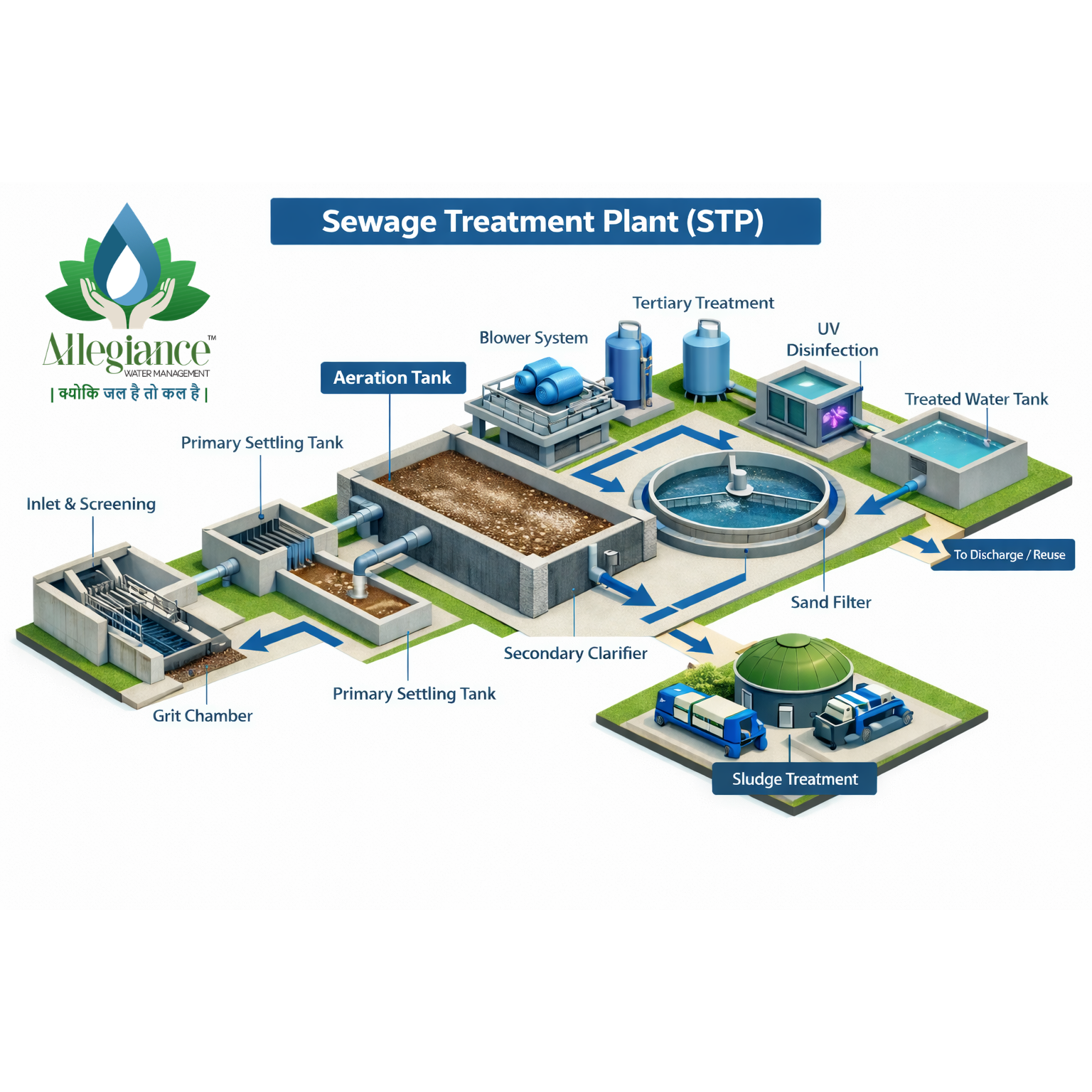
Sewage Treatment Plant (STP) – Sustainable Wastewater Management
A Sewage Treatment Plant (STP) is a system designed to treat wastewater generated from residential, commercial, and industrial sources. The main objective of an STP is to remove contaminants, harmful bacteria, and suspended solids from wastewater so that the treated water can be safely reused or discharged into the environment.
With increasing water scarcity and environmental regulations, wastewater treatment is no longer optional — it is essential for sustainable water management.
At Allegiance Water Management, we provide complete STP solutions including design, installation, operation, maintenance, and monitoring to ensure efficient and compliant wastewater treatment.
STP Treatment Process
The sewage treatment process typically includes the following stages:
- Inlet & Screening – Removes large solids like plastic, rags, and debris.
- Grit Chamber – Removes sand and heavy particles.
- Primary Settling Tank – Settles suspended solids and sludge.
- Aeration Tank – Biological treatment using air and bacteria to break down organic matter.
- Secondary Clarifier – Separates treated water from biological sludge.
- Tertiary Treatment – Filtration and UV disinfection for final purification.
- Treated Water Tank – Stores treated water for reuse.
- Sludge Treatment – Processes sludge for safe disposal.
Benefits of Sewage Treatment Plant
- Reduces environmental pollution
- Enables water reuse
- Saves fresh water
- Helps meet pollution control board norms
- Improves sustainability
- Reduces water bills
- Supports green building compliance
Applications of STP
- Residential Societies
- Commercial Buildings
- Hotels & Hospitals
- Industrial Plants
- Educational Campuses
-
Townships & Municipal Projects
FAQS1. What is an STP?
An STP (Sewage Treatment Plant) is a system that treats wastewater and makes it safe for reuse or discharge.
2. Where can treated water be reused?
Treated water can be reused for gardening, flushing, cooling towers, and industrial processes.
3. Is STP mandatory?
Yes, in many areas Pollution Control Boards and local authorities require STP installation for residential societies, industries, and commercial buildings.
4. How much space is required for an STP?
Space depends on capacity, but modern compact STPs are available that require less space.
5. What is the maintenance required for STP?
Regular maintenance includes sludge removal, checking blowers, pumps, and periodic water quality testing.