
India's groundwater
extraction rules have grown significantly stricter over the past decade as
aquifers across the country come under increasing stress. For industries,
infrastructure developers, and large commercial users, understanding these
rules is essential before drilling a single borewell. This guide summarizes the
key regulations governing groundwater extraction in India today.
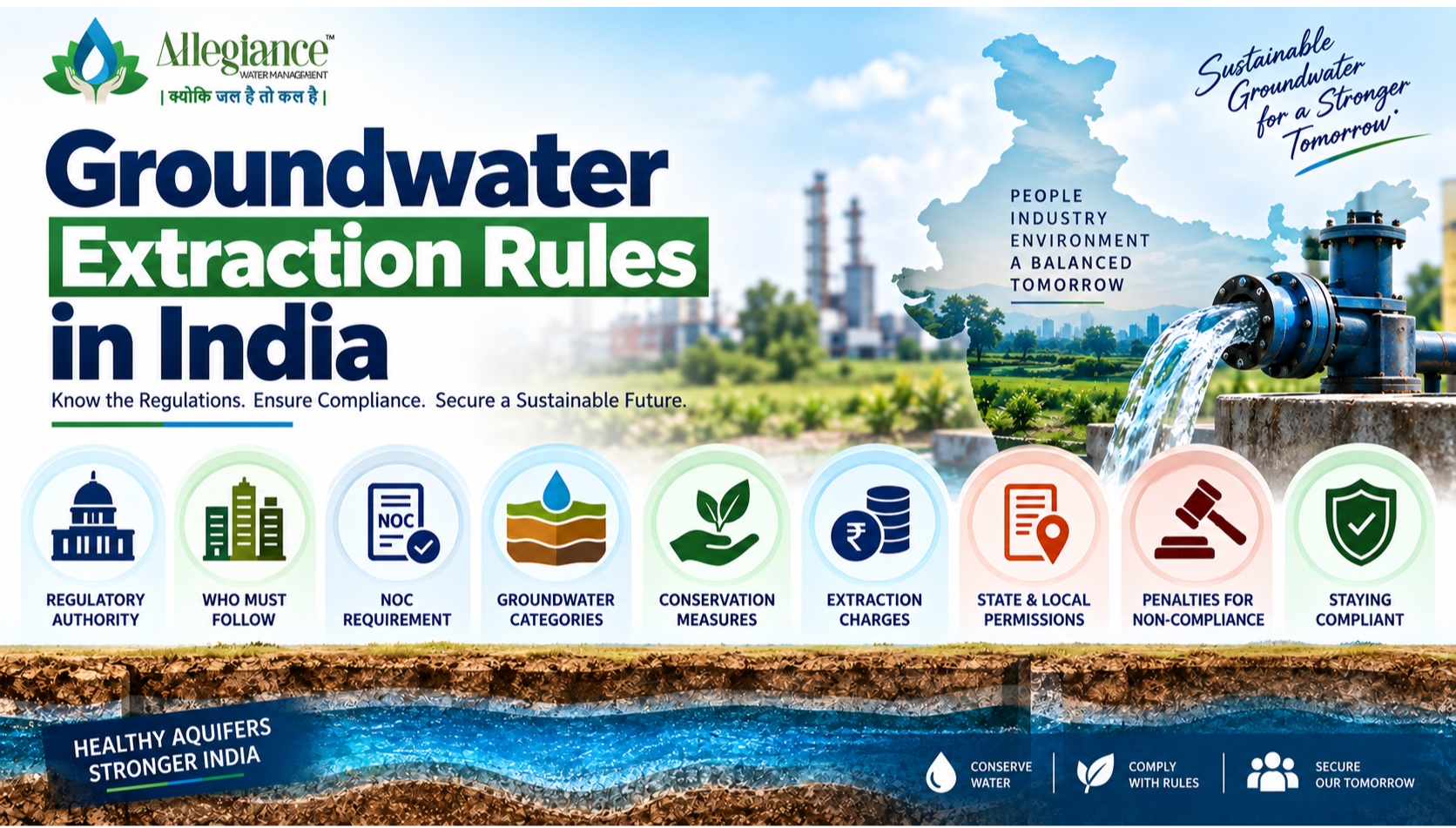
The Regulatory Authority
Groundwater extraction in India
is primarily regulated by the Central Ground Water Authority, constituted under
Section 3 of the Environment (Protection) Act, 1986, under the Ministry of Jal
Shakti. CGWA guidelines apply pan-India, though some states operate their own
groundwater authorities alongside or instead of CGWA depending on local
legislation. In either case, the underlying principle remains the same:
groundwater is a shared resource that must be extracted within sustainable
limits.
Who Must Follow These Rules
Groundwater extraction rules
apply broadly to industries, infrastructure and real estate projects, mining
operations, packaged drinking water plants, and bulk commercial users such as
hotels, hospitals, and educational institutions operating their own borewells.
Individual households, small agricultural users, and certain government
drinking water schemes are typically exempt from the full NOC process, though
registration requirements may still apply.
The NOC Requirement
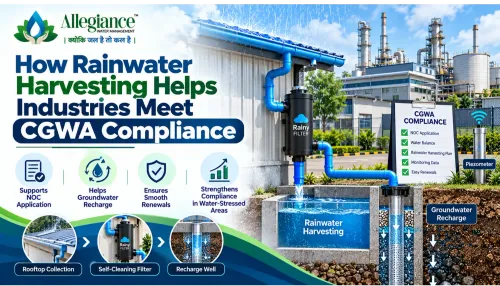
Any entity falling under a
regulated category must obtain a No Objection Certificate before constructing a
groundwater abstraction structure or drawing subsurface water. The NOC is
issued after evaluating the groundwater category of the area, the proposed
extraction volume, and the applicant's water conservation measures, including
rainwater harvesting and recharge plans. NOC validity generally ranges from two
to five years depending on the project type and area category, after which
renewal is required.
Groundwater Categories and Restrictions
India's groundwater assessment
units are classified as Safe, Semi-Critical, Critical, or Over-Exploited, based
on the ratio of extraction to natural recharge. Rules become progressively
stricter moving from Safe to Over-Exploited zones. In Over-Exploited units, new
industries generally cannot obtain an NOC, with limited exceptions for eligible
micro, small, and medium enterprises, and expansion of existing groundwater use
is also restricted.
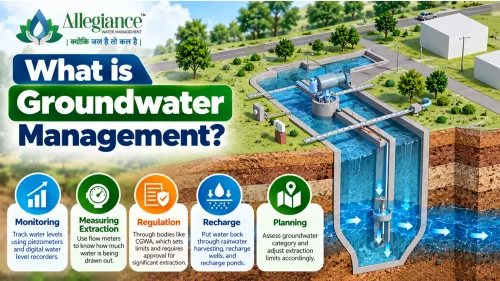
Mandatory Conservation Measures
Groundwater extraction rules
require most approved users to implement conservation infrastructure as a
condition of approval, including:
•
Rooftop rainwater harvesting or recharge systems within
the premises
•
Digital flow meters installed at all abstraction
points, with monthly readings uploaded to the compliance portal
•
Groundwater level monitoring through piezometers or
observation wells in certain cases
•
Water management plans for users operating in
Semi-Critical, Critical, or Over-Exploited zones
•
Impact assessment reports for extraction above defined
daily thresholds
Extraction Charges
Approved users are required to
pay groundwater abstraction charges based on the volume extracted, applicable
across Safe, Semi-Critical, Critical, and Over-Exploited units. Entities with
functioning artificial recharge structures in place, as required under their
NOC conditions, may receive relief recognizing their conservation contribution.
All charges and application fees are typically paid through the official online
payment portal.
Local and State-Level Permissions
In addition to the central CGWA
NOC, permission from the relevant state government or local municipal authority
is often required before drilling a new borewell. Some states also require
registration of drilling rigs, meaning both the rig operator and the extraction
structure must be properly authorized.
Penalties for Non-Compliance
Extraction without a valid NOC,
or in violation of approved conditions, is treated as a breach of the
Environment (Protection) Act, 1986. Consequences can include environmental
compensation, sealing of borewells, disconnection of electricity supply, cancellation
of operating licenses, and in severe cases, criminal prosecution. Unauthorized
or unregistered drilling rigs used to construct abstraction structures attract
separate penalties as well.
Staying Compliant
Given the complexity of these
rules, most industries rely on groundwater consultation services covering
feasibility surveys, geohydrological assessments, NOC applications, and ongoing
compliance monitoring. Building rainwater harvesting, groundwater recharge, and
flow monitoring into a facility's water infrastructure from the outset makes it
far easier to secure and retain approval as regulations continue to tighten.
Conclusion
Groundwater extraction in India
is governed by a layered set of rules involving CGWA approval, category-based
restrictions, mandatory conservation infrastructure, and financial charges.
Understanding where your project fits within this framework, and building
compliance into your operations early, is the most reliable way to extract
groundwater legally and sustainably.